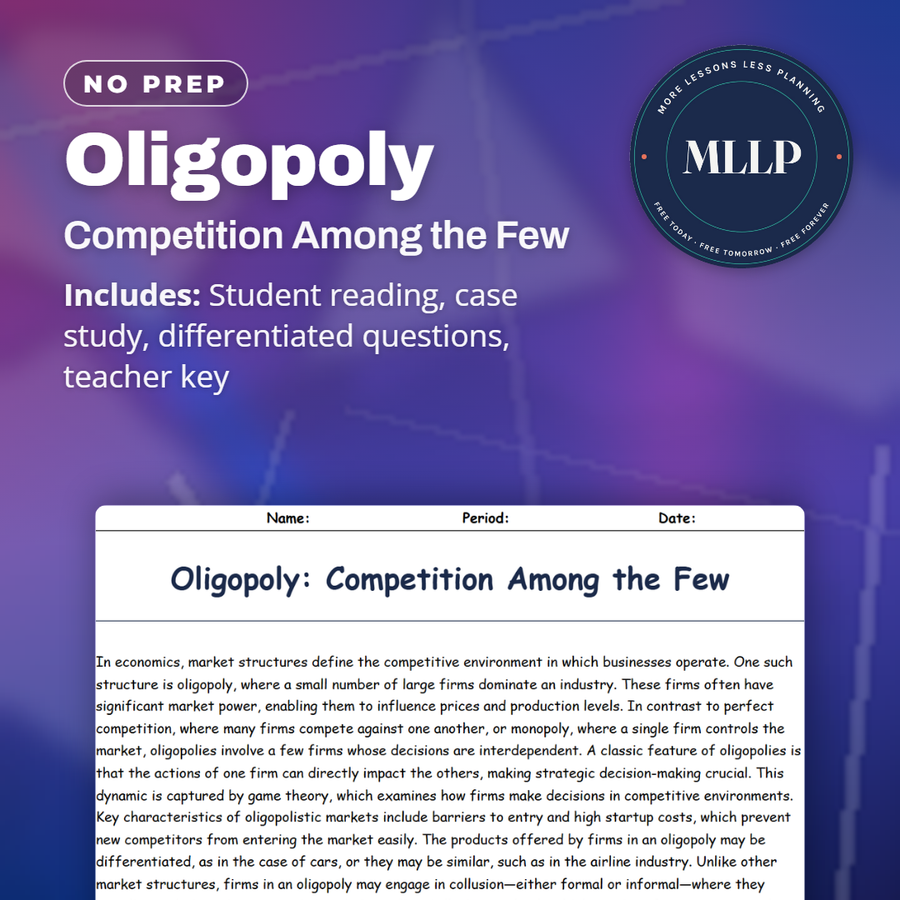
Oligopoly: Competition Among the Few
Quality reviewed September 2026
Facts verified September 8, 2026
- Grades
- Grades 9-12
- Length
- 8-page student worksheet
- Time
- About one 50-minute class period
- Great for
- Sub plans and independent work
- Includes
- Reading passage, comprehension questions + full answer key
- Format
- Print-and-go PDF
What students do
- Read passages explaining how a small number of large firms dominate oligopolistic markets like airlines and automobiles
- Analyze the 2015 airline capacity investigation to understand how firms coordinate to avoid price wars
- Apply game theory concepts to explain why firms may find it rational to reduce competition rather than slash prices
- Match oligopoly characteristics to real industries and answer questions about how collusion affects consumer prices
What it covers
- Barriers to entry and high startup costs that limit the number of competitors in oligopolistic industries
- Collusion and tacit coordination where firms avoid aggressive price competition to protect profit margins
- Strategic decision-making using game theory, including how the prisoner's dilemma explains firm behavior
Start reading this worksheet
In economics, market structures define the competitive environment in which businesses operate. One such structure is oligopoly, where a small number of large firms dominate an industry. These firms often have significant market power, enabling them to influence prices and production levels. In contrast to perfect competition, where many firms compete against one another, or monopoly, where a single firm controls the market, oligopolies involve a few firms whose decisions are interdependent. A classic feature of oligopolies is that the actions of one firm can directly impact the others, making strategic decision-making crucial. This dynamic is captured by game theory, which examines how firms make decisions in competitive environments. Key characteristics of oligopolistic markets include barriers to entry and high startup costs, which prevent new competitors from entering the market easily. The products offered by firms in an oligopoly may be differentiated, as in the case of cars, or they may be similar, such as in the airline industry. Unlike other market structures, firms in an oligopoly may engage in collusion—either formal or informal—where they coordinate their actions to maximize their profits. Collusion can lead to higher prices for consumers and reduced competition, which is often illegal in many countries. One well-known example of an oligopoly is the automobile industry. A handful of companies, such as General Motors, Ford, and Toyota, control a large portion of the global market. These companies engage in strategic decisions about pricing, production, and marketing, often responding to each other’s actions. In some cases, automobile manufacturers collaborate on technology and design, sharing research and development costs to maintain competitiveness while limiting unnecessary competition. The airline industry also operates as an oligopoly, particularly in certain regions of the world. Major airlines, such as American Airlines, Delta, and United, dominate domestic air travel in the United States. While these companies may compete on certain routes or for specific customer segments, they often cooperate through codeshare agreements and joint ventures, reducing the intensity of competition on some flights. This coordination can lead to higher ticket prices and fewer choices for passengers, though the airlines argue it improves operational efficiency.
Collusion and Non-Price Competition
In an oligopoly, firms often have strong incentives to engage in collusion in order to increase their profits by reducing competition. Collusion may take the form of explicit agreements or may occur through tacit understanding, where firms indirectly agree to avoid aggressive competition. The most common form of collusion is price-fixing, where firms agree to set prices at a certain level, avoiding price wars that could hurt all parties. While price-fixing is illegal in many countries, it is difficult to detect, especially when firms communicate through informal channels. Aside from price-based competition, oligopolistic firms often rely heavily on non-price competition. Since prices are often stable due to collusion or interdependence, firms compete by differentiating their products through advertising, branding, and improved customer service. For example, in the automobile industry, firms may highlight features such as safety, fuel efficiency, or design aesthetics rather than competing on price alone. This form of competition can benefit consumers by offering more variety, but it can also result in high marketing costs and the creation of artificial product distinctions.
Game Theory and Strategic Decision-Making
A key aspect of oligopolistic competition is strategic decision-making, which can be analyzed through game theory. Game theory is a mathematical approach to studying decision-making in situations where the outcome depends not only on one’s own actions but also on the actions of others. It provides insight into how firms in oligopolies can predict and respond to their competitors’ strategies. One common game theory model applied to oligopolies is the prisoner’s dilemma, which illustrates the conflict between individual rationality and collective rationality. In this scenario, two firms might benefit from cooperating (for example, by maintaining high prices), but if both firms act in their own self-interest (by cutting prices), they could both end up worse off. Game theory helps explain why firms in oligopolies often engage in tacit collusion rather than open price wars. However, it also highlights the inherent instability of such agreements, as firms may always have an incentive to cheat on the agreement for short-term gains.
Like what you read? The full reading, the case study, and every question set are in the free download below, along with the answer key.
Why this matters
Major airlines were quietly cutting seat capacity in 2015 instead of competing on fares, and the Justice Department opened an investigation into why ticket prices stayed high without anyone signing an agreement to keep them there. An oligopoly can look coordinated without anyone picking up a phone, because the smartest move for each firm depends on what the others are expected to do.
Students want to believe cutting prices is always the winning move for one airline, which is exactly what the prisoner's dilemma complicates. Once they work through why each firm is better off avoiding a price war even though the group could get away with charging more, they understand why an oligopoly can feel like quiet cooperation without a shred of open collusion.
From one teacher to another
I use this worksheet when students explore markets dominated by just a handful of large firms. The reading covers what oligopolies are and why barriers to entry keep competitors out, then digs into how firms compete without starting price wars that hurt everyone. The airline case study is compelling: in 2015, the Justice Department investigated major U.S. airlines for reducing seat capacity to keep fares high rather than competing on price. Students learn game theory concepts, seeing why each airline might decide that capacity cuts are smarter than price wars. They answer questions about how this coordination affects passengers and explore the tension between what's rational for each firm and what would be best for consumers overall.
What you get
- Answer Key
-
Student Worksheet
General Motors, Ford, and Toyota sometimes share research and development costs on technology and design even while competing on price and marketing. Airlines use a milder version of the logic, as American, Delta, and United coordinate through codeshare agreements and joint ventures that ease competition on shared routes. Advertising and branding, not price cuts, become the main battleground once firms see a price war leaves everyone worse off.
Download
Where should I send the next one?
Everything here is free and it stays that way. Leave your email and I'll send you the new lessons as they go up. You can unsubscribe from any one of them.
Related resources
Anti-Trust Laws and Regulation: Promoting Fair Competition

Barriers to Entry: What Keeps Competitors Out
Monopoly Power: Why Single Sellers Dominate the Market
Non-Price Competition: How Firms Compete Beyond Cost
Perfect Competition: How Markets Operate at Maximum Efficiency
Profit Maximization in Market Structures: How Businesses Succeed
Every lesson on this site is free to download and use. If one of them saved you a prep period, you can chip in a few bucks toward my three kids' daycare fund. That's genuinely where tips go.