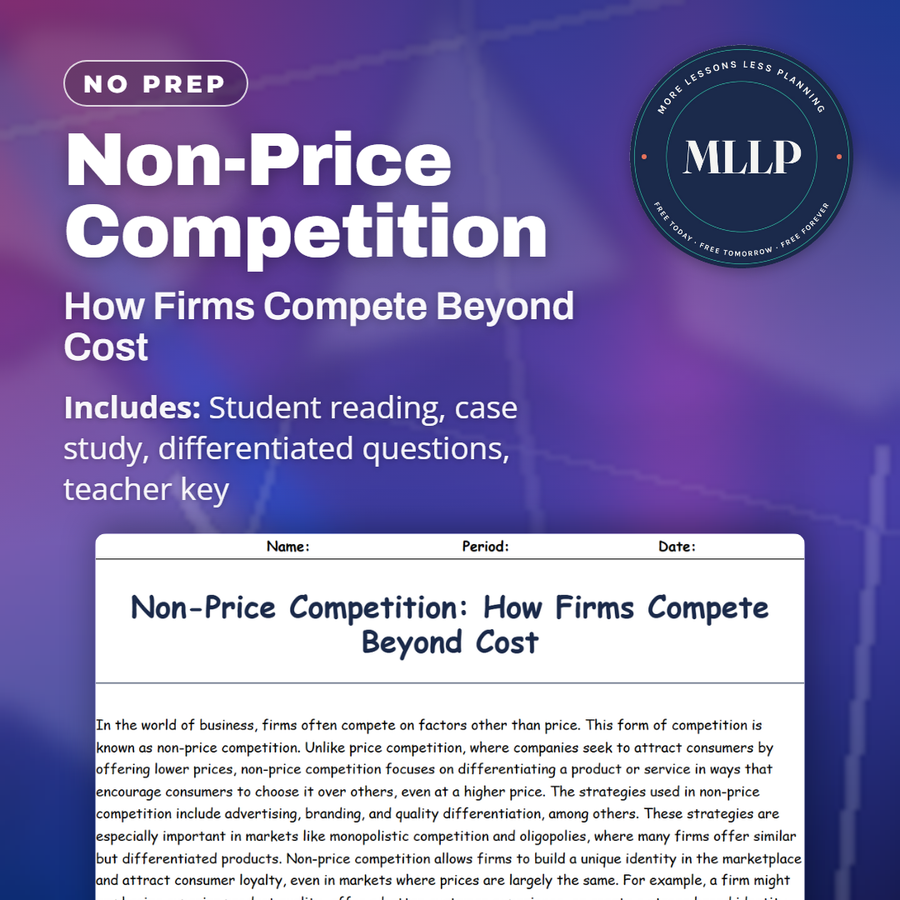
Non-Price Competition: How Firms Compete Beyond Cost
Quality reviewed September 2026
Facts verified September 8, 2026
- Grades
- Grades 9-12
- Length
- 8-page student worksheet
- Time
- About one 50-minute class period
- Great for
- Sub plans and independent work
- Includes
- Reading passage, comprehension questions + full answer key
- Format
- Print-and-go PDF
What students do
- Read passages on how firms use advertising, branding, and product differentiation instead of price wars
- Analyze the Starbucks case to see how quality, loyalty programs, and atmosphere command premium prices
- Match non-price strategies like loyalty programs and customer service to their role in building brand loyalty
- Answer questions about why quality differentiation and strong brands allow firms to charge higher prices
What it covers
- Advertising and branding as tools for building consumer loyalty and product identity
- Quality differentiation through features, durability, ingredients, and customer experience
- How non-price competition works in monopolistic competition and oligopolies where many firms sell similar products
Start reading this worksheet
In the world of business, firms often compete on factors other than price. This form of competition is known as non-price competition. Unlike price competition, where companies seek to attract consumers by offering lower prices, non-price competition focuses on differentiating a product or service in ways that encourage consumers to choose it over others, even at a higher price. The strategies used in non-price competition include advertising, branding, and quality differentiation, among others. These strategies are especially important in markets like monopolistic competition and oligopolies, where many firms offer similar but differentiated products. Non-price competition allows firms to build a unique identity in the marketplace and attract consumer loyalty, even in markets where prices are largely the same. For example, a firm might emphasize superior product quality, offer a better customer experience, or create a strong brand identity. These strategies can be just as effective, if not more so, than lowering prices, especially in industries where consumers are willing to pay a little extra for something they perceive as superior. In markets characterized by monopolistic competition, firms often face significant pressure from rivals who offer similar products. This is where product differentiation comes into play. Firms try to set themselves apart by offering products that stand out in some way. Whether through design, ingredients, features, or customer service, the goal is to create a product that feels unique and valuable to consumers.
Advertising and Branding: Key Tools in Non-Price Competition
Advertising and branding are two of the most powerful tools that firms use to gain a competitive edge through non-price competition. Advertising helps firms promote their products, educate consumers, and build a connection between their brand and the consumer’s desires or values. Firms use various types of advertising, including traditional TV and print ads, as well as modern digital platforms like social media, search engines, and influencer marketing. Through advertising, firms can reinforce their brand identity, which is a crucial part of building consumer loyalty. Branding refers to the creation of a unique image or identity for a product or company. It can be as simple as a logo or slogan, or as complex as an entire marketing strategy built around a specific lifestyle or set of values. Think of Apple’s branding, which is focused on innovation, simplicity, and premium quality. Consumers who identify with these values are often willing to pay more for Apple’s products, even if similar alternatives are available at lower prices. The strong branding efforts ensure that Apple’s products are seen as distinct, premium, and worth the extra cost. Non-price competition also plays a significant role in industries like fashion, automobiles, and technology, where branding and product differentiation are especially important. In the automobile industry, for example, brands like Tesla, BMW, and Mercedes-Benz emphasize not just the price and functionality of their vehicles, but also the image and values associated with owning a particular brand. Consumers are often willing to pay a premium for a car that aligns with their identity or lifestyle, whether it’s the luxury associated with BMW or the environmental consciousness tied to Tesla.
Quality Differentiation: Standing Out from the Crowd
Another important form of non-price competition is quality differentiation. This involves offering products that are of higher quality or provide more benefits than competing products. For example, in the smartphone market, companies like Apple and Samsung constantly innovate and improve the features of their phones, including cameras, battery life, and software. While the price of these phones may be similar, consumers choose based on the perceived quality of the product and its features. Quality differentiation can also involve factors like durability, design, or the specific ingredients used in a product. In the food industry, companies that offer organic or all-natural products differentiate themselves from competitors who use artificial ingredients or preservatives. This emphasis on quality appeals to consumers who are willing to pay more for a product they perceive as healthier or better for the environment.
Like what you read? The full reading, the case study, and every question set are in the free download below, along with the answer key.
Why this matters
Two coffee shops can pay the same price for beans and still charge a customer two very different amounts, and the gap has nothing to do with the coffee itself. Starbucks sells an atmosphere, a loyalty program, and a brand people already trust, which is why raising the price rarely costs it the customer the way it would in a market selling identical products.
Price looks like the only lever a business has until students trace how deliberately Starbucks avoids pulling it. They assume competing means cutting cost, then watch a company build loyalty programs and a consistent in-store feel specifically so it never has to discount at all. After that, they start noticing the same strategy in every brand they already spend money on.
From one teacher to another
I use this worksheet when students learn how firms compete on factors other than lowering prices. The reading explains that in markets with many similar products, companies survive by making themselves look different through advertising, brand identity, and quality claims. Starbucks is the perfect example: students read how Starbucks sells an experience along with the coffee. By sourcing premium beans, creating a cozy atmosphere, and running loyalty programs that reward repeat customers, Starbucks convinces people the premium price is worth it. Students match strategies to examples and answer questions about why branding is so powerful. They understand that two coffee shops might charge differently even when their raw costs are the same, because one has built trust and identity that customers value.
What you get
- Answer Key
-
Student Worksheet
Nike's slogan Just Do It and Apple's focus on innovation and simplicity are the reading's shorthand for how a logo or tagline can do work a lower price never could. Tesla, BMW, and Mercedes-Benz sell an image as much as horsepower, and Apple and Samsung compete on camera quality and battery life even when prices land close together, so a phone can win a buyer on its camera alone.
Download
Where should I send the next one?
Everything here is free and it stays that way. Leave your email and I'll send you the new lessons as they go up. You can unsubscribe from any one of them.
Related resources
Anti-Trust Laws and Regulation: Promoting Fair Competition
Barriers to Entry: What Keeps Competitors Out
Monopoly Power: Why Single Sellers Dominate the Market
Oligopoly: Competition Among the Few
Perfect Competition: How Markets Operate at Maximum Efficiency
Profit Maximization in Market Structures: How Businesses Succeed
Every lesson on this site is free to download and use. If one of them saved you a prep period, you can chip in a few bucks toward my three kids' daycare fund. That's genuinely where tips go.