Monopoly Power: Why Single Sellers Dominate the Market
Quality reviewed September 2026
Facts verified September 8, 2026
- Grades
- Grades 9-12
- Length
- 6-page student worksheet
- Time
- About one 50-minute class period
- Great for
- Sub plans and independent work
- Includes
- Reading passage, comprehension questions + full answer key
- Format
- Print-and-go PDF
What students do
- Read passages on how single sellers dominate markets through barriers to entry and lack of substitutes
- Compare advantages and disadvantages of monopolies, such as innovation incentives versus higher prices for consumers
- Analyze the AT&T case to understand why governments break up monopolies to restore competition
- Answer short-answer questions about how monopolists act as price makers and why this harms consumers
What it covers
- Characteristics of monopolies including single sellers, price-maker status, and barriers to entry
- Pros and cons of monopolies, including innovation potential balanced against inefficiency and consumer harm
- The AT&T monopoly and its 1982 breakup into regional Baby Bells, and the resulting benefits of competition
Start reading this worksheet
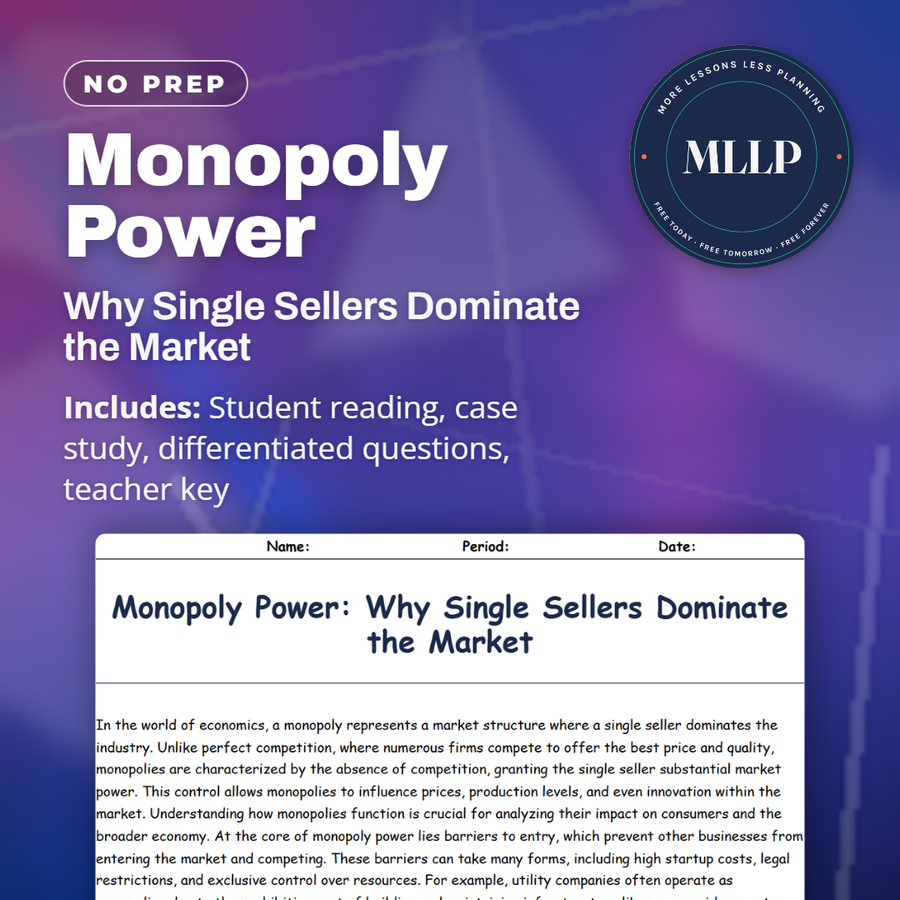
In the world of economics, a monopoly represents a market structure where a single seller dominates the industry. Unlike perfect competition, where numerous firms compete to offer the best price and quality, monopolies are characterized by the absence of competition, granting the single seller substantial market power. This control allows monopolies to influence prices, production levels, and even innovation within the market. Understanding how monopolies function is crucial for analyzing their impact on consumers and the broader economy. At the core of monopoly power lies barriers to entry, which prevent other businesses from entering the market and competing. These barriers can take many forms, including high startup costs, legal restrictions, and exclusive control over resources. For example, utility companies often operate as monopolies due to the prohibitive cost of building and maintaining infrastructure like power grids or water systems. In such cases, monopolies can achieve efficiency by eliminating redundant systems, but they also raise concerns about price-setting and fairness. Another defining feature of monopolies is their ability to act as price makers, meaning they set prices rather than taking them from the market. With no competitors, monopolies can charge higher prices than firms in competitive markets, often leading to increased profits at the expense of consumers. For instance, a pharmaceutical company holding a patent for a life-saving drug can set a price far above production costs because patients have no alternative suppliers.
Like what you read? The full reading, the case study, and every question set are in the free download below, along with the answer key.
Why this matters
AT&T once controlled nearly every phone line in the country and argued that scale made it more efficient, not less fair. The government broke it up anyway in 1982, carving it into regional Baby Bells, and prices fell while mobile phones and internet access followed within years. A market with one seller simply behaves differently from one with several.
The drug-patent example is where my students stop treating monopoly as a simple villain. A company with no rival can gamble on expensive research because it knows a working drug will not face a cheaper copycat right away, but that same absence of competition removes any pressure to cut costs or improve quality. AT&T is where both sides of that trade-off finally meet.
From one teacher to another
I use this worksheet when teaching monopolies and their impact on markets and consumers. The reading covers what makes a monopoly, including high barriers to entry like infrastructure costs and pharmaceutical patents. Students read about how monopolists set prices like a life-saving drug company with no competitors, then explore the trade-off: monopolies can invest in risky R&D because they know they'll profit, but without competition, there's no pressure to cut costs or improve quality. The AT&T case brings it home—AT&T controlled nearly all U.S. phone lines and claimed that was efficient, but after the government broke it up in 1982, prices dropped, innovation surged, and mobile phones and internet access followed. Students see how regulation can restore what competition would naturally provide.
What you get
- Answer Key
-
Student Worksheet
Local water utilities operate as textbook monopolies because building a second set of pipes across a city costs far more than any rival could justify, an example of a natural monopoly holding its ground through infrastructure alone. It ties that case to a pharmaceutical patent that lets a company price a life-saving drug above cost, and warns that either kind of monopoly can end up concentrating wealth and power in very few hands.
Download
Where should I send the next one?
Everything here is free and it stays that way. Leave your email and I'll send you the new lessons as they go up. You can unsubscribe from any one of them.
Related resources
Anti-Trust Laws and Regulation: Promoting Fair Competition

Barriers to Entry: What Keeps Competitors Out
Non-Price Competition: How Firms Compete Beyond Cost
Oligopoly: Competition Among the Few
Perfect Competition: How Markets Operate at Maximum Efficiency
Profit Maximization in Market Structures: How Businesses Succeed
Every lesson on this site is free to download and use. If one of them saved you a prep period, you can chip in a few bucks toward my three kids' daycare fund. That's genuinely where tips go.