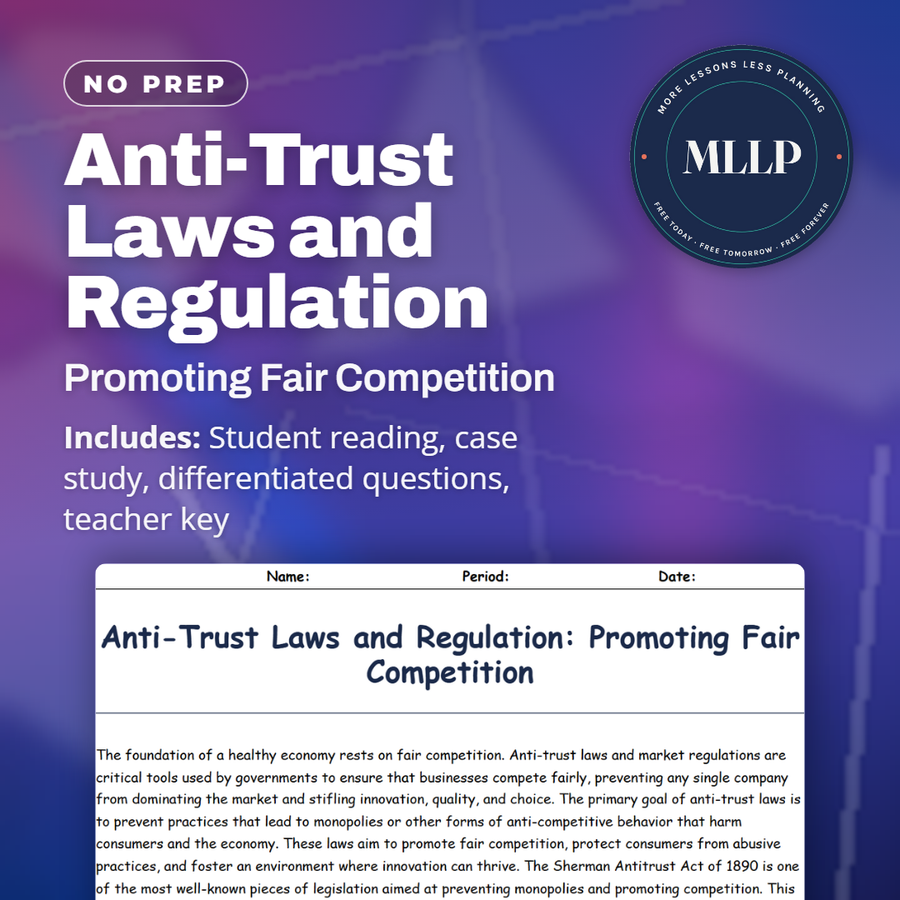
Anti-Trust Laws and Regulation: Promoting Fair Competition
Quality reviewed September 2026
Facts verified September 8, 2026
- Grades
- Grades 9-12
- Length
- 8-page student worksheet
- Time
- About one 50-minute class period
- Great for
- Sub plans and independent work
- Includes
- Reading passage, comprehension questions + full answer key
- Format
- Print-and-go PDF
What students do
- Read passages on the Sherman Antitrust Act and how it prevents monopolies and price-fixing
- Analyze the Microsoft case to understand how the FTC challenges anti-competitive practices
- Match key terms like collusion and price-fixing to their economic definitions
- Answer questions about how anti-trust laws protect consumers from abusive market power
What it covers
- The Sherman Antitrust Act of 1890 and its role in preventing monopolies and business collusion
- Federal Trade Commission enforcement, including merger review and investigation of anti-competitive behavior
- Historical examples including Standard Oil's 1911 breakup and the Microsoft antitrust case
Start reading this worksheet
The foundation of a healthy economy rests on fair competition. Anti-trust laws and market regulations are critical tools used by governments to ensure that businesses compete fairly, preventing any single company from dominating the market and stifling innovation, quality, and choice. The primary goal of anti-trust laws is to prevent practices that lead to monopolies or other forms of anti-competitive behavior that harm consumers and the economy. These laws aim to promote fair competition, protect consumers from abusive practices, and foster an environment where innovation can thrive. The Sherman Antitrust Act of 1890 is one of the most well-known pieces of legislation aimed at preventing monopolies and promoting competition. This law prohibits any business practices that restrict competition or create monopolies, such as price-fixing, bid-rigging, and market allocation. Another significant regulatory body, the Federal Trade Commission (FTC), was created in 1914 to enforce these laws and protect consumers. The FTC has the authority to investigate and challenge business practices that it deems anti-competitive, including mergers and acquisitions that may significantly reduce competition. Anti-trust laws not only focus on monopolistic practices but also address collusion and price-fixing, where companies conspire to set prices artificially high rather than competing on their own merits. These practices harm consumers by limiting choices, reducing quality, and increasing prices. By preventing such behaviors, anti-trust regulations work to create a more dynamic and competitive market that benefits consumers, increases product diversity, and lowers prices.
Historical Context of Anti-Trust Laws
The creation of anti-trust laws in the United States was driven by the rise of large monopolies during the late 19th and early 20th centuries. During this period, a few powerful companies gained control over entire industries, such as Standard Oil in the oil industry and U.S. Steel in the steel industry. These companies were able to use their market power to manipulate prices, eliminate competition, and exploit workers, ultimately harming consumers and stifling innovation. The Sherman Antitrust Act, passed in 1890, was the first significant step taken by the U.S. government to address these concerns. The law declared illegal any business practices that restrained interstate commerce or created monopolies. However, the early enforcement of the Sherman Act was limited, and it wasn’t until the Clayton Antitrust Act of 1914 and the creation of the Federal Trade Commission (FTC) that the U.S. government had more effective tools to combat monopolistic practices. One of the most famous anti-trust cases was the breakup of Standard Oil in 1911. Standard Oil, led by John D. Rockefeller, controlled over 90% of the oil industry in the U.S. The Supreme Court ruled that Standard Oil had violated the Sherman Antitrust Act and ordered it to be broken up into 34 smaller companies. This decision was a landmark in the enforcement of anti-trust laws and set a precedent for future cases.
Enforcement of Anti-Trust Laws: The Role of the FTC
The Federal Trade Commission (FTC) plays a crucial role in enforcing anti-trust laws and regulating businesses to prevent monopolistic behavior. The FTC was established in 1914 with the goal of promoting consumer protection and ensuring fair competition in the marketplace. It does this by investigating potential anti-competitive practices, reviewing mergers and acquisitions, and taking enforcement actions when necessary. One of the FTC’s primary functions is to review proposed mergers and acquisitions between companies. The FTC assesses whether these mergers would result in a significant reduction in competition in the market, which could harm consumers by leading to higher prices, reduced product quality, or less innovation. If a merger is deemed to violate anti-trust laws, the FTC can block the merger or require changes to ensure that competition is maintained. The merger between T-Mobile and Sprint in 2020 is a recent example of the U.S. Department of Justice’s Antitrust Division’s role in anti-trust enforcement. The DOJ Antitrust Division reviewed and conditionally approved the merger in 2019, and the FCC separately approved the spectrum/license transfer, with conditions to ensure that competition in the wireless market remained intact. The conditions included protections for lower-income consumers and commitments to invest in expanding coverage.
Like what you read? The full reading, the case study, and every question set are in the free download below, along with the answer key.
Why this matters
In 1911, the government broke up Standard Oil for having grown too dominant to compete against. That case set the pattern the Sherman Antitrust Act still follows: when the Federal Trade Commission went after Microsoft decades later for bundling Internet Explorer with Windows, it was applying the same logic to a software company instead of an oil company.
Regulation reads like a punishment for success until the Microsoft case complicates that. Bundling a free browser sounds harmless, until students see how it squeezed out a competitor like Netscape, and the settlement that followed shows regulation working as a correction, not a penalty for being good at business.
From one teacher to another
I use this worksheet when students are learning how government regulates markets to protect competition. The reading covers the Sherman Antitrust Act, the role of the Federal Trade Commission, and real cases like Microsoft's bundling of Internet Explorer with Windows. My students work through passages explaining why anti-trust laws matter, then tackle questions about price-fixing, market dominance, and how mergers are reviewed. The Microsoft case study makes the concepts concrete—students see how bundling software unfairly squeezed out competitors like Netscape, and how settlement agreements forced changes to Microsoft's practices. This gives them a solid foundation for understanding why governments step in when firms abuse market power.
What you get
- Answer Key
-
Student Worksheet
In 2019, the Department of Justice approved T-Mobile's merger with Sprint on the condition it protect lower income customers and commit to expanding wireless coverage. That review shows federal enforcement working through negotiated terms instead of a courtroom breakup, and it separates bid rigging from price fixing as two distinct ways firms illegally dodge competing on their own merits.
Download
Where should I send the next one?
Everything here is free and it stays that way. Leave your email and I'll send you the new lessons as they go up. You can unsubscribe from any one of them.
Related resources
Barriers to Entry: What Keeps Competitors Out
Monopoly Power: Why Single Sellers Dominate the Market
Non-Price Competition: How Firms Compete Beyond Cost
Oligopoly: Competition Among the Few
Perfect Competition: How Markets Operate at Maximum Efficiency
Profit Maximization in Market Structures: How Businesses Succeed
Every lesson on this site is free to download and use. If one of them saved you a prep period, you can chip in a few bucks toward my three kids' daycare fund. That's genuinely where tips go.