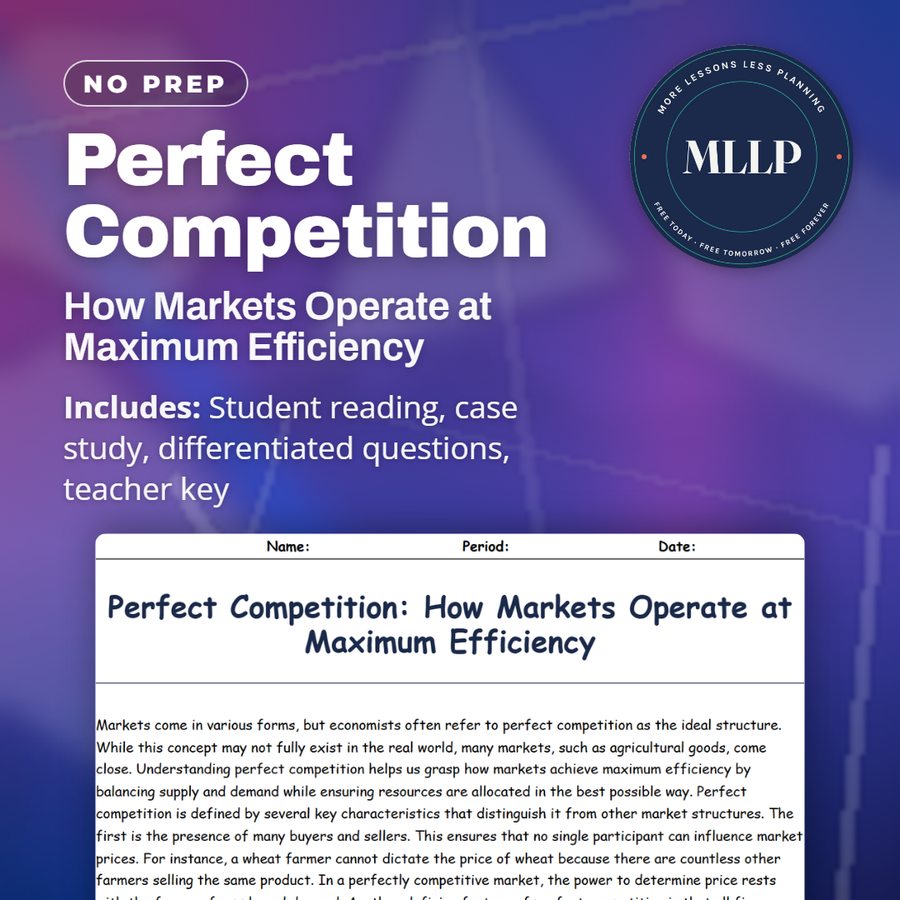
Perfect Competition: How Markets Operate at Maximum Efficiency
Quality reviewed September 2026
Facts verified September 8, 2026
- Grades
- Grades 9-12
- Length
- 6-page student worksheet
- Time
- About one 50-minute class period
- Great for
- Sub plans and independent work
- Includes
- Reading passage, comprehension questions + full answer key
- Format
- Print-and-go PDF
What students do
- Read passages on the characteristics of perfectly competitive markets including many sellers and identical products
- Analyze the Kansas wheat market to understand how farmers become price takers who cannot influence prices
- Identify how free entry and exit in competitive markets ensure efficiency and optimal resource allocation
- Answer questions about allocative and productive efficiency and why farmers innovate even on thin profit margins
What it covers
- Many buyers and sellers with no single participant able to influence market price
- Identical products and homogenous goods that make price the only factor in consumer choice
- Free entry and exit, allocative efficiency, and productive efficiency in perfectly competitive markets
Start reading this worksheet
Markets come in various forms, but economists often refer to perfect competition as the ideal structure. While this concept may not fully exist in the real world, many markets, such as agricultural goods, come close. Understanding perfect competition helps us grasp how markets achieve maximum efficiency by balancing supply and demand while ensuring resources are allocated in the best possible way. Perfect competition is defined by several key characteristics that distinguish it from other market structures. The first is the presence of many buyers and sellers. This ensures that no single participant can influence market prices. For instance, a wheat farmer cannot dictate the price of wheat because there are countless other farmers selling the same product. In a perfectly competitive market, the power to determine price rests with the forces of supply and demand. Another defining feature of perfect competition is that all firms produce identical products. Because products are homogenous, consumers base their decisions solely on price, not brand or quality differences. In agricultural markets, for example, one bushel of wheat is essentially indistinguishable from another. This characteristic intensifies competition, as sellers cannot rely on product differentiation to gain an advantage. Free entry and exit into the market also plays a vital role in perfect competition. This means that new businesses can enter the market without significant barriers, such as expensive startup costs or restrictive regulations. Similarly, firms that cannot compete effectively can exit the market without incurring excessive losses. This fluidity ensures that the market remains competitive and that resources are allocated to their most productive uses. In a perfectly competitive market, firms are also considered price takers. They accept the market price as given and cannot charge more without losing customers to competitors. This keeps prices fair for consumers while incentivizing producers to minimize costs and improve efficiency. For instance, if the market price for wheat is $5 per bushel, every farmer must sell at this price or risk losing sales to others.
Like what you read? The full reading, the case study, and every question set are in the free download below, along with the answer key.
Why this matters
A Kansas wheat farmer cannot call a buyer and ask for a higher price, because global supply and demand already set it before the harvest is in. Having zero control over that number is what separates a perfectly competitive seller from every other market structure students will study this year.
Thin profit margins usually read like a business in trouble, so the wheat case study corrects that fast. Farmers survive on razor-thin margins by adopting tools like precision agriculture to cut costs, not by raising prices they are not allowed to set. That distinction, an inefficient business versus an efficient market, is the one I want them to walk away with.
From one teacher to another
I use this worksheet when teaching perfect competition as a market ideal that encourages efficiency. The reading explains the key features: countless buyers and sellers so no one firm has power, homogenous products so wheat from one farmer is the same as wheat from another, and free entry and exit so resources flow to the best uses. The Kansas wheat case study shows how this works in practice. Kansas farmers cannot set their own prices because global supply and demand determine the price. With thin margins, they survive only by innovating with tools like precision agriculture to cut costs and boost yields. Students read about allocative efficiency (the right quantity is produced to match demand) and productive efficiency (goods are made at the lowest possible cost). They understand that perfect competition, though rare in the real world, represents how markets can work when many competitors keep each other honest.
What you get
- Answer Key
-
Student Worksheet
If wheat sits at $5 a bushel, the reading says, every Kansas farmer must accept that price or lose buyers to a rival selling the same grain for less. Because no single grower can nudge the price and every bushel looks identical, two forms of efficiency show up together: no willing buyer at $5 goes unserved, which is allocative, and no farmer wastes resources above the lowest achievable cost, which is productive.
Download
Where should I send the next one?
Everything here is free and it stays that way. Leave your email and I'll send you the new lessons as they go up. You can unsubscribe from any one of them.
Related resources

Anti-Trust Laws and Regulation: Promoting Fair Competition

Barriers to Entry: What Keeps Competitors Out
Monopoly Power: Why Single Sellers Dominate the Market
Non-Price Competition: How Firms Compete Beyond Cost
Oligopoly: Competition Among the Few
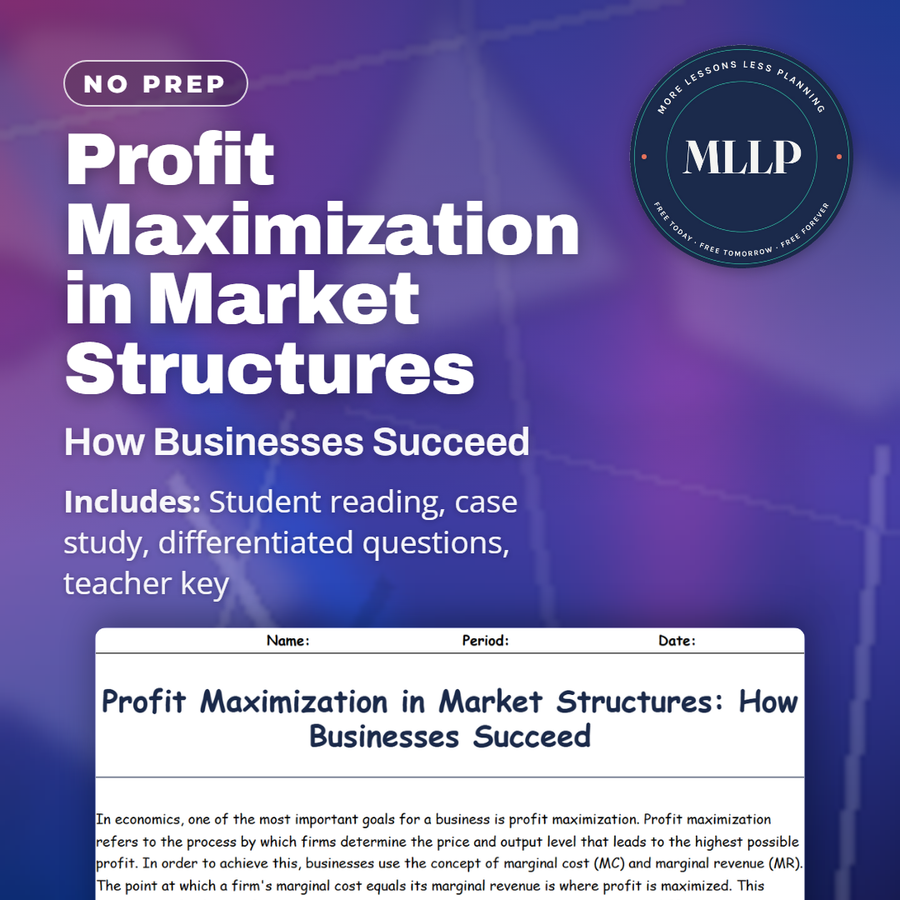
Profit Maximization in Market Structures: How Businesses Succeed
Every lesson on this site is free to download and use. If one of them saved you a prep period, you can chip in a few bucks toward my three kids' daycare fund. That's genuinely where tips go.