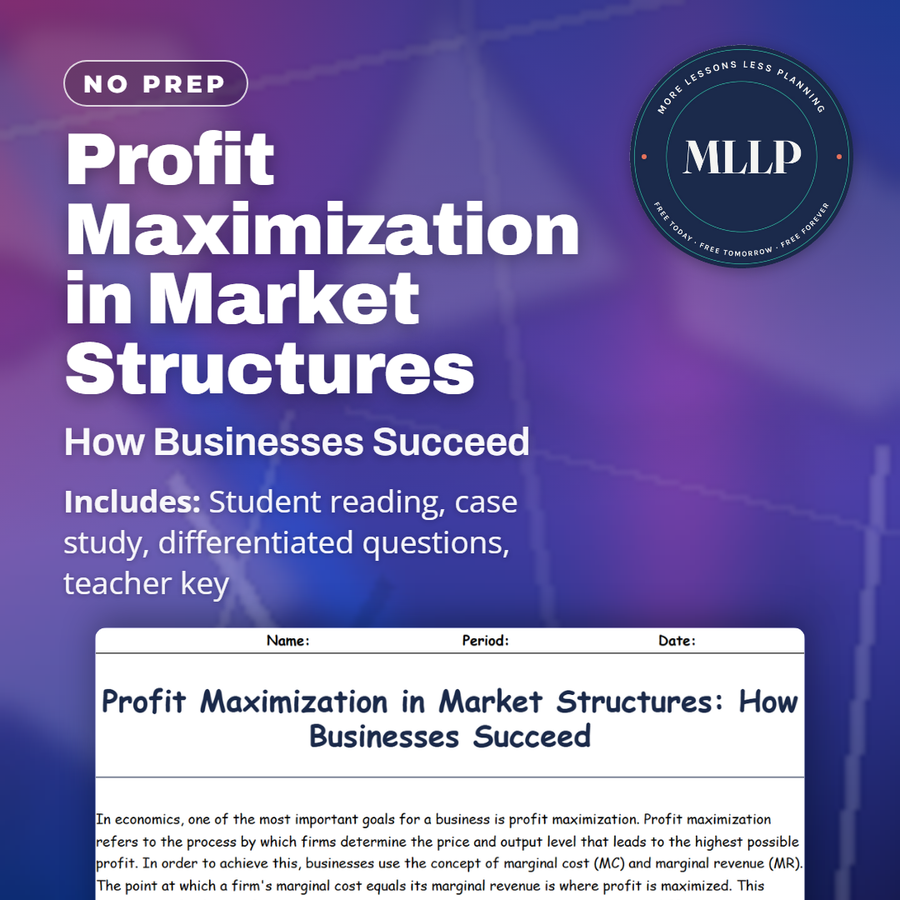
Profit Maximization in Market Structures: How Businesses Succeed
Quality reviewed September 2026
Facts verified September 8, 2026
- Grades
- Grades 9-12
- Length
- 8-page student worksheet
- Time
- About one 50-minute class period
- Great for
- Sub plans and independent work
- Includes
- Reading passage, comprehension questions + full answer key
- Format
- Print-and-go PDF
What students do
- Read passages on how firms use marginal cost and marginal revenue principles to determine optimal production levels
- Compare profit-maximization strategies across perfect competition, monopolistic competition, oligopoly, and monopoly
- Analyze Apple's pricing strategy and product differentiation to see how it maximizes profit in an oligopolistic market
- Answer questions about when to increase or decrease production based on marginal cost versus marginal revenue
What it covers
- The profit maximization principle where marginal cost equals marginal revenue for maximum efficiency
- How different market structures change a firm's profit-maximizing strategy and pricing power
- Real-world application by Apple Inc., including pricing strategies, product differentiation, and brand loyalty
Start reading this worksheet
In economics, one of the most important goals for a business is profit maximization. Profit maximization refers to the process by which firms determine the price and output level that leads to the highest possible profit. In order to achieve this, businesses use the concept of marginal cost (MC) and marginal revenue (MR). The point at which a firm's marginal cost equals its marginal revenue is where profit is maximized. This concept is a fundamental principle in microeconomics and is used by businesses across different market structures to guide their decision-making processes. Marginal cost is the additional cost incurred by producing one more unit of a good or service. Marginal revenue, on the other hand, is the additional revenue gained from selling one more unit of a good or service. The principle of profit maximization states that businesses should continue to produce more as long as marginal revenue is greater than marginal cost. However, when marginal cost exceeds marginal revenue, firms should reduce production to maximize profits. Understanding this balance helps businesses avoid inefficiency and ensures that resources are being used optimally. The relationship between marginal cost and marginal revenue is central to a firm’s ability to succeed in the marketplace. For firms in competitive markets, the objective is to find the quantity of output where the difference between total revenue and total cost is the greatest. Firms adjust their production levels accordingly, using this formula to make sure that they are operating at their most efficient level of production.
Profit Maximization in Different Market Structures
While the concept of profit maximization applies to all market structures, the strategies used by firms can vary greatly depending on the type of competition they face. The four main types of market structures—perfect competition, monopolistic competition, oligopoly, and monopoly—each have unique characteristics that affect how firms maximize their profits. In perfect competition, firms produce identical products, and no single firm has the power to influence prices. Firms in perfect competition are considered price takers, meaning they accept the market price as given. In this market structure, firms maximize profit by producing the quantity at which marginal cost equals marginal revenue, which also happens to be the point where the market price is equal to the firm’s average cost. In monopolistic competition, firms sell differentiated products, allowing them some degree of market power. Firms can set their own prices to a certain extent, but they still face competition from other firms offering similar products. To maximize profit, firms in monopolistic competition adjust output to the point where marginal cost equals marginal revenue, but they also engage in non-price competition (such as advertising and branding) to differentiate their products. An oligopoly is a market structure where a few large firms dominate the industry. These firms are interdependent, meaning the decisions made by one firm can significantly affect the others. Oligopolists often use strategic behavior and game theory to maximize profits. For example, firms may form cartels or engage in tacit collusion, where they work together to set prices or output levels. Profit maximization in an oligopoly requires careful consideration of competitors' actions and potential market responses. A monopoly, where a single firm controls the entire market, has the most control over pricing and output decisions. Monopolists maximize profit by producing at the output level where marginal cost equals marginal revenue, but because they face no competition, they can also influence the price. In a monopoly, the firm sets the price higher than the marginal cost to maximize profits.
Like what you read? The full reading, the case study, and every question set are in the free download below, along with the answer key.
Why this matters
A business succeeds or fails on one calculation: does making one more unit bring in more money than it costs? That is marginal cost meeting marginal revenue, the rule behind this reading. Apple shows how far a firm can bend it without breaking it, using branding to charge premium prices while still following the same math as a firm with no pricing power.
Students usually assume a hit product lets a company charge anything. Tracing Apple through the same marginal cost and marginal revenue rule as a firm in perfect competition corrects that. Lining up all four market structures turns pricing power into a spectrum, not luck.
From one teacher to another
I use this worksheet when students learn the core principle that guides business decision-making. The reading explains marginal cost (the cost of one more unit) and marginal revenue (the money from one more sale), then shows that firms maximize profit by producing where these two meet. Students explore how this plays out in different market structures. In perfect competition, firms are price takers so they produce where price equals marginal cost. In monopolistic competition, firms can charge a bit more because of product differentiation. In oligopolies and monopolies, firms have even more pricing power. The Apple case study shows a real firm operating in an oligopoly, using branding and quality to justify premium prices while still following the marginal cost equals marginal revenue rule. Students calculate scenarios and answer questions about production decisions.
What you get
- Answer Key
-
Student Worksheet
Apple's gross profit margin ran around 38% in 2020, well above most of the tech industry, yet even a firm with that kind of pricing power stops production at the point where one more unit would cost more than it earns. Ford and Toyota face the identical rule managing vehicle output, since building one car too many turns a normal batch into a loss instead of added profit.
Download
Where should I send the next one?
Everything here is free and it stays that way. Leave your email and I'll send you the new lessons as they go up. You can unsubscribe from any one of them.
Related resources
Anti-Trust Laws and Regulation: Promoting Fair Competition

Barriers to Entry: What Keeps Competitors Out
Monopoly Power: Why Single Sellers Dominate the Market
Non-Price Competition: How Firms Compete Beyond Cost
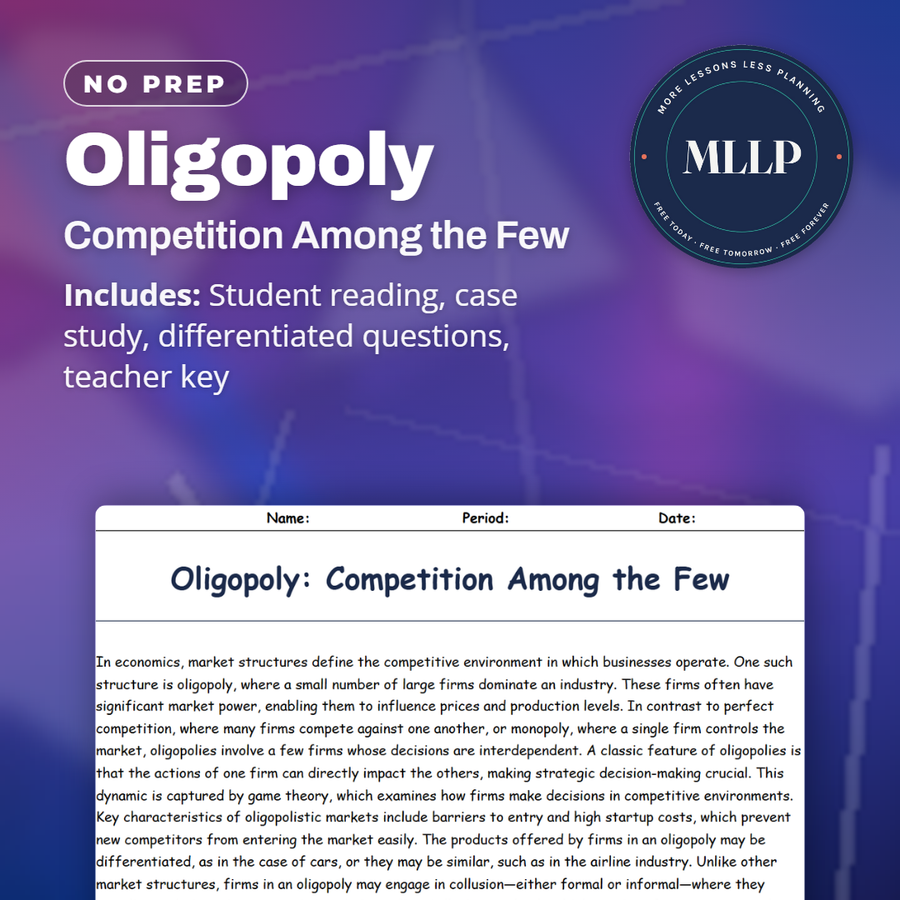
Oligopoly: Competition Among the Few
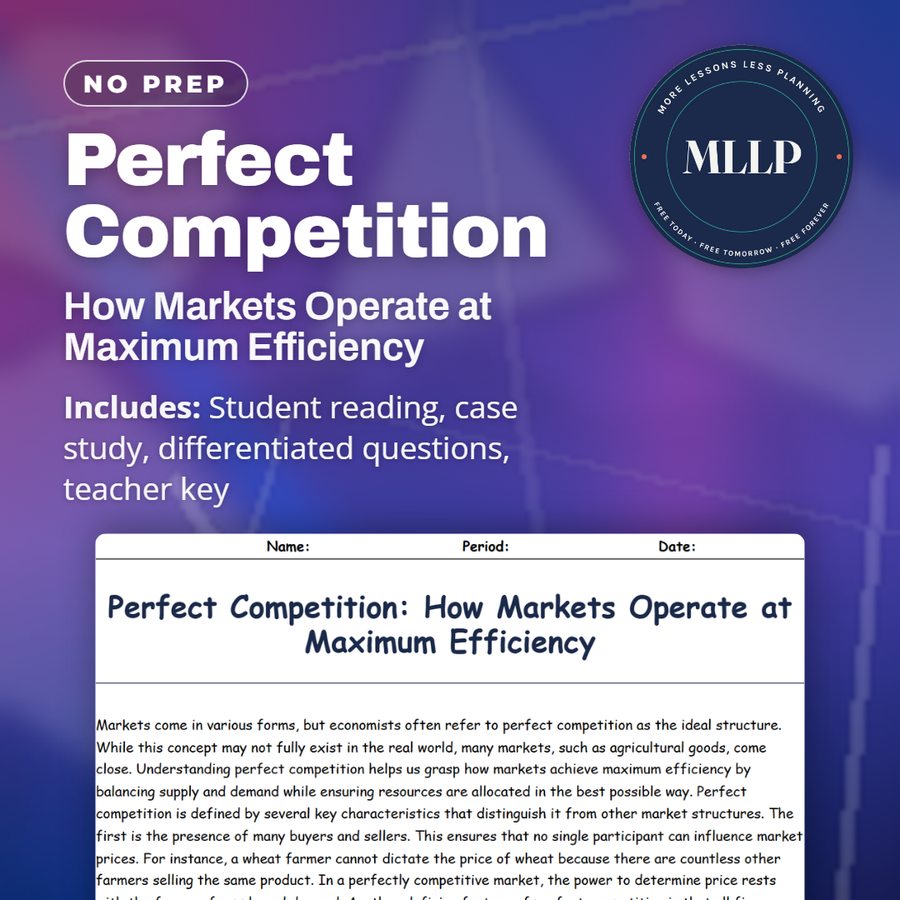
Perfect Competition: How Markets Operate at Maximum Efficiency
Every lesson on this site is free to download and use. If one of them saved you a prep period, you can chip in a few bucks toward my three kids' daycare fund. That's genuinely where tips go.