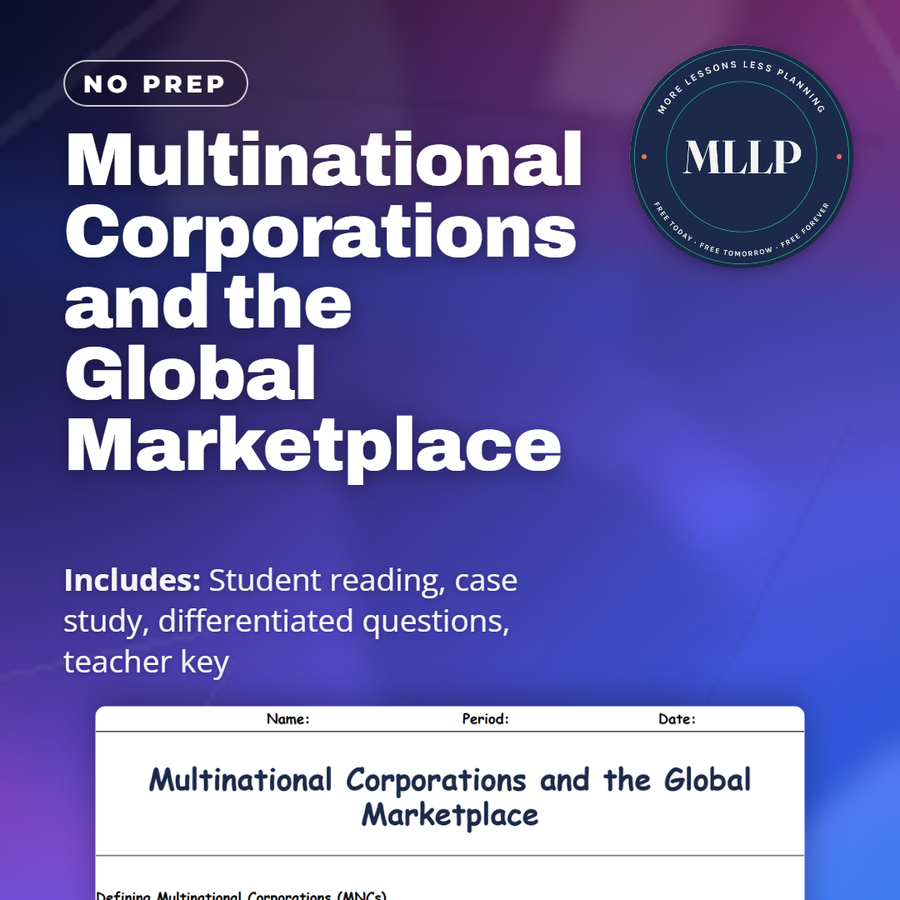
Multinational Corporations and the Global Marketplace
Quality reviewed September 2026
Facts verified September 8, 2026
- Grades
- Grades 9-12
- Length
- 6-page student worksheet
- Time
- About one 50-minute class period
- Great for
- Sub plans and independent work
- Includes
- Reading passage, comprehension questions + full answer key
- Format
- Print-and-go PDF
What students do
- Analyze Apple's global iPhone supply chain to explain why the company diversified assembly from China to India and Vietnam to mitigate geopolitical risk
- Examine transfer pricing strategies and how MNCs book profits in low-tax jurisdictions like Ireland
- Match terms like foreign direct investment, BEPS, local content rules, and corporate social responsibility to their definitions and real-world applications
- Explain how supply-chain concentration can become a strategic vulnerability when disruptions like COVID-19 or political unrest occur
What it covers
- How multinational corporations drive over two-thirds of world trade through global supply chains and vertical integration
- Benefits and criticisms in host countries: job creation and technology transfer, versus profit shifting, crowding out local firms, and environmental harm
- Regulatory responses including local content rules, performance requirements, BEPS initiatives, and ESG standards that pressure MNCs on labor and environmental practices
Start reading this worksheet
Defining Multinational Corporations (MNCs)
Multinational corporations (MNCs) are firms that manage production or deliver services in more than one country. Driven by foreign direct investment (FDI), MNCs establish subsidiaries, joint ventures, or branches abroad to access new markets, resources, and talent. Giants like Apple, Toyota, and Unilever coordinate complex global networks: R&D in Silicon Valley, manufacturing in Southeast Asia, and marketing across Europe. By leveraging economies of scale, transfer pricing, and technology spillovers, MNCs can achieve cost efficiencies and accelerate innovation. At the same time, their size and influence raise questions about competition, labor standards, and tax avoidance.
The Role of MNCs in Global Trade
MNCs drive over two-thirds of world trade through their internal supply chains. They import intermediate goods into production hubs, assemble final products, and export to end-user markets. This vertical integration reduces transaction costs and coordinates quality control. MNCs often benefit from investment incentives, including tax breaks, infrastructure support, and regulatory concessions, from host countries eager to attract capital. In return, local economies gain technology transfer, managerial know-how, and employment. Yet critics argue that MNCs may repatriate profits, exert downward pressure on labor, and leverage political connections to secure favorable terms.
Benefits and Criticisms in Host Countries
Host nations welcome MNCs for economic development: new factories create jobs, boost exports, and enhance skill levels. In emerging markets like Vietnam, MNCs in electronics have fueled export-led growth and urbanization. However, concerns include profit shifting through transfer pricing to minimize taxes, crowding out local firms unable to compete, and potential environmental harm when regulations are lax. The concept of a “race to the bottom” suggests that host governments might weaken labor or environmental standards to lure investment, undermining long-term welfare.
Like what you read? The full reading, the case study, and every question set are in the free download below, along with the answer key.
Why this matters
Why would a company agree to pay more for its own labor? That's the puzzle inside Apple's supply chain: designers in California, chips from Taiwan, camera parts from Japan, and assembly employing over a million workers in China, with much of the profit booked in low-tax Ireland. When COVID shut down those plants, Apple spent a billion dollars shifting assembly into India and Vietnam anyway.
Ethics is the first guess, not strategy, when students hear that Apple chose higher labor costs on purpose. The real answer, tariff avoidance and faster delivery to nearby markets, teaches them that decisions they assume are about image are often about risk management.
From one teacher to another
I use this reading to show students how MNCs operate at a scale that reshapes economies. The definition is straightforward: firms managing production or services in multiple countries. But the real story is in the supply chain. Apple designs in Cupertino, sourcing semiconductors from Taiwan's TSMC, camera modules from Sony in Japan, rare-earth magnets from China, with assembly at Foxconn and Pegatron in China employing over a million workers. Profits land in low-tax Ireland. Students complete fill-in-the-blank questions about efficiency advantages and labor audits. Then COVID hits. Plant closures in China delayed new model launches. Apple invested $1 billion in India and Vietnam. My students ask: Why would Apple accept higher labor costs to spread production? The case study answers: tariff avoidance, faster time-to-market for domestic consumers, and reduced geopolitical risk. We then discuss the tensions: Apple negotiates strict quality and labor audits, yet reports surface of excessive overtime. The matching section connects transfer pricing and BEPS (Base Erosion and Profit Shifting) to the broader question of tax avoidance. By the end, students understand that MNCs deliver efficiency and scale, but their size and strategies raise real questions about competition, labor rights, taxes, and environmental impact.
What you get
- Answer Key
-
Student Worksheet
Multinational strategy breaks into five categories here, from market-access seeking to strategic-asset seeking such as buying up technology and brands, plus political influence through lobbying in host and home countries. Toyota and Unilever join Apple as firms that split research, manufacturing, and marketing across regions. A separate section names the risk of a race to the bottom, where host governments loosen labor rules to keep investment.
Download
Where should I send the next one?
Everything here is free and it stays that way. Leave your email and I'll send you the new lessons as they go up. You can unsubscribe from any one of them.
Related resources
Emerging Markets and Economic Growth Around the World
Free Trade vs. Protectionism: Economic Pros and Cons
Globalization: Economic Interdependence and Transformation
How Trade Affects Domestic Industries and Jobs
The Balance of Payments: Tracking Global Money Flow
Trade Agreements: NAFTA, WTO, and Global Cooperation
Every lesson on this site is free to download and use. If one of them saved you a prep period, you can chip in a few bucks toward my three kids' daycare fund. That's genuinely where tips go.