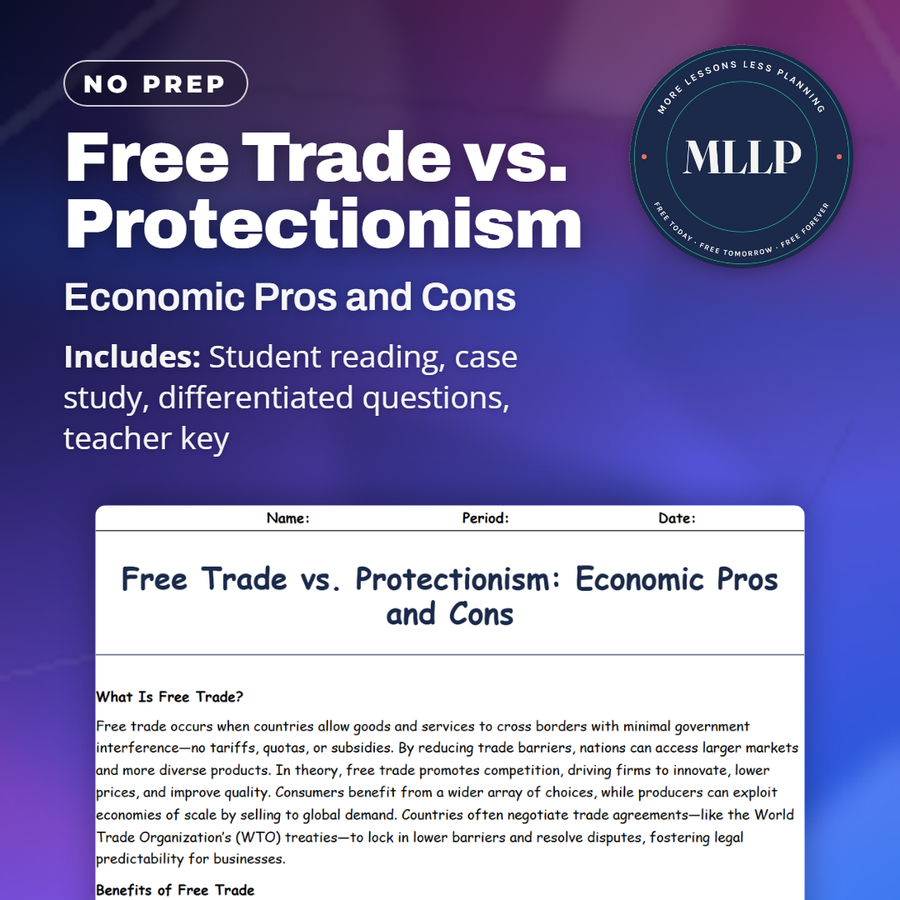
Free Trade vs. Protectionism: Economic Pros and Cons
Quality reviewed September 2026
Facts verified September 8, 2026
- Grades
- Grades 9-12
- Length
- 6-page student worksheet
- Time
- About one 50-minute class period
- Great for
- Sub plans and independent work
- Includes
- Reading passage, comprehension questions + full answer key
- Format
- Print-and-go PDF
What students do
- Analyze the 2018 U.S. steel tariff case study to identify which industries gained jobs and which faced higher input costs and employment losses
- Match protectionist tools like tariffs, quotas, subsidies, and dumping to their definitions and economic effects
- Explain why downstream industries like automakers opposed tariffs on raw materials using evidence from the passage
- Answer questions about free trade's efficiency gains versus protectionism's job-preservation benefits
What it covers
- Benefits of free trade: comparative advantage, lower consumer prices, innovation, and resource reallocation to productive sectors
- Protectionist measures and their drawbacks: the infant-industry argument, tariff revenue, job losses, and retaliatory trade wars
- The 2018 steel tariff case: how protecting producers harmed consumers and downstream manufacturers, triggering global retaliation
Start reading this worksheet
What Is Free Trade?
Free trade occurs when countries allow goods and services to cross borders with minimal government interference. That means no tariffs, quotas, or subsidies. By reducing trade barriers, nations can access larger markets and more diverse products. In theory, free trade promotes competition, driving firms to innovate, lower prices, and improve quality. Consumers benefit from a wider array of choices, while producers can exploit economies of scale by selling to global demand. Countries often negotiate trade agreements, like the World Trade Organization’s (WTO) treaties, to lock in lower barriers and resolve disputes, fostering legal predictability for businesses.
Benefits of Free Trade
When markets open up, comparative advantage kicks in: nations export what they produce relatively efficiently and import what they produce less efficiently. This specialization raises total world output. For example, if Country A excels in electronics and Country B in textiles, both gain by focusing on their strengths and trading. Consumers enjoy lower prices; producers tap into larger customer bases; resources shift toward high-value industries. Free trade can spur innovation as firms face foreign competitors. Studies show that countries that embraced trade liberalization in the 1990s saw GDP growth rates 1–2 percentage points higher than protected peers.
Why Countries Protect
Not all embrace free trade. Protectionism (using tariffs, quotas, or subsidies) shields domestic industries from foreign competition. Governments may protect fledgling sectors under the “infant industry” argument, granting them time to develop. They might also defend jobs in politically sensitive industries like steel or agriculture. From a national security standpoint, nations worry about relying on foreign suppliers for critical goods. Protectionist policies can raise domestic production, preserve employment, and generate tariff revenue for public coffers.
Like what you read? The full reading, the case study, and every question set are in the free download below, along with the answer key.
Why this matters
A 25 percent tariff on imported steel did exactly what it was designed to do: it boosted domestic steel output and brought back jobs at mills that had been cutting shifts. It also raised automaker costs by an estimated $50 million, and by late 2019 economists counted a net loss of 75,000 manufacturing jobs.
Students want tariffs to be simply good or bad, and this reading won't let them land there. I have them list who gained and who lost from the same policy, then defend whether the trade-off was worth it. They start noticing there is almost always a downstream industry nobody mentioned in the headline.
From one teacher to another
I use this reading when teaching the central tension in trade policy: what helps producers can hurt consumers. The free trade section shows how comparative advantage works with clear examples (Country A in electronics, Country B in textiles). But the protectionism section gets students asking real questions: Should governments shield fledgling industries? How do tariffs affect workers? The steel tariff case study is where the reading shines. Students see that 25 percent tariffs boosted U.S. steel output and rehired workers, but auto plants faced $50 million cost increases and delayed wage raises. By late 2019, economists estimated a net loss of 75,000 manufacturing jobs. My students wrestle with the retaliation piece: EU tariffs on bourbon and motorcycles hurt American exporters in different sectors. The matching and short-answer questions push students beyond "tariffs are good" or "tariffs are bad" toward thinking about targeted assistance and long-term effects.
What you get
- Answer Key
-
Student Worksheet
Steel mills reported a 5% jump in output right after the March 2018 tariffs, imposed under Section 232 of the Trade Expansion Act, and rehired workers laid off in prior years. By late 2019 U.S. steel prices sat 10% above pre-tariff levels, and small businesses reported unpredictable material costs that make long-term planning difficult, a ripple effect the case study traces past the headline jobs numbers.
Download
Where should I send the next one?
Everything here is free and it stays that way. Leave your email and I'll send you the new lessons as they go up. You can unsubscribe from any one of them.
Related resources
Emerging Markets and Economic Growth Around the World
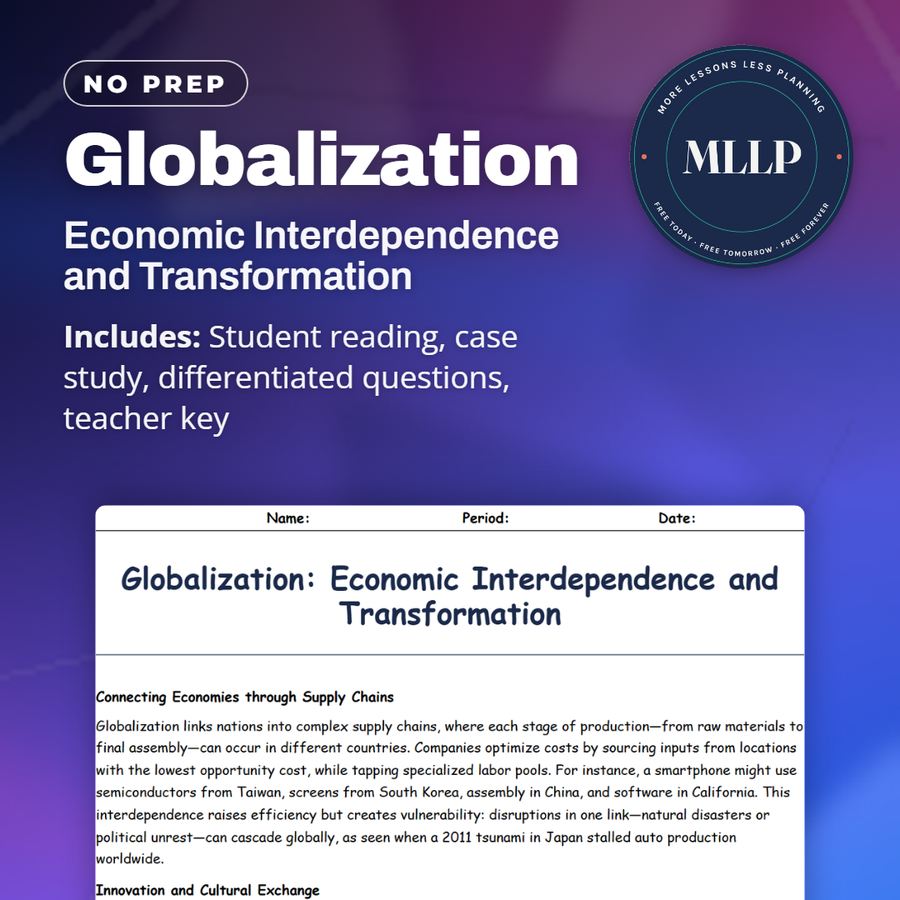
Globalization: Economic Interdependence and Transformation
How Trade Affects Domestic Industries and Jobs
Multinational Corporations and the Global Marketplace
The Balance of Payments: Tracking Global Money Flow
Trade Agreements: NAFTA, WTO, and Global Cooperation
Every lesson on this site is free to download and use. If one of them saved you a prep period, you can chip in a few bucks toward my three kids' daycare fund. That's genuinely where tips go.