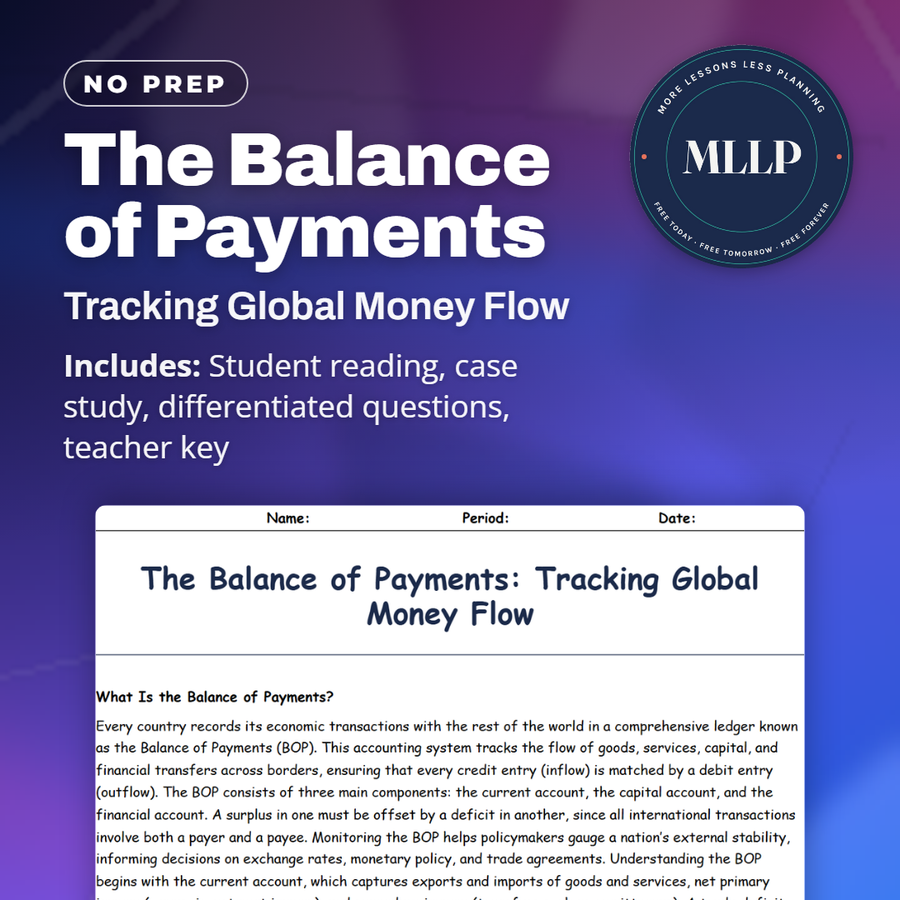
The Balance of Payments: Tracking Global Money Flow
Quality reviewed September 2026
Facts verified September 8, 2026
- Grades
- Grades 9-12
- Length
- 7-page student worksheet
- Time
- About one 50-minute class period
- Great for
- Sub plans and independent work
- Includes
- Reading passage, comprehension questions + full answer key
- Format
- Print-and-go PDF
What students do
- Analyze the U.S. twin deficits of 2005-2008 to explain how current account deficits are financed by financial account surpluses (foreign capital inflows)
- Trace how the 2008 financial crisis affected capital flows and caused the dollar to initially depreciate, then rebound after Fed rate cuts and stimulus
- Match balance-of-payments components like current account, financial account, FDI, and portfolio investment to their definitions
- Explain why capital inflows can mask underlying current account weakness and why sustained deficits leave economies vulnerable to sudden investor losses of confidence
What it covers
- The balance-of-payments ledger: how current account deficits (imports exceeding exports) must be offset by financial account surpluses (capital inflows)
- The three BOP components: current account (goods, services, income, transfers), capital account (migrants' transfers, debt forgiveness), and financial account (FDI, portfolio flows)
- How central banks use BOP data to adjust exchange rates and interest rates, and why sustained surpluses can spark trade tensions
Start reading this worksheet
What Is the Balance of Payments?
Every country records its economic transactions with the rest of the world in a comprehensive ledger known as the Balance of Payments (BOP). This accounting system tracks the flow of goods, services, capital, and financial transfers across borders, ensuring that every credit entry (inflow) is matched by a debit entry (outflow). The BOP consists of three main components: the current account, the capital account, and the financial account. A surplus in one must be offset by a deficit in another, since all international transactions involve both a payer and a payee. Monitoring the BOP helps policymakers gauge a nation’s external stability, informing decisions on exchange rates, monetary policy, and trade agreements. Understanding the BOP begins with the current account, which captures exports and imports of goods and services, net primary income (wages, investment income), and secondary income (transfers such as remittances). A trade deficit, imports exceeding exports, shows up as a current account deficit, meaning the country must attract capital from abroad to finance it. Conversely, a current account surplus indicates net lending to the rest of the world. Persistent deficits can erode foreign reserves or lead to debt accumulation, while sustained surpluses may signal undervalued currency or weak domestic demand.
Components of the Capital and Financial Accounts
While the current account tracks flows of goods and services, the capital account and financial account record cross-border transfers of assets. The capital account is relatively small. It covers debt forgiveness, migrants’ transfers, and the acquisition or disposal of non-produced, non-financial assets (like patents). The larger financial account logs investments: foreign direct investment (FDI), portfolio flows (stocks and bonds), and “other” investments (loans, deposits). When a country runs a current account deficit, it must run a corresponding financial account surplus, foreigners investing in domestic assets, to balance the books. For example, a $100 billion trade deficit might coincide with $70 billion in portfolio inflows and $30 billion in FDI. Shifts in sentiment can reverse these flows overnight: if foreign investors fear instability, capital may flee, forcing the currency to depreciate or depleting reserve buffers. Thus, the BOP framework highlights vulnerabilities to sudden stops and capital flight, guiding central banks in reserve management and intervention strategies.
Like what you read? The full reading, the case study, and every question set are in the free download below, along with the answer key.
Why this matters
A trade deficit sounds like a country losing money, but the balance of payments shows why that isn't quite right. In the mid-2000s, the U.S. current account deficit peaked at 6 percent of GDP as cheap credit fueled imports, covered by foreigners buying trillions in U.S. Treasuries, a financial account surplus that kept the books balanced until 2008.
The accounting alone can't say whether a deficit is dangerous, only weighing the evidence can. I have students trace what happened when foreign investors lost confidence in 2008: the dollar dropped, then recovered once the Fed cut rates, and the deficit narrowed to under 3 percent of GDP within a year.
From one teacher to another
I use this reading to demystify balance-of-payments accounting. Students often think trade deficits are failures, but the BOP framework shows they're logical: when you import more than you export, you must attract capital from abroad to balance the books. The U.S. case study drives this home. In the mid-2000s, the current account deficit peaked at 6 percent of GDP. Cheap credit fueled imports of electronics, commodities, and luxury goods. Foreigners bought trillions in U.S. Treasuries, creating a financial account surplus that masked vulnerabilities. My students fill in blanks about foreign capital, portfolio flows, and foreign exchange reserves. Then the 2008 crisis hits. Foreign appetite for risky assets evaporates. Portfolio inflows shrink. Some investors repatriate funds. The dollar initially plunges, then rebounds when the Fed cuts rates and resumes bond purchases. By 2009, the current account deficit had narrowed to under 3 percent of GDP. Students learn that the BOP doesn't cause crises, but it reveals who's exposed when sentiment shifts. The case also illustrates why policymakers watch both current and financial account flows. Large deficits look manageable when capital inflows are strong, but they leave economies exposed to sudden reversals. Matching and short-answer questions push students to connect reserve management, interest-rate policy, and capital controls to BOP stability.
What you get
- Answer Key
-
Student Worksheet
The capital account is the balance of payments' smallest piece, covering things like debt forgiveness, transfers migrants carry with them when they relocate, and the sale of patents and other assets that aren't physical or financial. Germany's decade-long current account surplus has drawn criticism from its EU neighbors, that run deficits, and a sudden financial account surplus can signal hot money that pushes central banks toward rate hikes.
Download
Where should I send the next one?
Everything here is free and it stays that way. Leave your email and I'll send you the new lessons as they go up. You can unsubscribe from any one of them.
Related resources
Emerging Markets and Economic Growth Around the World
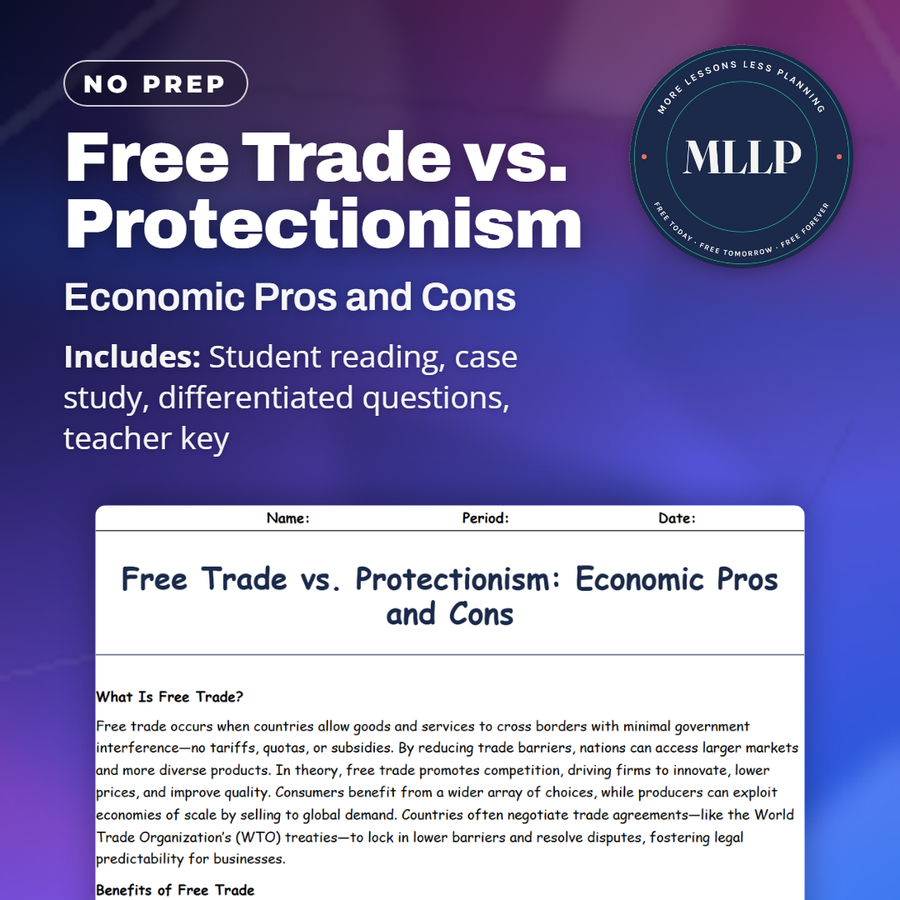
Free Trade vs. Protectionism: Economic Pros and Cons
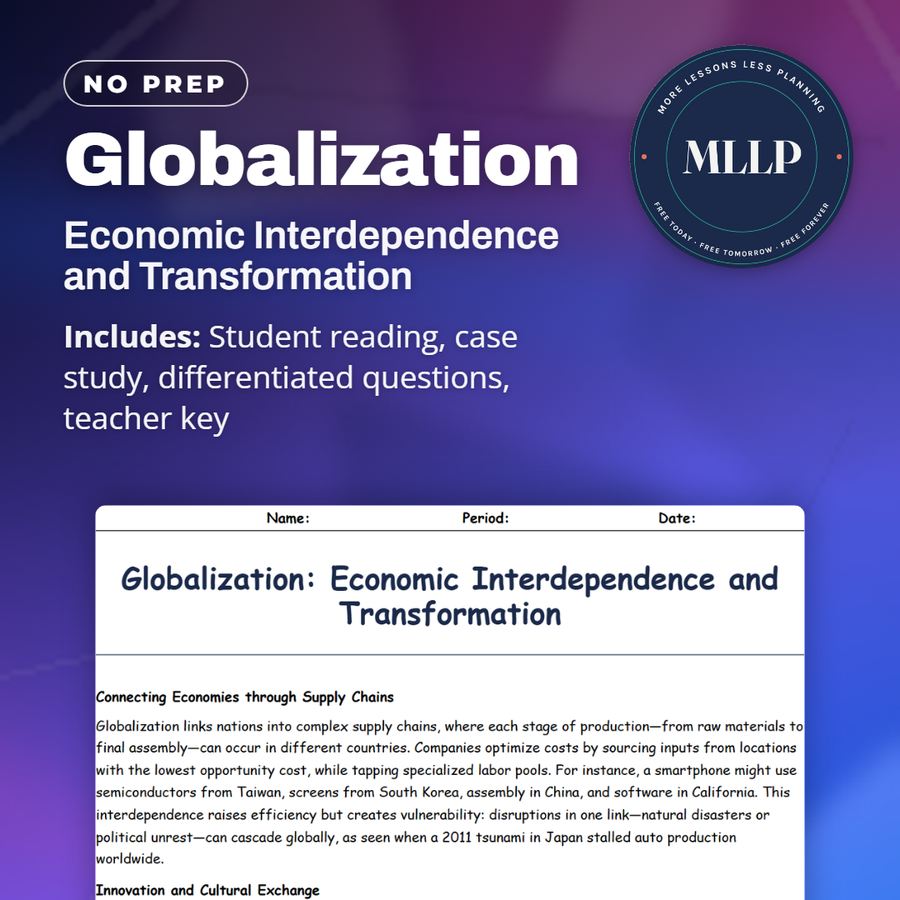
Globalization: Economic Interdependence and Transformation
How Trade Affects Domestic Industries and Jobs
Multinational Corporations and the Global Marketplace
Trade Agreements: NAFTA, WTO, and Global Cooperation
Every lesson on this site is free to download and use. If one of them saved you a prep period, you can chip in a few bucks toward my three kids' daycare fund. That's genuinely where tips go.