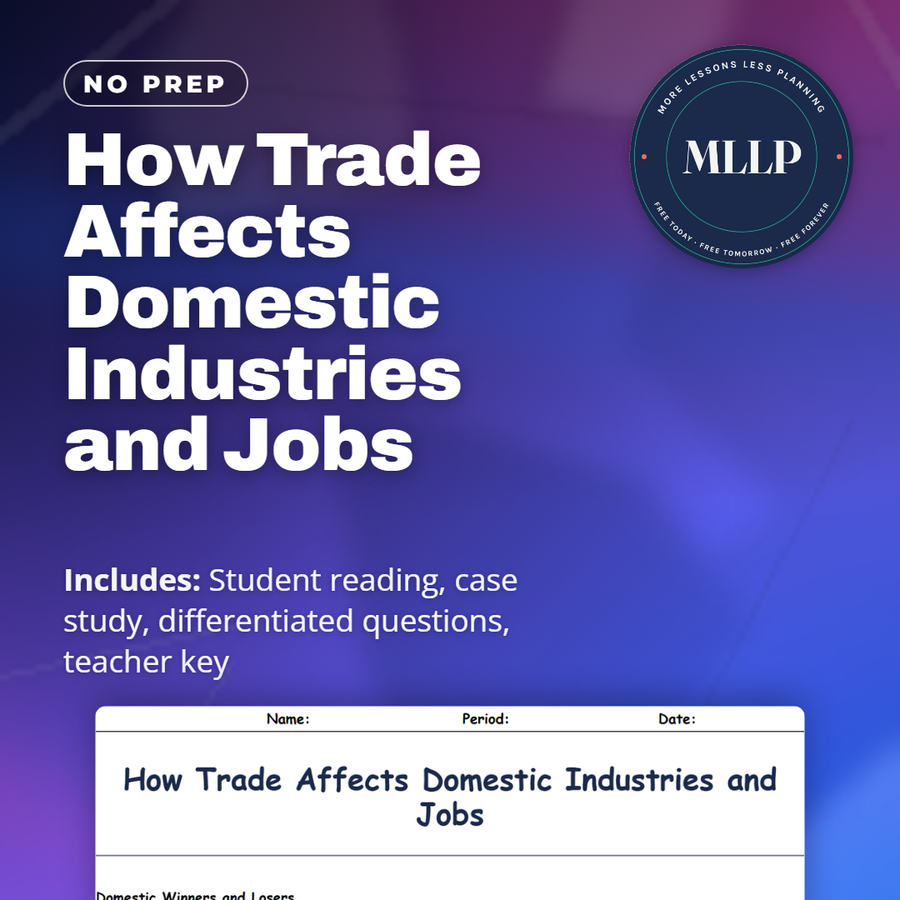
How Trade Affects Domestic Industries and Jobs
Quality reviewed September 2026
Facts verified September 8, 2026
- Grades
- Grades 9-12
- Length
- 7-page student worksheet
- Time
- About one 50-minute class period
- Great for
- Sub plans and independent work
- Includes
- Reading passage, comprehension questions + full answer key
- Format
- Print-and-go PDF
What students do
- Analyze NAFTA's influence on U.S. manufacturing and Mexican agriculture from 1994 onwards, identifying export-industry gains and import-competing losses
- Explain why displaced workers needed retraining programs and how regions with diversified economies absorbed job losses more effectively than single-industry towns
- Match terms like consumer benefits, outsourcing, trade-competing sectors, and Trade Adjustment Assistance to their definitions
- Trace how Mexico's agricultural downturn led farmers to shift toward high-value crops like avocados and berries using cooperative models
What it covers
- Domestic winners and losers from trade: export-oriented firms scale up while labor-intensive industries contract and relocate
- Consumer gains from lower prices and wider variety, balanced against job displacement and the need for worker retraining and relocation assistance
- Long-term industry transitions: how Detroit declined in auto manufacturing while tech hubs like Seattle grew as comparative advantages evolved
Start reading this worksheet
Domestic Winners and Losers
International trade creates winners and losers. Winners are sectors that expand when exposed to larger markets, while losers are industries that contract when faced with cheaper foreign competition. Export-oriented firms often scale up, hiring more workers and investing in new technology. For instance, U.S. aircraft manufacturers have thrived selling jets overseas, supporting high-skilled employment. Conversely, labor-intensive industries such as textiles may relocate to countries with lower wages, displacing domestic workers. These shifts reflect comparative advantage at work but can leave communities dependent on threatened industries vulnerable to job loss and economic decline.
Consumer Benefits and Costs
Consumers generally benefit from trade through lower prices, greater product variety, and improved quality. Imported electronics, apparel, and food items often cost less than their domestic counterparts would. This translates into higher real incomes. Households can purchase more with the same budget. However, lower prices may come at the cost of job displacement in certain sectors. Workers laid off from shrinking industries often require retraining or relocation, imposing social and fiscal costs. Thus, while aggregate welfare rises, distributional impacts can be severe without supportive policies.
Adjustment and Policy Responses
Governments can ease transitions with active labor market policies: retraining programs, wage insurance, and relocation assistance. The Trade Adjustment Assistance (TAA) program in the United States provides funding for displaced workers to acquire new skills, helping them reenter growing sectors. Wage insurance offers partial compensation when workers accept lower-paying jobs. Economic diversification initiatives invest in infrastructure and education in affected regions. Effective adjustment measures recognize that while trade raises overall prosperity, targeted support is essential to maintain social cohesion and economic resilience.
Like what you read? The full reading, the case study, and every question set are in the free download below, along with the answer key.
Why this matters
When tariff barriers between the United States and Mexico fell in 1994, U.S. auto and machinery exports climbed 150 percent over the next decade while Mexican corn farmers, unable to compete with subsidized U.S. corn, saw smallholder maize production drop 20 percent by 2000.
Students expect trade to have one clear winner and one clear loser, and I let that expectation stand until we compare Texas to North Carolina's furniture counties. Texas absorbed its displaced workers better because it had other industries to shift into. Mexico's avocado exports growing from $7 billion to $30 billion by 2015 shows adjustment can work when it's supported.
From one teacher to another
I use this reading to make trade's distributional impact concrete. Students learn that trade raises overall prosperity, but the question "Who pays?" is every bit as important as "Who gains?" The passage opens with U.S. aircraft manufacturers thriving on overseas sales while textiles relocated to lower-wage countries. That's comparative advantage in action. But then we hit NAFTA. When tariff barriers fell in 1994, U.S. auto and machinery makers gained access to regional markets and boosted exports by 150 percent over a decade. Assembly plants sprouted along the border. Yet Mexican farmers couldn't compete with subsidized U.S. corn, and smallholder maize cultivation fell 20 percent by 2000. North Carolina's furniture counties saw factory closures. Texas absorbed displaced workers better because it had diverse industries. My students complete matching questions on Trade Adjustment Assistance, then work through short-answer prompts asking why some regions adjust more easily. By the end, they see that Mexico's agricultural downturn prompted policy reforms, and farmers shifted to cooperatives and high-value crops—avocado exports jumped from $7 billion in 2000 to $30 billion by 2015. The message: trade creates opportunities and disruptions. Adjustment support and innovation determine whether losers become winners.
What you get
- Answer Key
-
Student Worksheet
Detroit's decline as an auto hub sits across from Seattle's rise as a tech hub in the reading's account of how trade reshapes industries over decades. Assembly plants sprang up in Michigan and Ohio once tariffs fell under NAFTA, aircraft manufacturers built high-skill jobs selling jets overseas, and textile production moved to lower-wage countries, three outcomes from the same trade policy landing in different places.
Download
Where should I send the next one?
Everything here is free and it stays that way. Leave your email and I'll send you the new lessons as they go up. You can unsubscribe from any one of them.
Related resources
Emerging Markets and Economic Growth Around the World
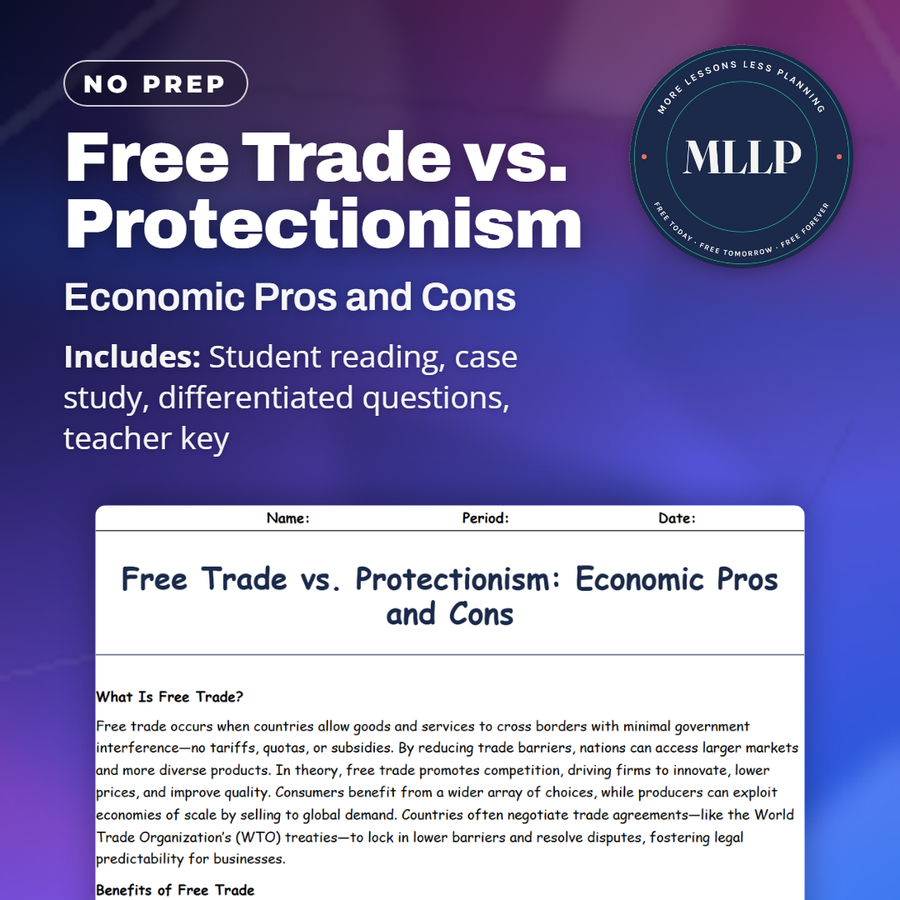
Free Trade vs. Protectionism: Economic Pros and Cons
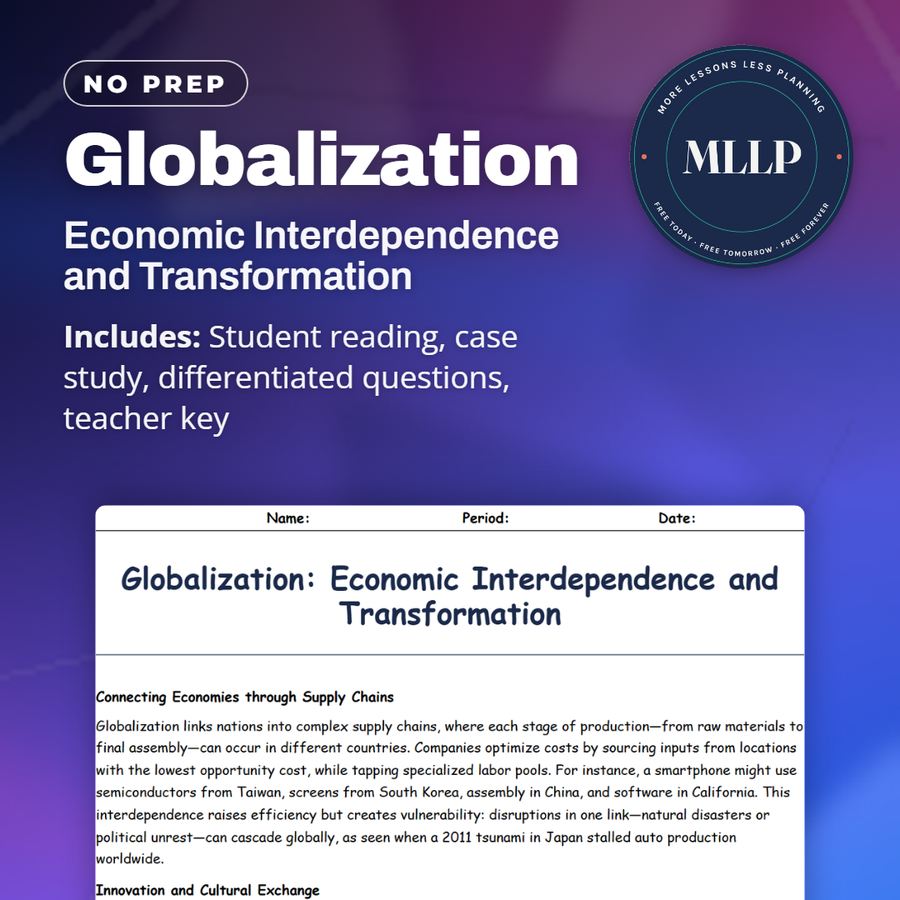
Globalization: Economic Interdependence and Transformation

Multinational Corporations and the Global Marketplace

The Balance of Payments: Tracking Global Money Flow

Trade Agreements: NAFTA, WTO, and Global Cooperation
Every lesson on this site is free to download and use. If one of them saved you a prep period, you can chip in a few bucks toward my three kids' daycare fund. That's genuinely where tips go.