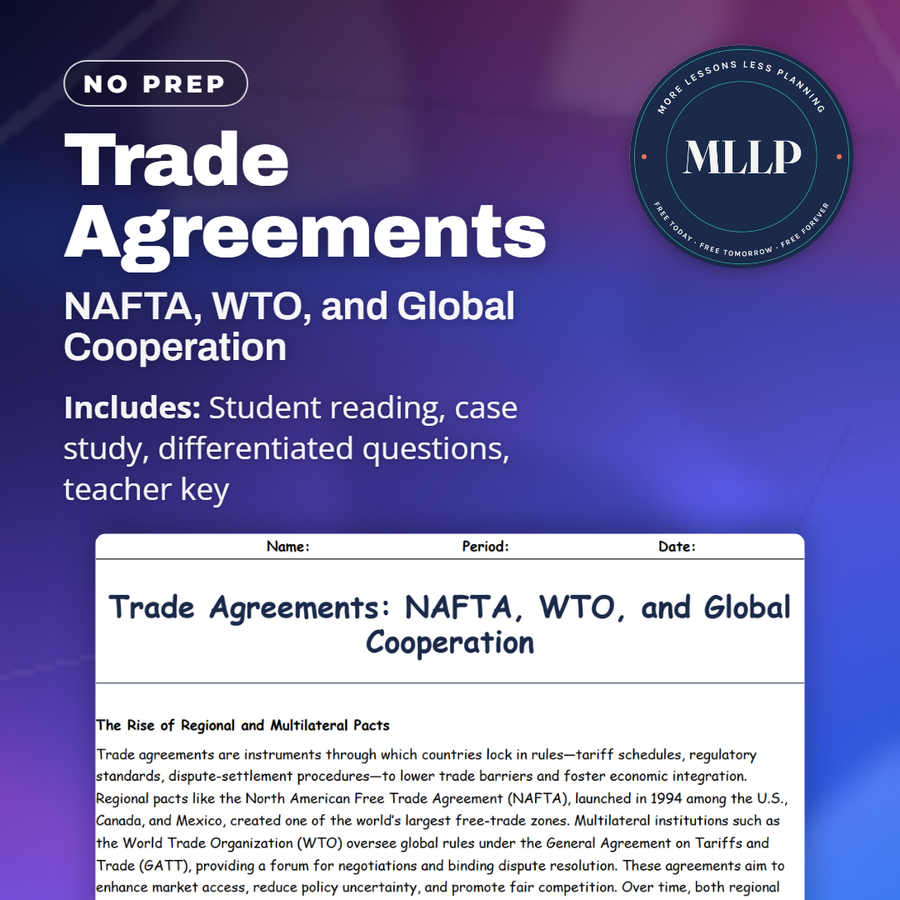
Trade Agreements: NAFTA, WTO, and Global Cooperation
Quality reviewed September 2026
Facts verified September 8, 2026
- Grades
- Grades 9-12
- Length
- 7-page student worksheet
- Time
- About one 50-minute class period
- Great for
- Sub plans and independent work
- Includes
- Reading passage, comprehension questions + full answer key
- Format
- Print-and-go PDF
What students do
- Analyze USMCA's $16-per-hour wage-floor rule for auto content to explain how targeted labor standards spur investment in the U.S. and Canada while creating adjustment challenges in Mexico
- Examine how the WTO's most-favored-nation and national treatment principles constrain discriminatory tariffs across 164 member nations
- Match terms like national treatment, safeguard measures, anti-dumping duties, rules of origin, and dispute settlement to their definitions
- Explain why the "spaghetti bowl" of overlapping regional trade agreements can raise compliance costs despite faster liberalization among participants
What it covers
- Regional trade pacts (NAFTA, USMCA) and multilateral institutions (WTO) that lock in tariff schedules, standards, and dispute-resolution procedures
- NAFTA's 99 percent tariff elimination and USMCA's modernized rules on digital trade, labor, and intellectual property protecting North American workers
- WTO framework principles: most-favored-nation treatment, national treatment, and the Dispute Settlement Body as an alternative to unilateral retaliation
Start reading this worksheet
The Rise of Regional and Multilateral Pacts
Trade agreements are instruments through which countries lock in rules, such as tariff schedules, regulatory standards, and dispute-settlement procedures, to lower trade barriers and foster economic integration. Regional pacts like the North American Free Trade Agreement (NAFTA), launched in 1994 among the U.S., Canada, and Mexico, created one of the world’s largest free-trade zones. Multilateral institutions such as the World Trade Organization (WTO) oversee global rules under the General Agreement on Tariffs and Trade (GATT), providing a forum for negotiations and binding dispute resolution. These agreements aim to enhance market access, reduce policy uncertainty, and promote fair competition. Over time, both regional and multilateral accords have evolved beyond simple tariff cuts. Modern trade agreements often include chapters on intellectual property, services, e-commerce, environment, and labor standards, reflecting broader policy goals. The proliferation of Preferential Trade Agreements (PTAs), now numbering over 300 globally, demonstrates countries’ eagerness to secure deeper commitments, even as WTO negotiations have stalled. While PTAs can accelerate liberalization among participants, critics warn of a “spaghetti bowl” of overlapping rules that raise compliance costs for businesses.
NAFTA to USMCA: Deepening North American Integration
NAFTA eliminated 99 percent of tariffs on goods traded among its members. U.S. manufacturers tapped Mexico’s lower labor costs for assembly, while Canada and Mexico benefited from U.S. capital and technology. Trade among the three partners more than tripled between 1993 and 2016. However, NAFTA faced political backlash over job losses in certain sectors and concerns about environmental and labor standards. In 2020, NAFTA was supplanted by the United States–Mexico–Canada Agreement (USMCA), which modernized rules on digital trade, strengthened auto-sector labor requirements, and introduced stricter intellectual-property protections. This illustrates how regional agreements adapt to new economic realities.
WTO Framework: Rules, Rounds, and Disputes
Established in 1995, the WTO encompasses 164 members, covering over 98 percent of global trade. Its core principles, most-favored-nation (MFN) and national treatment, prohibit discriminatory tariffs and domestic regulation against foreign goods and services. The WTO’s Dispute Settlement Body has adjudicated hundreds of cases, offering a rules-based alternative to unilateral retaliation. Yet, the Doha Development Round, launched in 2001 to address the needs of developing countries, remains incomplete, hindered by disputes over agricultural subsidies, industrial tariffs, and services liberalization. Recent challenges include appeals-process paralysis and rising protectionist pressures.
Like what you read? The full reading, the case study, and every question set are in the free download below, along with the answer key.
Why this matters
A $16-an-hour wage rule buried inside USMCA's rules of origin moved real money: by mid-2021, 34 percent of North American-assembled vehicles met the higher labor content threshold, up from 21 percent before the rule existed, and Ford and GM announced $4.5 billion in U.S. manufacturing upgrades to qualify.
Students picture trade agreements as tariff schedules and nothing else, so this case surprises them: a labor standard shifted investment more than a tariff cut ever did. I have them compare that rule to the WTO's most-favored-nation principle, which treats all 164 members the same instead of picking winners.
From one teacher to another
I use this reading to show how trade agreements operate as rule-making institutions. The passage opens with the key insight: agreements lock in rules to reduce policy uncertainty and foster economic integration. NAFTA created one of the world's largest free-trade zones. Trade among U.S., Canada, and Mexico tripled between 1993 and 2016. But NAFTA faced backlash over job losses and labor standards. Enter USMCA in 2020. The $16-per-hour wage rule exemplifies how modern agreements embed social objectives. By mid-2021, 34 percent of North American-assembled light vehicles met the higher content threshold (up from 21 percent pre-USMCA). Ford and GM announced $4.5 billion in U.S. manufacturing upgrades. Mexican plants struggled initially, but suppliers negotiated productivity bonuses, upgraded equipment, and refocused on higher-value parts. Students see the trade-off: targeted rules can spur higher wages and domestic investment, but they create transitional friction in integrated industries. The WTO section covers the 164-member institution's core principles: MFN (treat all WTO partners the same) and national treatment (don't discriminate against imports once they're in your market). Students complete multiple-choice questions distinguishing between safeguards and anti-dumping duties. The case study and matching sections drive home why some economies prefer regional pacts (faster, deeper on specific issues) while others value WTO membership (rules-based stability). The "spaghetti bowl" question challenges students to weigh the benefits of overlapping agreements against their compliance burden.
What you get
- Answer Key
-
Student Worksheet
The WTO, founded in 1995, now counts 164 members covering over 98 percent of world commerce, yet its Doha Round, launched in 2001, is still stuck over farm subsidies and industrial tariffs. Over 300 preferential trade deals layer extra commitments on top of that membership. In Puebla, a mid-size plant built around older engine-block designs could not meet USMCA's wage and content rules and slowed production.
Download
Where should I send the next one?
Everything here is free and it stays that way. Leave your email and I'll send you the new lessons as they go up. You can unsubscribe from any one of them.
Related resources
Emerging Markets and Economic Growth Around the World
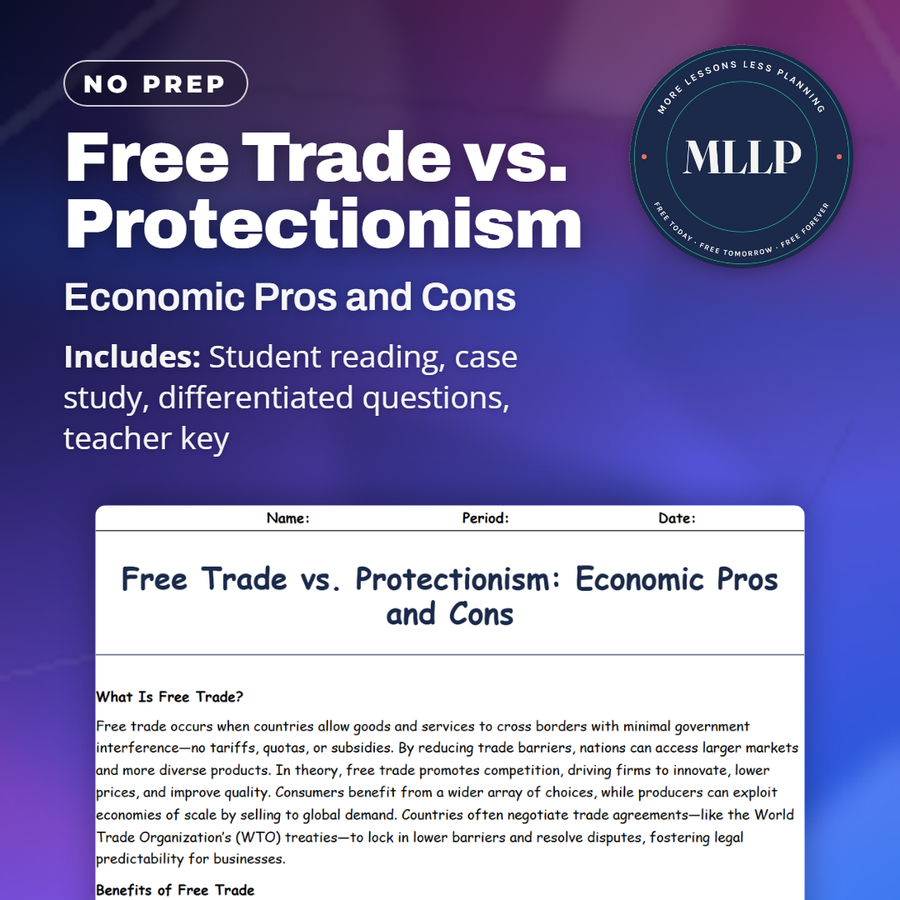
Free Trade vs. Protectionism: Economic Pros and Cons
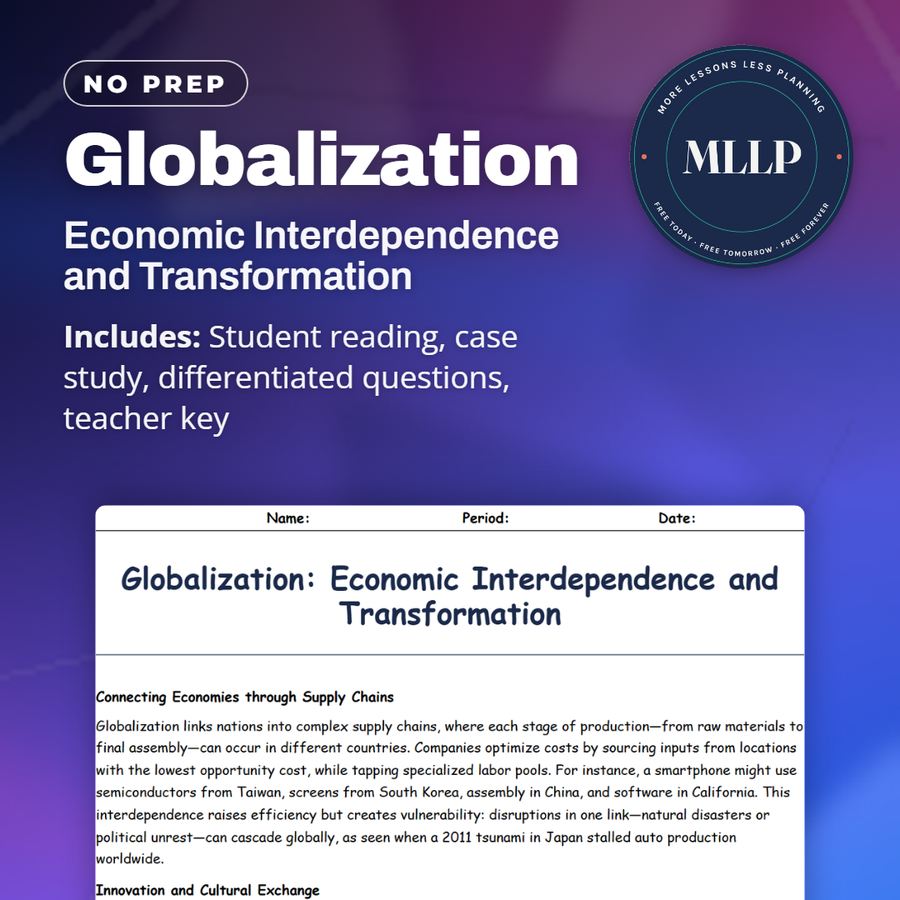
Globalization: Economic Interdependence and Transformation
How Trade Affects Domestic Industries and Jobs
Multinational Corporations and the Global Marketplace
The Balance of Payments: Tracking Global Money Flow
Every lesson on this site is free to download and use. If one of them saved you a prep period, you can chip in a few bucks toward my three kids' daycare fund. That's genuinely where tips go.