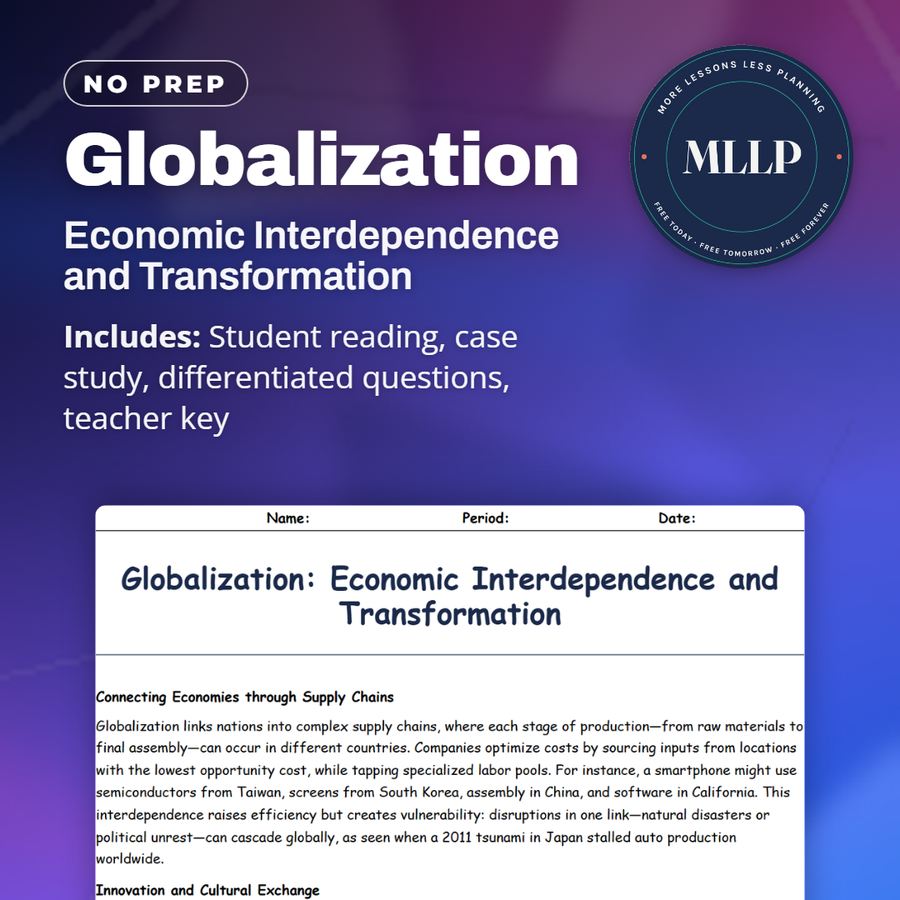
Globalization: Economic Interdependence and Transformation
Quality reviewed September 2026
Facts verified September 8, 2026
- Grades
- Grades 9-12
- Length
- 6-page student worksheet
- Time
- About one 50-minute class period
- Great for
- Sub plans and independent work
- Includes
- Reading passage, comprehension questions + full answer key
- Format
- Print-and-go PDF
What students do
- Analyze how the 2020 COVID-19 pandemic exposed vulnerabilities in global supply chains, from microcontroller shortages to PPE delays
- Examine trade-offs between globalization's efficiency gains and its role in widening income inequality within and between countries
- Match terms like just-in-time inventory, reshoring, cultural diffusion, and hybrid supply models to their definitions
- Explain why companies adopted dual-sourcing strategies and safety stocks after pandemic disruptions
What it covers
- Global supply chains in smartphones, automotive, and pharmaceuticals, where each production stage occurs in different countries
- How technology transfer, multinational corporations, and trade drive innovation and entrepreneurial clusters in Shenzhen and Bangalore
- Globalization's inequality: poverty reduction in China versus wage pressure on low-skilled workers and environmental costs in developing nations
Start reading this worksheet
Connecting Economies through Supply Chains
Globalization links nations into complex supply chains, where each stage of production, from raw materials to final assembly, can occur in different countries. Companies optimize costs by sourcing inputs from locations with the lowest opportunity cost, while tapping specialized labor pools. For instance, a smartphone might use semiconductors from Taiwan, screens from South Korea, assembly in China, and software in California. This interdependence raises efficiency but creates vulnerability: disruptions in one link, whether natural disasters or political unrest, can cascade globally, as seen when a 2011 tsunami in Japan stalled auto production worldwide.
Innovation and Cultural Exchange
Trade and investment drive technology transfer and knowledge diffusion. Multinational corporations bring best practices, management expertise, and research collaboration to host countries. Local firms often hire globally trained professionals, fostering entrepreneurial clusters: Silicon Valley-like hubs in Bangalore and Shenzhen. Cultural globalization accompanies economic ties: food, music, and fashion cross borders, enriching societies but also sparking debates over cultural homogenization. Global consumer brands gain footholds everywhere, while local artisans leverage e-commerce platforms to reach international customers.
Impacts on Inequality and Environment
Globalization has lifted hundreds of millions out of poverty. China’s extreme poverty rate, for example, fell from over 60 percent in 1990 to under 1 percent by 2015. But globalization has also exacerbated income inequality within and between countries. Skilled workers and capital owners in advanced economies capture most gains, while low-skilled workers face wage pressure. Environmental costs mount as production shifts to countries with laxer regulations, contributing to carbon emissions and resource depletion. The challenge lies in managing globalization so that growth is inclusive and sustainable, aligning trade policies with labor and environmental standards.
Like what you read? The full reading, the case study, and every question set are in the free download below, along with the answer key.
Why this matters
Take the phone in a student's pocket: designed in California, chips from Taiwan, a screen from Korea, and final assembly in China, four countries before it ever reached a shelf. That interdependence works beautifully until one link breaks: when factories in Wuhan shut down in 2020, assembly lines in Detroit stalled and European hospitals ran short on protective equipment for months.
What students get wrong is treating globalization as a story with one ending. I have them hold two true facts side by side: China's extreme poverty fell from over 60 percent to under 1 percent, while low-skilled workers elsewhere absorbed real wage pressure. Neither fact cancels the other.
From one teacher to another
I use this reading to help students see that globalization is neither a simple win nor a clear loss. The smartphone example shows interdependence: semiconductors from Taiwan, screens from Korea, assembly in China, software in California. A single disruption cascades globally. Then the COVID case study hits hard. When Wuhan factories shut down in 2020, automakers in Detroit couldn't assemble cars, and European hospitals faced PPE shortages for months. Students see the contrast: just-in-time inventory works beautifully until it doesn't. By 2022, firms had adopted hybrid models with safety stocks and dual sourcing. My students also grapple with inequality: yes, globalization lifted hundreds of millions from poverty (China's extreme poverty fell from over 60 percent to under 1 percent), but skilled workers and capital owners captured most gains while low-skilled workers faced wage pressure. The policy-challenge section raises questions about reshoring, nearshoring, and future multilateral cooperation that students debate thoughtfully.
What you get
- Answer Key
-
Student Worksheet
A 2011 tsunami in Japan once stalled auto production worldwide, the same kind of fragility COVID-19 exposed on a larger scale when factories in Wuhan closed in 2020. The European Union responded by funding new domestic PPE manufacturing, and Japan and South Korea offered incentives to bring drug production back home, moves the reading credits with helping some countries recover faster than others once the initial shock passed.
Download
Where should I send the next one?
Everything here is free and it stays that way. Leave your email and I'll send you the new lessons as they go up. You can unsubscribe from any one of them.
Related resources
Emerging Markets and Economic Growth Around the World
Free Trade vs. Protectionism: Economic Pros and Cons
How Trade Affects Domestic Industries and Jobs
Multinational Corporations and the Global Marketplace
The Balance of Payments: Tracking Global Money Flow
Trade Agreements: NAFTA, WTO, and Global Cooperation
Every lesson on this site is free to download and use. If one of them saved you a prep period, you can chip in a few bucks toward my three kids' daycare fund. That's genuinely where tips go.