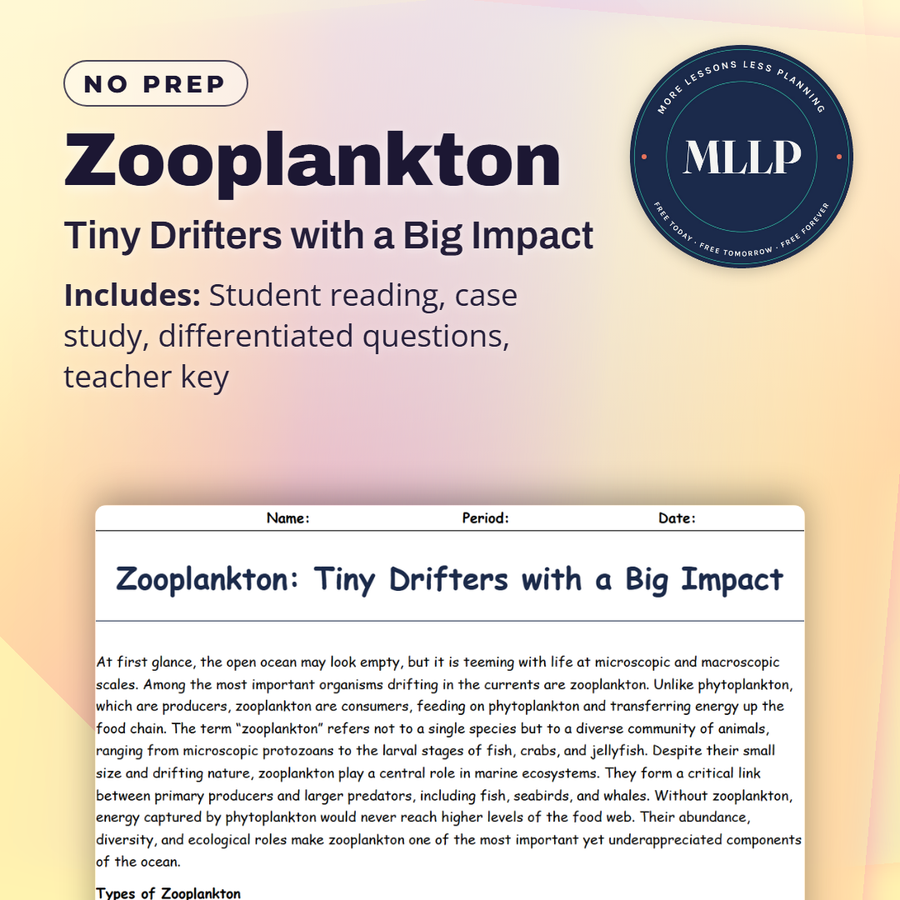
Zooplankton: Tiny Drifters with a Big Impact
Quality reviewed September 2026
Facts verified September 14, 2026
- Subject
- Science
- Grades
- Grades 9-12
- Length
- 6-page student worksheet
- Time
- About one 50-minute class period
- Great for
- Sub plans and independent work
- Includes
- Reading passage, comprehension questions + full answer key
- Format
- Print-and-go PDF
What students do
- Match terms like holoplankton, meroplankton, copepods, and krill to their correct definitions
- Fill in the blank sentences on meroplankton, phytoplankton, and diel vertical migration
- Answer multiple choice questions on holoplankton, the biological pump, and why zooplankton migrate vertically
- Write short answers on why zooplankton matter to fisheries, how vertical migration moves carbon, and why copepods are ecologically significant
What it covers
- The difference between holoplankton and meroplankton and how each fits into the food web
- Diel vertical migration and its role in moving carbon and nutrients through the water column
- A case study on Antarctic krill and their place at the center of the Southern Ocean food web
Start reading this worksheet
At first glance, the open ocean may look empty, but it is teeming with life at microscopic and macroscopic scales. Among the most important organisms drifting in the currents are zooplankton. Unlike phytoplankton, which are producers, zooplankton are consumers, feeding on phytoplankton and transferring energy up the food chain. The term “zooplankton” refers not to a single species but to a diverse community of animals, ranging from microscopic protozoans to the larval stages of fish, crabs, and jellyfish. Despite their small size and drifting nature, zooplankton play a central role in marine ecosystems. They form a critical link between primary producers and larger predators, including fish, seabirds, and whales. Without zooplankton, energy captured by phytoplankton would never reach higher levels of the food web. Their abundance, diversity, and ecological roles make zooplankton one of the most important yet underappreciated components of the ocean.
Types of Zooplankton
Zooplankton can be divided into two broad groups: holoplankton and meroplankton. Holoplankton spend their entire lives as plankton, drifting in the water column. Examples include copepods, krill, and some jellyfish. Copepods are especially abundant; in fact, they may be the most numerous multicellular animals on Earth. Krill, another type of holoplankton, are famous for supporting the massive food webs of the Southern Ocean, where they feed whales, seals, and seabirds. Meroplankton, on the other hand, are organisms that only spend part of their life cycle as plankton. Many marine animals, such as fish, crabs, and sea stars, release their eggs into the water, where the larvae drift as plankton before settling down into adult forms. This strategy allows their offspring to disperse widely, increasing the chances of survival and colonization of new habitats. The combination of holoplankton and meroplankton ensures that zooplankton communities are diverse and highly adaptable.
The Role of Zooplankton in Food Webs
Zooplankton serve as the primary consumers in ocean food chains. They graze on phytoplankton, bacteria, and even smaller zooplankton, transferring energy to larger predators. This role makes them essential to fisheries, as the productivity of fish populations often depends on the availability of zooplankton. For instance, sardines, anchovies, and other forage fish feed heavily on zooplankton, and these fish then become prey for larger fish, seabirds, and humans. Another important aspect of zooplankton ecology is their role in the biological pump. When zooplankton consume phytoplankton, they package carbon into sinking fecal pellets that descend into deeper waters. This process helps transport carbon from the surface to the deep ocean, where it can remain stored for centuries. In this way, zooplankton not only sustain food webs but also influence Earth’s climate by regulating carbon cycling.
Like what you read? The full reading, the case study, and every question set are in the free download below, along with the answer key.
Why this matters
Copepods and krill spend their entire lives as plankton, while a crab or a fish only drifts that way as a larva, a difference that splits zooplankton into holoplankton and meroplankton. Much of that population also rises toward the surface every night to feed and sinks back down before dawn, a migration that moves carbon through the water column on a schedule tied to sunlight.
Antarctic krill make this concrete for students, since a single crustacean species feeds penguins, seals, and whales across the Southern Ocean. I use krill to introduce the idea of a keystone species early, because once warming seas and commercial harvesting pressure one small organism, students can trace the ripple through predators most of them already find interesting.
From one teacher to another
Zooplankton drive this reading, covering the difference between holoplankton like copepods and krill and meroplankton like fish and crab larvae. The case study focuses on Antarctic krill, the small crustaceans that feed penguins, seals, and whales across the Southern Ocean, and the pressures warming seas and commercial harvesting put on their populations. It grounds the concept of a keystone species in a single well-documented species.
What you get
Download
Where should I send the next one?
Everything here is free and it stays that way. Leave your email and I'll send you the new lessons as they go up. You can unsubscribe from any one of them.
Related resources
Chemosynthesis at Hydrothermal Vent Communities
Cyanobacteria and the Breath of Life
Diatoms, Dinoflagellates, and Coccolithophores Explained
Harmful Algal Blooms: Red Tides, Toxins, and Ecological Consequences
Photosynthesis in the Marine Environment
Phytoplankton: The Powerhouse of the Oceans
Every lesson on this site is free to download and use. If one of them saved you a prep period, you can chip in a few bucks toward my three kids' daycare fund. That's genuinely where tips go.