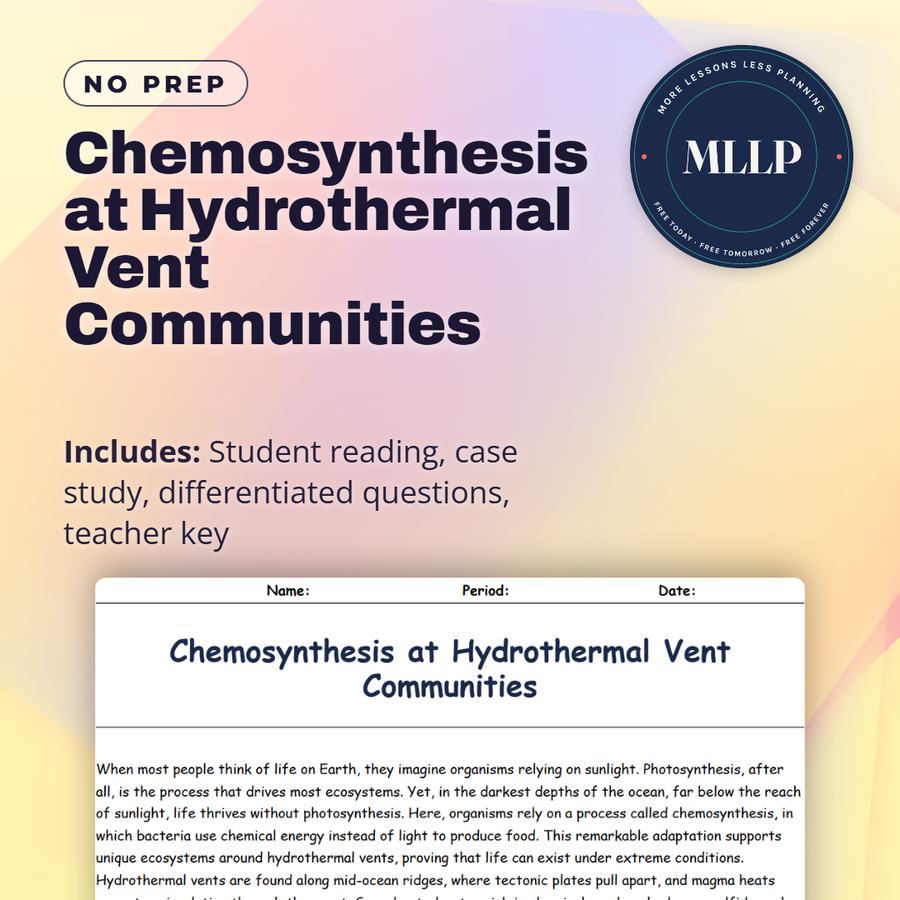
Chemosynthesis at Hydrothermal Vent Communities
Quality reviewed September 2026
Facts verified September 14, 2026
- Subject
- Science
- Grades
- Grades 9-12
- Length
- 6-page student worksheet
- Time
- About one 50-minute class period
- Great for
- Sub plans and independent work
- Includes
- Reading passage, comprehension questions + full answer key
- Format
- Print-and-go PDF
What students do
- Match terms like chemosynthesis, tube worms, Alvin, and the Galápagos Rift to their correct definitions
- Fill in the blank sentences on chemosynthesis, the 1977 vent discovery, and how bacteria feed tube worms
- Answer multiple choice questions on hydrogen sulfide, the trophosome, and why the vent discovery changed science
- Write short answers on the tube worm and bacteria partnership, why vent environments are extreme, and what vents suggest about life beyond Earth
What it covers
- How chemosynthesis lets bacteria produce food from hydrogen sulfide instead of sunlight
- The vent communities built around tube worms, clams, crabs, and fish near mid-ocean ridges
- The 1977 discovery of hydrothermal vents by the submersible Alvin at the Galápagos Rift
Start reading this worksheet
When most people think of life on Earth, they imagine organisms relying on sunlight. Photosynthesis, after all, is the process that drives most ecosystems. Yet, in the darkest depths of the ocean, far below the reach of sunlight, life thrives without photosynthesis. Here, organisms rely on a process called chemosynthesis, in which bacteria use chemical energy instead of light to produce food. This remarkable adaptation supports unique ecosystems around hydrothermal vents, proving that life can exist under extreme conditions. Hydrothermal vents are found along mid-ocean ridges, where tectonic plates pull apart, and magma heats seawater circulating through the crust. Superheated water rich in chemicals such as hydrogen sulfide gushes out of the vents, forming towering “black smokers” and “white smokers.” While these environments are toxic to most forms of life, they provide the foundation for some of the most extraordinary ecosystems on the planet.
The Process of Chemosynthesis
Chemosynthesis mirrors photosynthesis in that both produce organic molecules to sustain life. However, while photosynthesis relies on light energy, chemosynthesis uses chemical energy. In vent ecosystems, bacteria oxidize hydrogen sulfide to obtain energy, which they use to convert carbon dioxide and water into sugars. These sugars then support not only the bacteria themselves but also the larger organisms that live in symbiosis with them. For example, giant tube worms have no mouth or stomach. Instead, they house chemosynthetic bacteria in a special organ called a trophosome. The bacteria provide the worms with nutrition, while the worms supply the bacteria with hydrogen sulfide and oxygen from the surrounding water. This mutualistic relationship exemplifies how life can adapt to extreme environments when conventional food chains are absent.
Vent Communities and Adaptations
The communities around hydrothermal vents are among the most diverse and specialized in the deep sea. Giant tube worms, clams, and mussels rely on symbiotic relationships with chemosynthetic bacteria. Crabs and shrimp graze on bacterial mats, while fish and octopuses prey on smaller animals. Adaptations to this extreme environment are remarkable. Many vent organisms can tolerate high temperatures, fluctuating chemical levels, and immense pressures. Tube worms, for example, grow rapidly, reaching lengths of over two meters in just a few years—an adaptation to the unpredictable lifespan of vent fields, which may go dormant after decades. These communities highlight the resilience and creativity of life in finding ways to survive under conditions that seem uninhabitable.
Like what you read? The full reading, the case study, and every question set are in the free download below, along with the answer key.
Why this matters
In 1977 the submersible Alvin found something that should not have been possible: an entire ecosystem living on the ocean floor near the Galapagos Rift with no sunlight reaching it at all. Bacteria there make food from hydrogen sulfide instead of light, and tube worms depend completely on those same bacteria living inside them to survive.
What keeps the story from feeling like a footnote in ocean history is the last question, which asks what vent chemistry might mean for finding life on icy moons like Europa. Once students accept that food does not require sunlight on Earth, the search for life elsewhere in the solar system stops sounding far-fetched.
From one teacher to another
This worksheet covers how bacteria near hydrothermal vents make food from hydrogen sulfide instead of light. Students read about tube worms and their bacterial partners. The reading also covers the 1977 Alvin expedition that found the first vent ecosystem at the Galápagos Rift. That discovery raised questions about whether similar chemistry could support life on icy moons like Europa.
What you get
Download
Where should I send the next one?
Everything here is free and it stays that way. Leave your email and I'll send you the new lessons as they go up. You can unsubscribe from any one of them.
Related resources
Cyanobacteria and the Breath of Life
Diatoms, Dinoflagellates, and Coccolithophores Explained
Harmful Algal Blooms: Red Tides, Toxins, and Ecological Consequences
Photosynthesis in the Marine Environment
Phytoplankton: The Powerhouse of the Oceans
Plankton and the Global Carbon Cycle
Every lesson on this site is free to download and use. If one of them saved you a prep period, you can chip in a few bucks toward my three kids' daycare fund. That's genuinely where tips go.