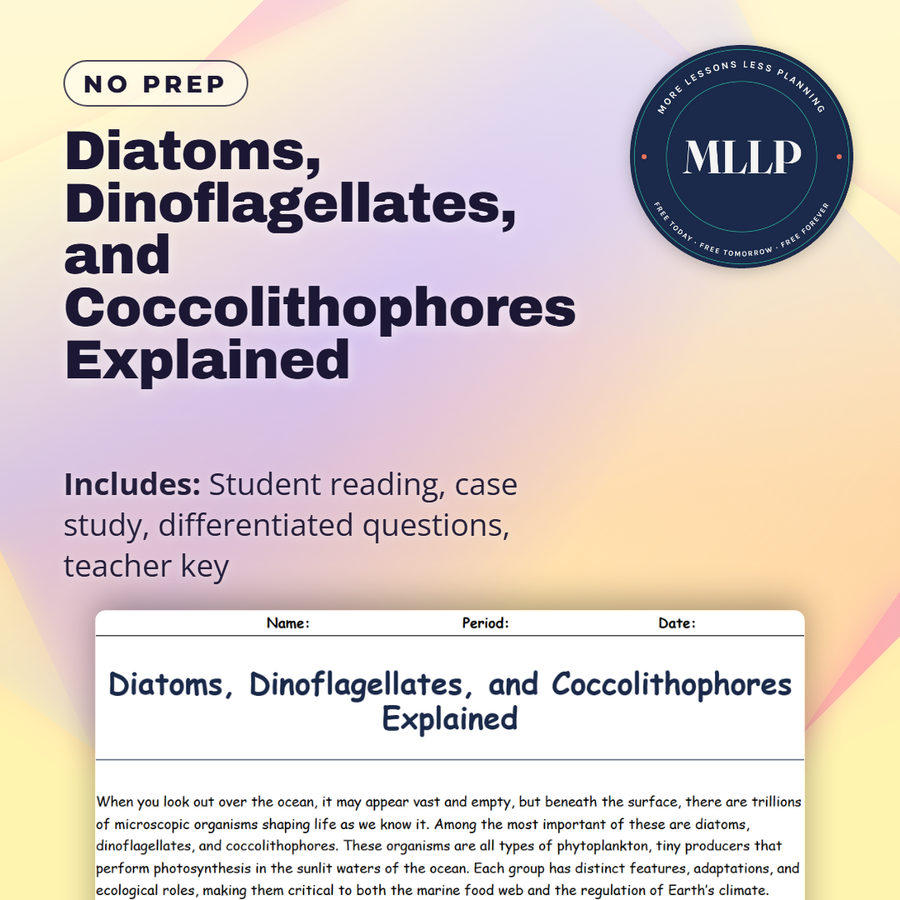
Diatoms, Dinoflagellates, and Coccolithophores Explained
Quality reviewed September 2026
Facts verified September 14, 2026
- Subject
- Science
- Grades
- Grades 9-12
- Length
- 7-page student worksheet
- Time
- About one 50-minute class period
- Great for
- Sub plans and independent work
- Includes
- Reading passage, comprehension questions + full answer key
- Format
- Print-and-go PDF
What students do
- Match terms like diatoms, dinoflagellates, coccolithophores, and sea sparkle to their correct definitions
- Fill in the blank sentences on flagella, calcium carbonate plates, and diatom frustules
- Answer multiple choice questions on diatom carbon storage, red tides, and coccolithophores and ocean acidification
- Write short answers on how coccolithophore blooms affect food webs, how diatoms aid the biological pump, and how dinoflagellates move in the water column
What it covers
- The silica frustules of diatoms and their role in storing carbon in the biological pump
- The mobility and bioluminescence of dinoflagellates, including their link to red tides
- A case study on the 1997 coccolithophore bloom that turned the Bering Sea turquoise
Start reading this worksheet
When you look out over the ocean, it may appear vast and empty, but beneath the surface, there are trillions of microscopic organisms shaping life as we know it. Among the most important of these are diatoms, dinoflagellates, and coccolithophores. These organisms are all types of phytoplankton, tiny producers that perform photosynthesis in the sunlit waters of the ocean. Each group has distinct features, adaptations, and ecological roles, making them critical to both the marine food web and the regulation of Earth’s climate. Though they are invisible to the naked eye, these phytoplankton influence everything from fish populations to atmospheric gases. Their presence or absence can dramatically alter the productivity of entire ecosystems. By studying these organisms closely, scientists have learned that their differences help them occupy unique ecological niches. Together, diatoms, dinoflagellates, and coccolithophores showcase the diversity and adaptability of life in the ocean.
Diatoms: Nature’s Glass Houses
Diatoms are among the most abundant phytoplankton in the world, particularly in colder and nutrient-rich waters. Their most defining characteristic is their silica-based cell walls, called frustules, which resemble glass. These frustules come in a variety of beautiful and intricate shapes, almost like microscopic works of art. Because they are heavy, diatom shells often sink after death, carrying carbon with them to the seafloor. This makes diatoms important players in the biological pump, which helps regulate Earth’s climate by storing carbon in deep-sea sediments. In addition to their ecological role, diatoms are highly efficient at photosynthesis, producing an estimated 20–25% of the world’s oxygen. Their ability to bloom quickly when nutrients are abundant supports huge populations of zooplankton, fish, and larger predators. This rapid growth and high productivity mean that diatoms are often considered the backbone of the marine food web in colder regions such as the North Atlantic and the Southern Ocean. Without them, much of the ocean’s biodiversity would struggle to survive.
Dinoflagellates: The Movers and Shakers
While diatoms drift passively, dinoflagellates are unique because they can move through the water using whip-like structures called flagella. This mobility allows them to adjust their depth in the water column to find light or nutrients. Dinoflagellates are most common in warm, stratified waters where they often thrive under stable conditions. Dinoflagellates are also famous for their diversity of behaviors. Some are photosynthetic, while others are mixotrophic, meaning they can both photosynthesize and consume other organisms for food. A few are bioluminescent, glowing with light when disturbed by waves or swimming fish, creating shimmering displays sometimes called “sea sparkle.” However, dinoflagellates can also cause ecological problems. Certain species form harmful algal blooms, producing toxins that kill fish, shellfish, and even affect human health. These events, often referred to as red tides, disrupt ecosystems and damage coastal economies. Despite their dangerous side, dinoflagellates are crucial in tropical and subtropical waters, fueling marine ecosystems where diatoms are less dominant.
Like what you read? The full reading, the case study, and every question set are in the free download below, along with the answer key.
Why this matters
A single bloom turned the Bering Sea turquoise in 1997, made of three different organisms: glass-shelled diatoms, dinoflagellates that swim and glow, and coccolithophores plated in calcium carbonate. The diatoms alone lock away enough carbon through the biological pump to matter for the planet's carbon cycle.
Before this reading, phytoplankton is one blurry green category to most of my students. Seeing that a coccolithophore bloom can change water color enough to leave zooplankton unable to find food makes each group look like its own organism with its own strategy, not interchangeable pond scum.
From one teacher to another
Three groups of phytoplankton take center stage in this reading: diatoms with their glass-like shells, dinoflagellates that swim and sometimes glow, and coccolithophores with their calcium carbonate plates. The case study looks at the 1997 coccolithophore bloom that colored the Bering Sea turquoise and left zooplankton struggling to find food.
What you get
Download
Where should I send the next one?
Everything here is free and it stays that way. Leave your email and I'll send you the new lessons as they go up. You can unsubscribe from any one of them.
Related resources
Chemosynthesis at Hydrothermal Vent Communities
Cyanobacteria and the Breath of Life
Harmful Algal Blooms: Red Tides, Toxins, and Ecological Consequences
Photosynthesis in the Marine Environment
Phytoplankton: The Powerhouse of the Oceans
Plankton and the Global Carbon Cycle
Every lesson on this site is free to download and use. If one of them saved you a prep period, you can chip in a few bucks toward my three kids' daycare fund. That's genuinely where tips go.