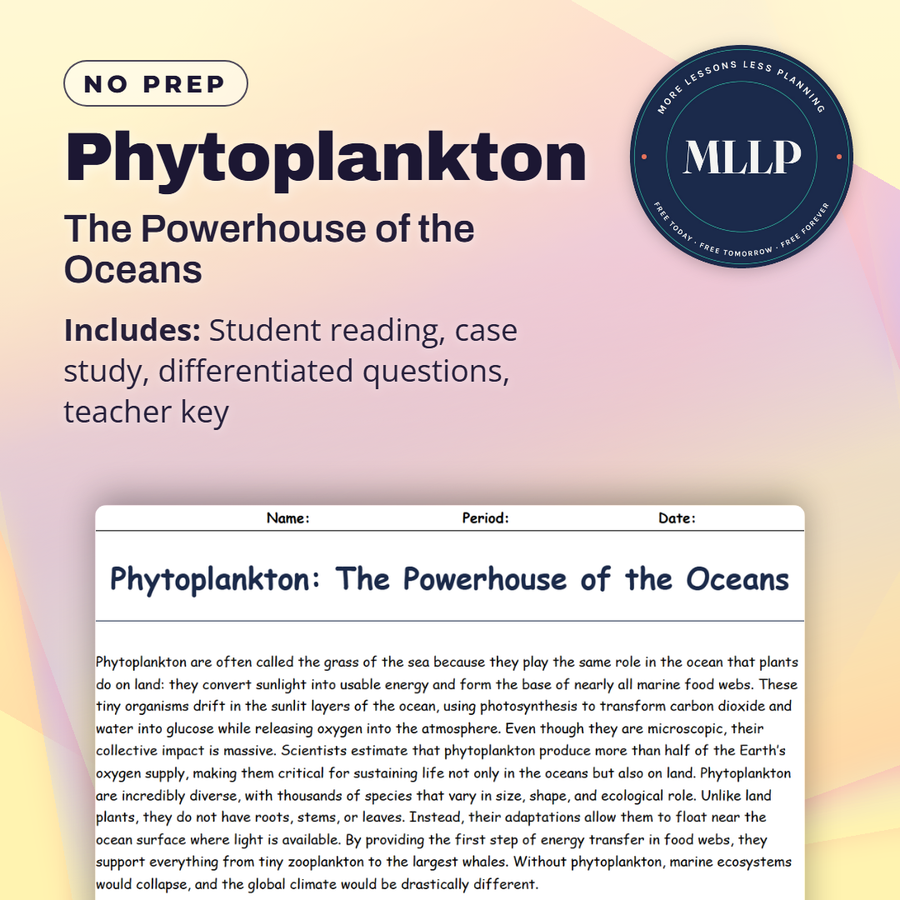
Phytoplankton: The Powerhouse of the Oceans
Quality reviewed September 2026
Facts verified September 14, 2026
- Subject
- Science
- Grades
- Grades 9-12
- Length
- 7-page student worksheet
- Time
- About one 50-minute class period
- Great for
- Sub plans and independent work
- Includes
- Reading passage, comprehension questions + full answer key
- Format
- Print-and-go PDF
What students do
- Match terms like dinoflagellates, coccolithophores, diatoms, and zooplankton to their correct definitions
- Fill in the blank sentences describing phytoplankton as the grass of the sea, the North Atlantic bloom, and greenhouse gases
- Answer multiple choice questions on the share of oxygen phytoplankton produce, diatom shells, and the biological pump
- Write short answers on why phytoplankton anchor the food web, how diatoms differ from coccolithophores, and why scientists track them by satellite
What it covers
- Why phytoplankton are called the grass of the sea and how they anchor marine food webs
- The distinct traits of diatoms, dinoflagellates, and coccolithophores
- A case study on the North Atlantic spring bloom and its role in carbon cycling
Start reading this worksheet
Phytoplankton are often called the grass of the sea because they play the same role in the ocean that plants do on land: they convert sunlight into usable energy and form the base of nearly all marine food webs. These tiny organisms drift in the sunlit layers of the ocean, using photosynthesis to transform carbon dioxide and water into glucose while releasing oxygen into the atmosphere. Even though they are microscopic, their collective impact is massive. Scientists estimate that phytoplankton produce more than half of the Earth’s oxygen supply, making them critical for sustaining life not only in the oceans but also on land. Phytoplankton are incredibly diverse, with thousands of species that vary in size, shape, and ecological role. Unlike land plants, they do not have roots, stems, or leaves. Instead, their adaptations allow them to float near the ocean surface where light is available. By providing the first step of energy transfer in food webs, they support everything from tiny zooplankton to the largest whales. Without phytoplankton, marine ecosystems would collapse, and the global climate would be drastically different.
Types of Phytoplankton
Phytoplankton can be classified into several groups, each with distinct features and ecological importance. Diatoms are among the most abundant; they have intricate silica shells called frustules that resemble glass. These shells sink to the seafloor after the diatoms die, contributing to marine sediments. Dinoflagellates are another key group, recognizable by their whip-like flagella that allow them to move through the water. Some species are bioluminescent, glowing when disturbed, while others cause harmful algal blooms. Coccolithophores are covered with tiny calcium carbonate plates that reflect light, sometimes making the ocean appear turquoise during massive blooms. Each group plays a unique role in marine environments. Diatoms dominate in nutrient-rich waters, especially in colder regions, while dinoflagellates thrive in warmer, stratified waters. Coccolithophores contribute significantly to the global carbon cycle because their calcium plates sink and lock carbon away in sediments. These differences highlight how phytoplankton species adapt to regional conditions and together regulate ocean productivity.
Phytoplankton and the Food Web
The importance of phytoplankton extends beyond their role as producers. They serve as the primary food source for zooplankton, which in turn feed small fish, crustaceans, and eventually larger predators like tuna, sharks, and whales. In this way, phytoplankton indirectly support commercial fisheries that humans depend on for food. Their abundance or decline directly affects the health of marine populations, making them an important indicator of ecosystem stability. Phytoplankton are also sensitive to environmental changes such as nutrient availability, temperature shifts, and light conditions. When nutrients like nitrogen and phosphorus enter the water from upwelling or river runoff, phytoplankton populations can explode in growth, forming massive blooms. While these blooms often provide food for zooplankton and fish, excessive growth can sometimes lead to harmful algal blooms. The balance between phytoplankton growth and consumption is therefore central to ocean ecology.
Like what you read? The full reading, the case study, and every question set are in the free download below, along with the answer key.
Why this matters
The North Atlantic spring bloom is large enough to see from space, a single seasonal event where phytoplankton multiply fast enough to feed copepods and fish like herring and mackerel. Calling phytoplankton the grass of the sea only makes sense once students see a bloom operating at that scale.
A single-celled organism rarely feels connected to something as large as the planet's oxygen supply, so comparing diatoms, dinoflagellates, and coccolithophores gives that connection actual detail instead of a vague line about tiny plants mattering.
From one teacher to another
Phytoplankton anchor this reading, covering their role as the ocean's primary producers and the different groups that make up the community. The case study follows the North Atlantic spring bloom, a massive seasonal event visible from space that feeds copepods and fish like herring and mackerel. It links a single bloom to global carbon storage.
What you get
Download
Where should I send the next one?
Everything here is free and it stays that way. Leave your email and I'll send you the new lessons as they go up. You can unsubscribe from any one of them.
Related resources
Chemosynthesis at Hydrothermal Vent Communities
Cyanobacteria and the Breath of Life
Diatoms, Dinoflagellates, and Coccolithophores Explained
Harmful Algal Blooms: Red Tides, Toxins, and Ecological Consequences
Photosynthesis in the Marine Environment
Plankton and the Global Carbon Cycle
Every lesson on this site is free to download and use. If one of them saved you a prep period, you can chip in a few bucks toward my three kids' daycare fund. That's genuinely where tips go.