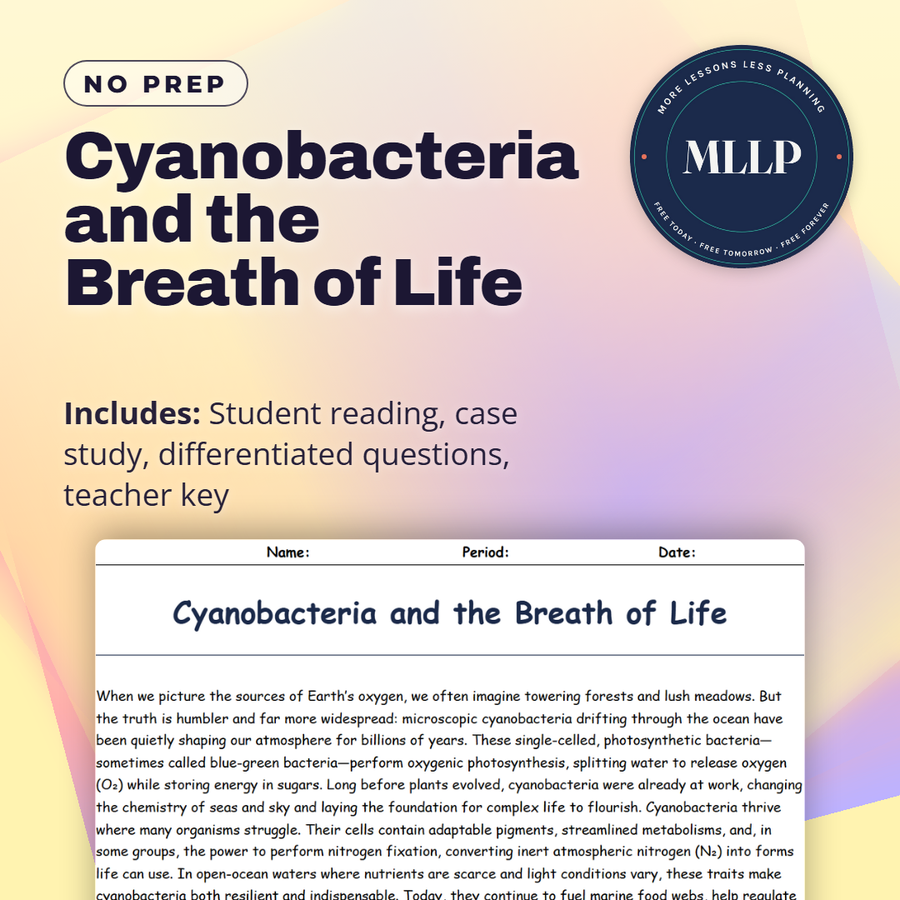
Cyanobacteria and the Breath of Life
Quality reviewed September 2026
Facts verified September 14, 2026
- Subject
- Science
- Grades
- Grades 9-12
- Length
- 8-page student worksheet
- Time
- About one 50-minute class period
- Great for
- Sub plans and independent work
- Includes
- Reading passage, comprehension questions + full answer key
- Format
- Print-and-go PDF
What students do
- Match terms like the Great Oxidation Event, Prochlorococcus, Trichodesmium, and phycobilins to their correct definitions
- Fill in the blank sentences on nitrogen fixation, heterocysts, and the photic zone
- Answer multiple choice questions on the Great Oxidation Event, Prochlorococcus, and light-capturing pigments
- Write short answers on nitrogen fixation in nutrient-poor waters, low-light adaptations, and the risks of harmful blooms
What it covers
- How cyanobacteria produce oxygen through photosynthesis and drove the Great Oxidation Event
- The roles of Prochlorococcus, Synechococcus, and Trichodesmium in the modern ocean
- A case study on a Trichodesmium bloom fixing nitrogen in the subtropical Atlantic
Start reading this worksheet
When we picture the sources of Earth’s oxygen, we often imagine towering forests and lush meadows. But the truth is humbler and far more widespread: microscopic cyanobacteria drifting through the ocean have been quietly shaping our atmosphere for billions of years. These single-celled, photosynthetic bacteria (sometimes called blue-green bacteria) perform oxygenic photosynthesis, splitting water to release oxygen (O₂) while storing energy in sugars. Long before plants evolved, cyanobacteria were already at work, changing the chemistry of seas and sky and laying the foundation for complex life to flourish. Cyanobacteria thrive where many organisms struggle. Their cells contain adaptable pigments, streamlined metabolisms, and, in some groups, the power to perform nitrogen fixation, converting inert atmospheric nitrogen (N₂) into forms life can use. In open-ocean waters where nutrients are scarce and light conditions vary, these traits make cyanobacteria both resilient and indispensable. Today, they continue to fuel marine food webs, help regulate climate, and support fisheries and coastal communities, often without any fanfare at all.
From Anoxic Skies to an Oxygenated World
Roughly 2.4 billion years ago, the planet’s atmosphere held almost no free oxygen. Then came a planetary turning point: the Great Oxidation Event (GOE). Over countless generations, cyanobacteria released O₂ as a byproduct of photosynthesis. At first, that oxygen reacted with dissolved iron in the oceans, precipitating vast banded iron formations we still mine today. Eventually, oxygen accumulated in the atmosphere, transforming Earth’s red, oxygen-poor world into the blue planet we recognize. This oxygenation didn’t simply make breathing possible. It enabled aerobic respiration, a far more efficient way to harvest energy from food, and it set the stage for the evolution of eukaryotes and, much later, plants and animals. The GOE also strengthened the ozone layer, shielding surface life from harmful ultraviolet radiation. In short, cyanobacteria didn’t just “add oxygen”: they rewired Earth’s biogeochemistry, opening evolutionary pathways that led, ultimately, to us.
How Cyanobacteria Power Today’s Oceans
Although their ancient legacy is dramatic, cyanobacteria remain vital in modern seas. Marine genera such as Prochlorococcus and Synechococcus dominate the sunlit photic zone across enormous swaths of the open ocean. Tiny Prochlorococcus cells, among the smallest known photosynthetic organisms, are astonishingly abundant; their collective photosynthesis supports a significant share of global oxygen production and primary productivity in nutrient-poor, oligotrophic waters. Trichodesmium, a filamentous cyanobacterium often called “sea sawdust,” performs nitrogen fixation in warm, clear seas. It injects new, bioavailable nitrogen into surface waters and jump-starts productivity where nitrate is scarce. These microbes don’t act in isolation. As cyanobacteria fix carbon through photosynthesis, they feed zooplankton and support higher trophic levels, while their dissolved organic carbon fuels the microbial loop, where bacteria and protists recycle nutrients. Some cyanobacteria form harmful blooms under nutrient-rich, warm conditions, producing toxins or fueling oxygen-depleting decay. Managing runoff and warming is therefore essential to keep the balance, maximizing cyanobacteria’s benefits while minimizing risks.
Like what you read? The full reading, the case study, and every question set are in the free download below, along with the answer key.
Why this matters
Billions of years ago, cyanobacteria were already filling the atmosphere with oxygen through photosynthesis. The Great Oxidation Event permanently changed Earth's atmosphere, and the same basic chemistry still runs today in cells as small as Prochlorococcus.
My students usually picture the ocean's smallest organisms as background scenery, not as the reason there is breathable air at all. Following a real Trichodesmium bloom fixing nitrogen in the nutrient-poor Atlantic connects an event from deep time to something happening in the ocean this week.
From one teacher to another
This worksheet follows cyanobacteria from the Great Oxidation Event billions of years ago to the tiny Prochlorococcus cells drifting through the modern ocean. The case study follows a research team tracking a Trichodesmium bloom that adds new nitrogen to nutrient-poor Atlantic water.
What you get
Download
Where should I send the next one?
Everything here is free and it stays that way. Leave your email and I'll send you the new lessons as they go up. You can unsubscribe from any one of them.
Related resources
Chemosynthesis at Hydrothermal Vent Communities
Diatoms, Dinoflagellates, and Coccolithophores Explained
Harmful Algal Blooms: Red Tides, Toxins, and Ecological Consequences
Photosynthesis in the Marine Environment
Phytoplankton: The Powerhouse of the Oceans
Plankton and the Global Carbon Cycle
Every lesson on this site is free to download and use. If one of them saved you a prep period, you can chip in a few bucks toward my three kids' daycare fund. That's genuinely where tips go.