Ziggurats and Sumerian Cities
Quality reviewed September 2026
- Subject
- World History
- Grades
- Grades 9-12
- Time
- About two 50-minute class periods
- Includes
- 11 ready-to-teach files
- Format
- Word (.docx) · PowerPoint (.pptx)
- Slide deck
- Guided notes
- Guided notes teacher key
- Activity + answer key
- Quiz + answer key
- Exit ticket + answer key
- Teacher guide
- Teacher presentation notes
What students do
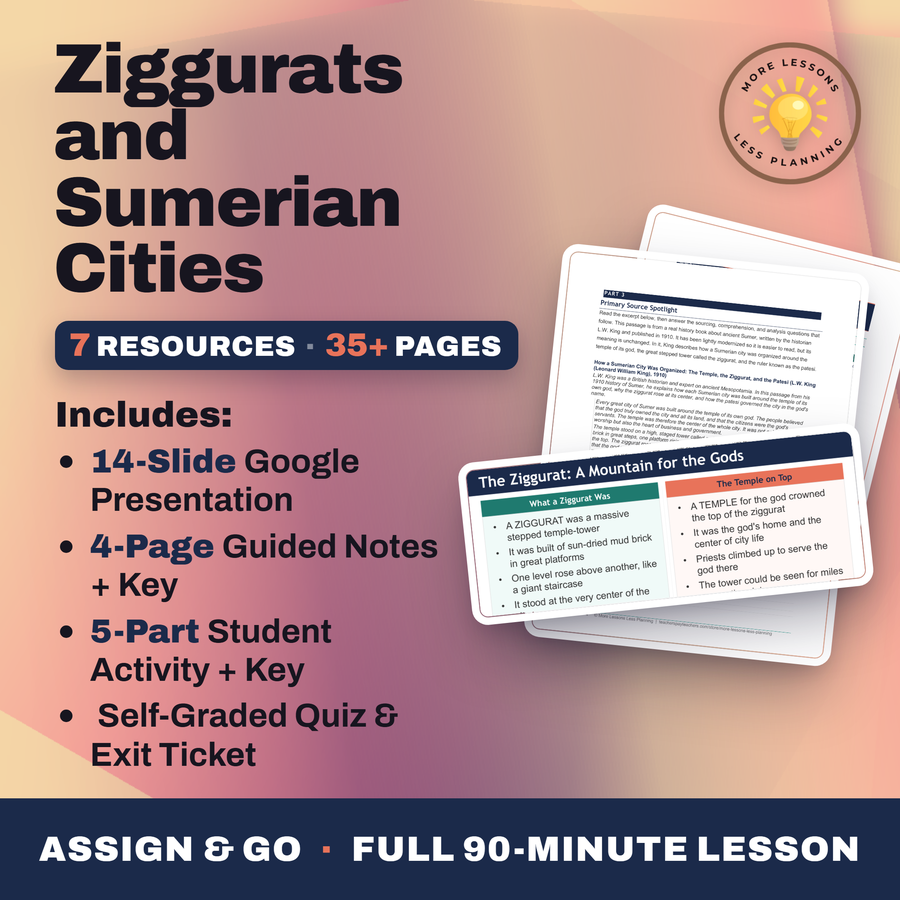
- Explain what a city-state was and why Sumer was made of many, not one unified country
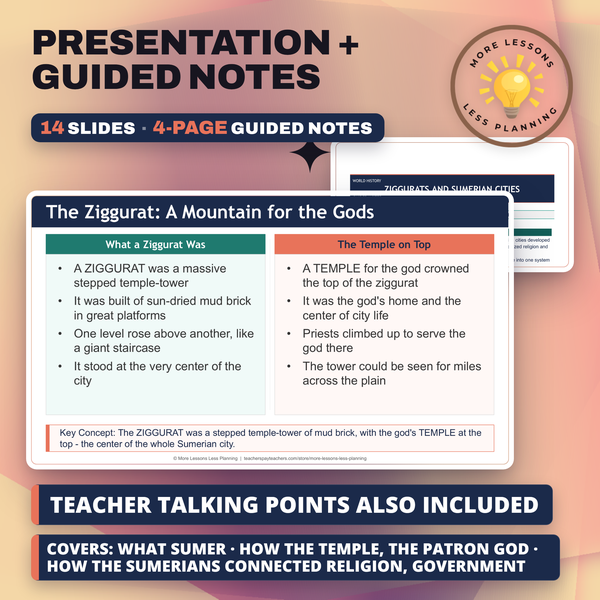
- Describe the ziggurat's stepped mud-brick platforms and the temple that crowned the top
- Trace how a patesi ruled as a patron god's steward while priests managed the temple's land and grain
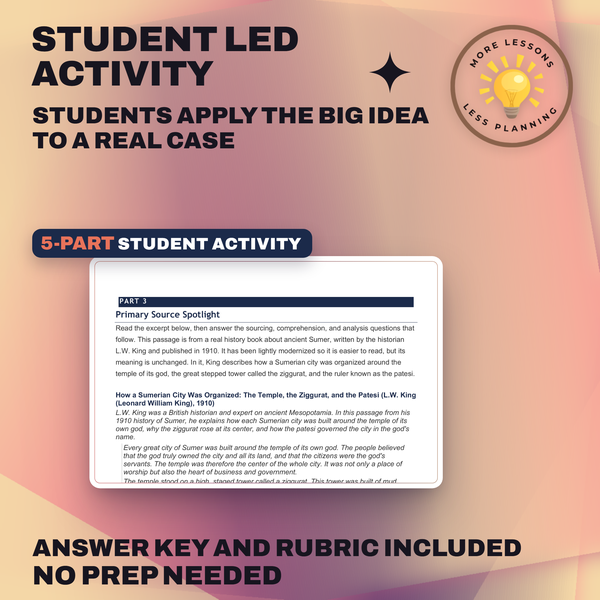
- Read L.W. King's 1910 account of a Sumerian temple and connect it to how irrigation and cuneiform kept a city running
What it covers
- The ziggurat's stepped mud-brick platforms and the temple that crowned its top
- The patesi's dual role as priest and prince, ruling in the patron god's name
- Irrigation, food surplus, and the specialization of labor that built Sumerian cities
- Cuneiform's origin as an accounting tool for grain, land, and taxes, not literature
Learning targets
- Explain what Sumer, a city-state, and a ziggurat were and where Sumerian cities developed
- Describe how the temple, the patron god, the patesi, and the priests organized religion and government in a Sumerian city-state
- Analyze how the Sumerians connected religion, government, and urban life into one system centered on the temple
Peek inside
Where Sumer Was
SUMER was the region of southern MESOPOTAMIA
It lay between the Tigris and Euphrates rivers
Rich river mud made farming possible here
By about 3500 BCE it held the world's first cities
Where the First Cities Grew
was the region of southern Mesopotamia where the world's first cities and civilization developed.
, the land between the Tigris and Euphrates rivers, is where Sumer and its cities were located.
1. Who wrote this description of Sumerian cities, and in what year was it published? Using the note above, state what kind of source this is - an ancient Sumerian document written by the Sumerians themselves, or a modern historian describing ancient Sumer.
Why this matters
A patesi in Sumer ruled as the steward of a god believed to literally own the city's land, not as an independent king in his own right. Taxes, grain, and canal labor were all handled as service to that temple, the actual center of both religious and political power in the city.
That claim is one I want students checking against L.W. King's own 1910 account of a Sumerian temple, not taking a textbook's word for it. Tracing cuneiform back to an accounting tool for grain and taxes, not literature, also resets what they assume writing was invented to do in the first place.
From one teacher to another
I ask students where religion, government, and their own jobs would go if their town ran on one single institution, and then I show them Sumer, where the answer was the temple. Every city-state had its own patron god who was believed to actually own the land, a patesi who ruled as that god's steward rather than for himself, and priests who ran the grain stores and canal crews like a combination bank and city hall. They trace the chain that made it all possible - irrigation producing a surplus, the surplus freeing people to become potters and scribes instead of farmers, and cuneiform emerging first as an accounting tool, not literature. Students finish by reading L.W. King's 1910 account of a Sumerian temple and using it to explain why religion and government weren't separate systems in Sumer at all.
Every file in this toolkit
Download
Where should I send the next one?
Everything here is free and it stays that way. Leave your email and I'll send you the new lessons as they go up. You can unsubscribe from any one of them.
Related resources
Cuneiform The First Writing
Hieroglyphics and the Rosetta Stone
Oracle Bones and Early Chinese Writing
Pyramids and Pharaohs
The Art of Mummification
The Code of Hammurabi
Every lesson on this site is free to download and use. If one of them saved you a prep period, you can chip in a few bucks toward my three kids' daycare fund. That's genuinely where tips go.