

The Code of Hammurabi
Quality reviewed September 2026
- Subject
- World History
- Grades
- Grades 9-12
- Time
- About two 50-minute class periods
- Includes
- 11 ready-to-teach files
- Format
- Word (.docx) · PowerPoint (.pptx)
- Slide deck
- Guided notes
- Guided notes teacher key
- Activity + answer key
- Quiz + answer key
- Exit ticket + answer key
- Teacher guide
- Teacher presentation notes
What students do
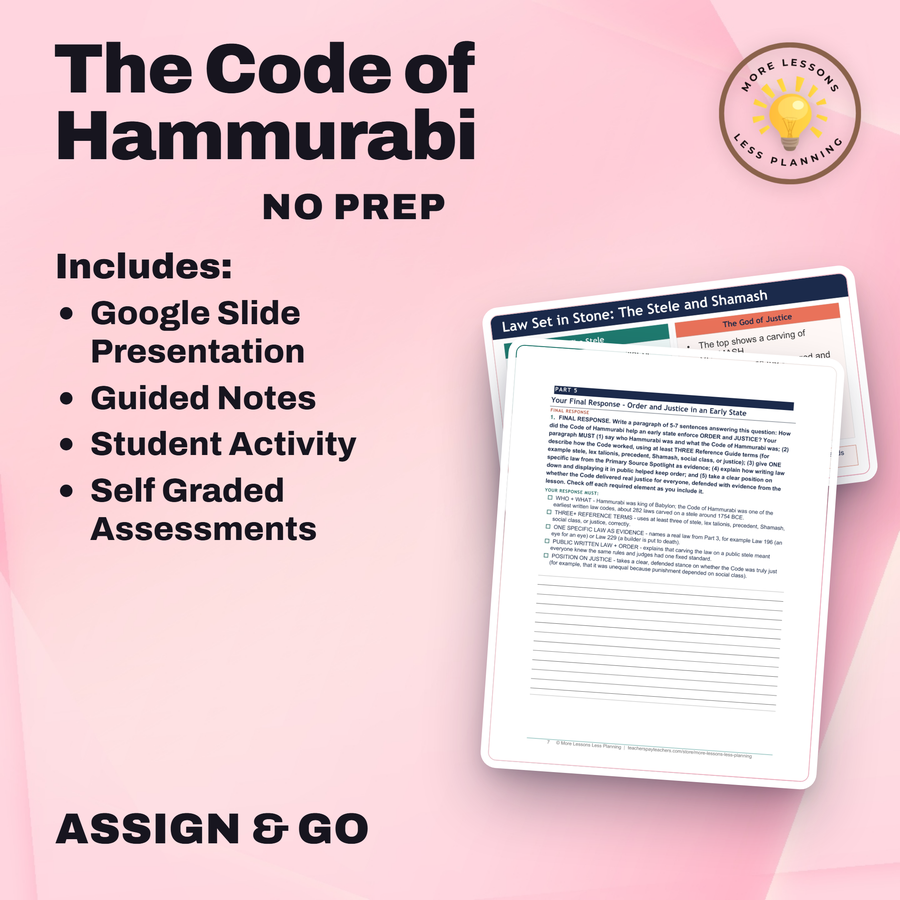
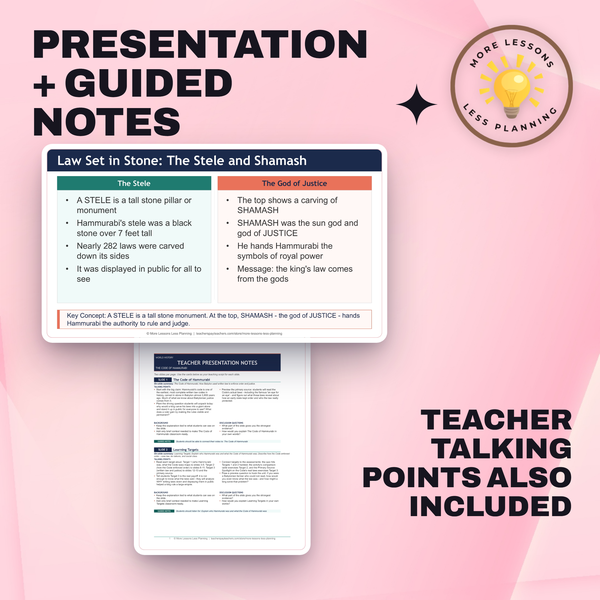
- Explain who Hammurabi was and how the Code was carved on a public stele under the god Shamash
- Define lex talionis and identify it in real laws from the Code
- Read real laws from L.W. King's 1915 translation and explain how punishments changed depending on the victim's social class
- Argue why displaying written law in public helped Hammurabi hold his empire together
What it covers
- How the Code of Hammurabi used "if...then" case law and lex talionis, "an eye for an eye," to set punishments
- How the Code treated Babylon's social classes differently, using real laws about injury and property
- Core vocabulary: stele, Hammurabi, Shamash, lex talionis, precedent, social class, Mesopotamia
- Real laws from the Code of Hammurabi in L.W. King's 1915 English translation, including laws on theft, injury, and property
Learning targets
- Explain who Hammurabi was and what the Code of Hammurabi was - one of the earliest written law codes, carved on a stone stele in Babylon around 1754 BCE
- Describe how the Code organized Babylonian society and enforced order, including case law, lex talionis ('an eye for an eye'), and different treatment by social class
- Analyze how a written, publicly displayed law code helped an early state create order, justice, and royal authority
Peek inside
The King
HAMMURABI was the king of BABYLON
He reigned about 1792 to 1750 BCE
A skilled war leader and organizer
He issued history's most famous early law code
The King and His World
was the king of Babylon who reigned about 1792 to 1750 BCE.
was the city-state in Mesopotamia that Hammurabi ruled and made his capital.
was the land between the rivers - the Tigris and the Euphrates - where Babylon rose and the world's first cities and empires developed.
1. Who created these laws, and when and where were they written down? Use the author line, the date, and the citation above. Also state how we know their wording today.
Why this matters
Lex talionis, an eye for an eye, sounds like a simple rule until real numbered laws from the Code show it applied differently depending on whether the injured party was a free person, a commoner, or an enslaved person. The punishment for the same injury moved with the victim's social rank, not with the act itself.
Carving close to 300 of those laws onto a public stele under the god Shamash was itself a political act, a way for Hammurabi to hold a large empire together through one shared, visible standard everyone could check for themselves. Students tend to read the stele as a list of punishments until they ask who it was built to persuade.
From one teacher to another
I built this one around the actual laws, not a summary of them. Students read real numbered laws from L.W. King's 1915 translation - the eye-for-an-eye punishments, the penalty for a builder whose house collapses and kills its owner - and work out for themselves how the punishment shifts depending on whether the victim is a free person, a commoner, or an enslaved person. That's the move I wanted: instead of being told Babylonian law was unequal, students find the inequality themselves in the primary source. The lesson also covers why Hammurabi bothered carving nearly 300 laws onto a public stone stele under the sun god Shamash, and the argument ties back to how early states used written, displayed law to project authority. It's a strong pair with any lesson on early river valley government since it gives students a concrete legal document instead of an abstract description of "law codes."
Every file in this toolkit
Download
Where should I send the next one?
Everything here is free and it stays that way. Leave your email and I'll send you the new lessons as they go up. You can unsubscribe from any one of them.
Related resources

Cuneiform The First Writing
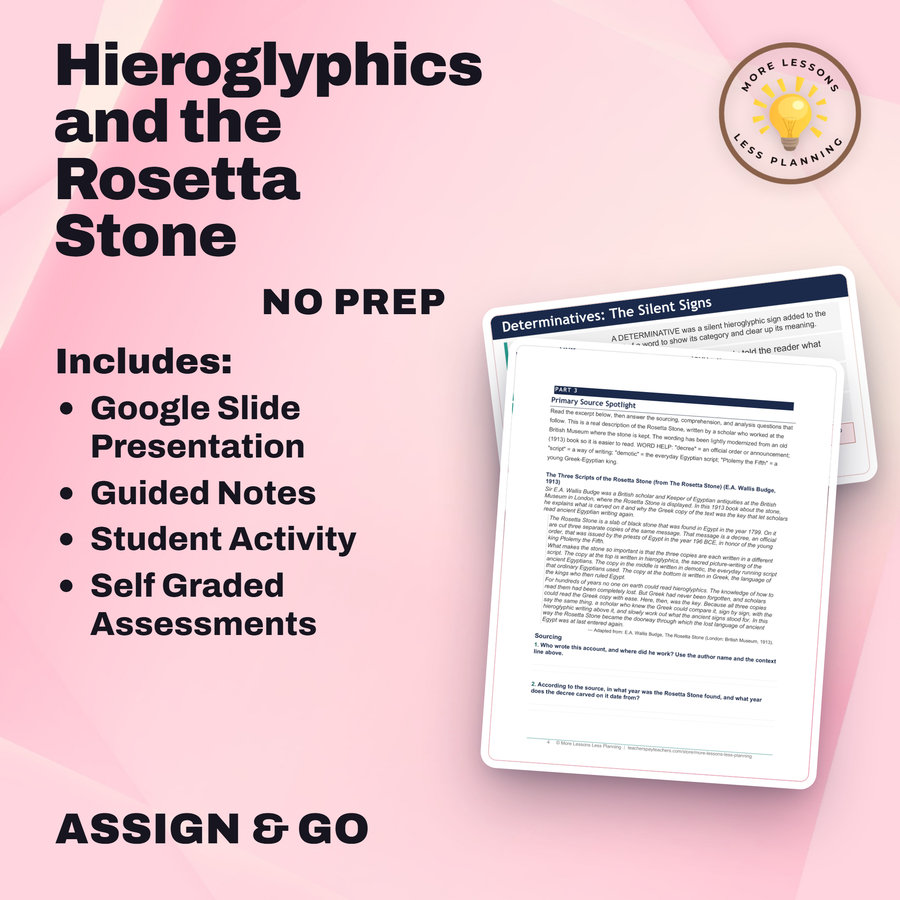
Hieroglyphics and the Rosetta Stone

Oracle Bones and Early Chinese Writing
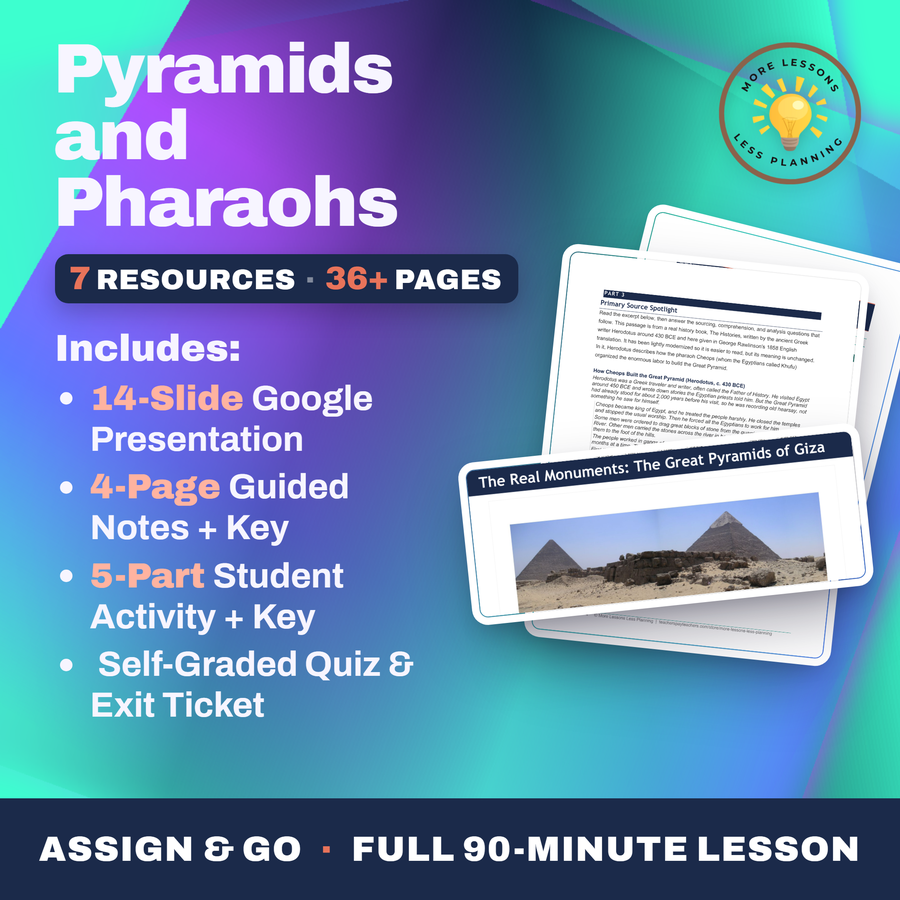
Pyramids and Pharaohs
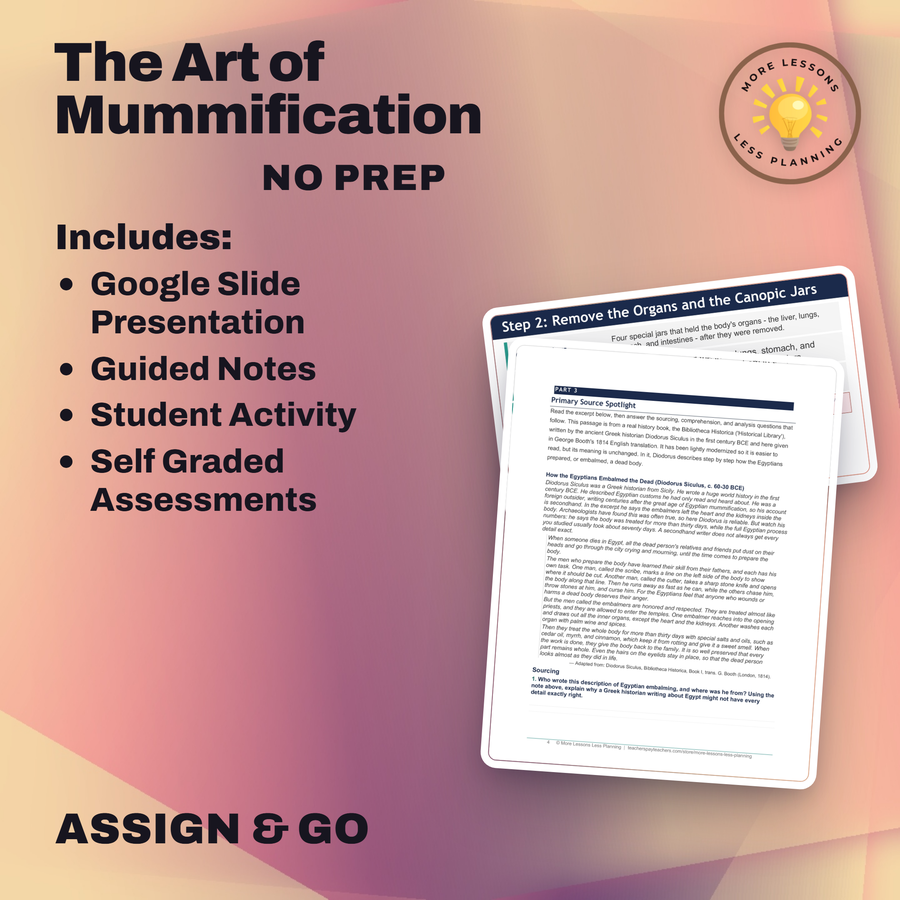
The Art of Mummification

The Epic of Gilgamesh
Every lesson on this site is free to download and use. If one of them saved you a prep period, you can chip in a few bucks toward my three kids' daycare fund. That's genuinely where tips go.