Oracle Bones and Early Chinese Writing
Quality reviewed September 2026
- Subject
- World History
- Grades
- Grades 9-12
- Time
- About two 50-minute class periods
- Includes
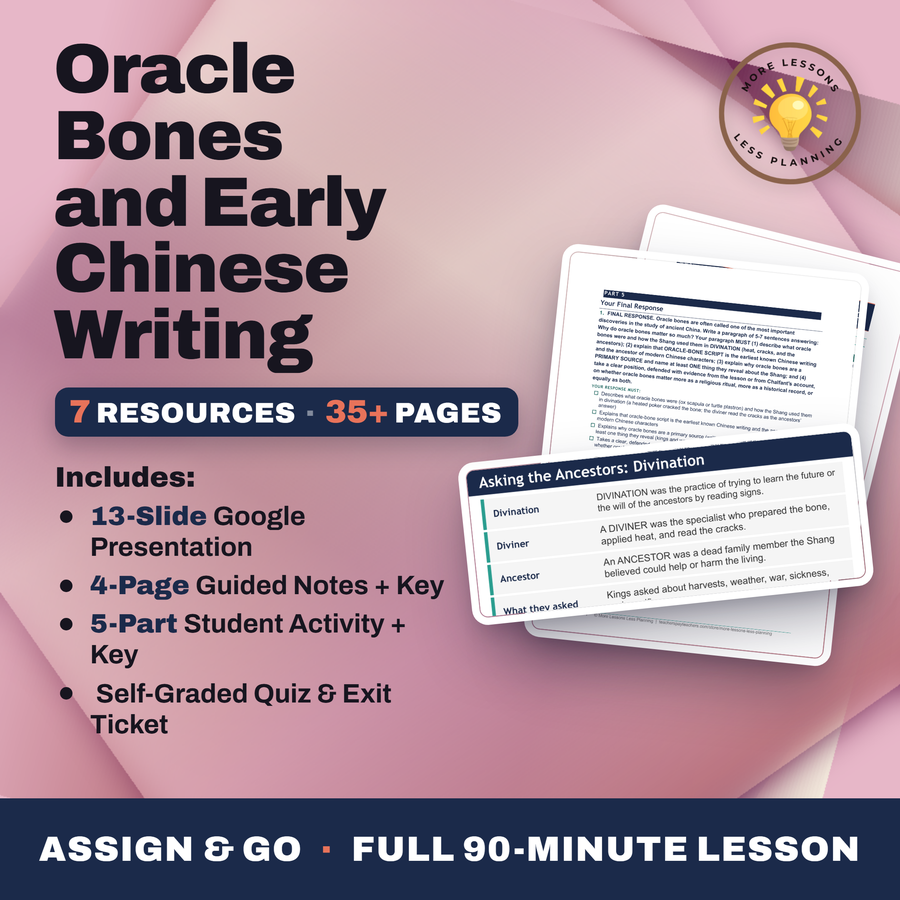
- 11 ready-to-teach files
- Format
- Word (.docx) · PowerPoint (.pptx)
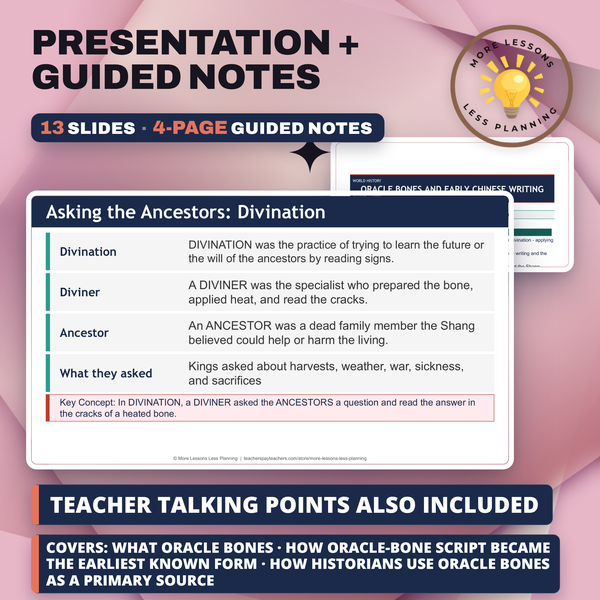
- Slide deck
- Guided notes
- Guided notes teacher key
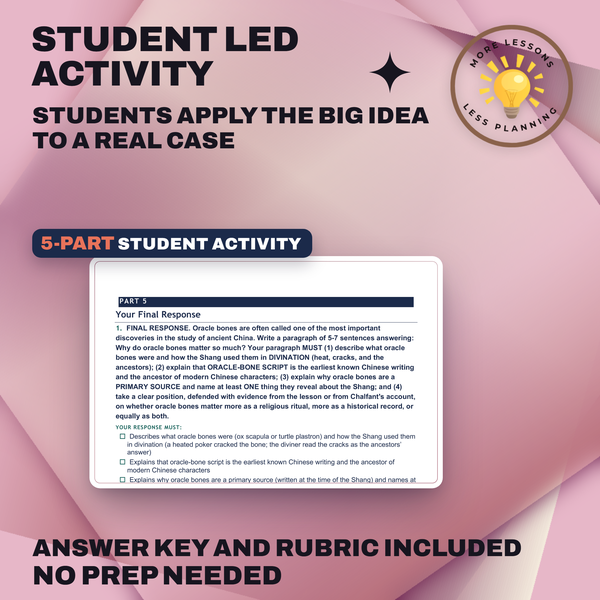
- Activity + answer key
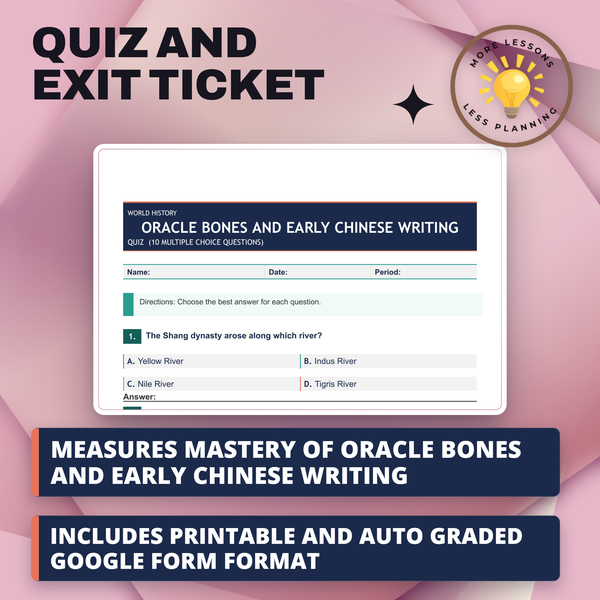
- Quiz + answer key
- Exit ticket + answer key
- Teacher guide
- Teacher presentation notes
What students do
- Explain how Shang diviners applied heat to turtle plastrons and ox scapulae and read the resulting cracks
- Distinguish oracle-bone script as the earliest known form of Chinese writing from the divination practice itself
- Read an excerpt of Frank H. Chalfant's 1906 study and identify what oracle-bone inscriptions do and don't tell us
- Compare what oracle bones reveal about the Shang dynasty with what remains uncertain in the historical record
What it covers
- How Shang diviners prepared, heated, and read cracks on turtle plastrons and ox scapulae to consult the ancestors
- Oracle-bone script as the earliest known form of Chinese writing, carved directly onto the bones
- Core vocabulary: divination, diviner, inscription, ox scapula, turtle plastron, Shang Dynasty, Yellow River
- Frank H. Chalfant's 1906 study of oracle-bone writing as a primary source on how this evidence was first studied
Learning targets
- Describe what oracle bones were and how Shang diviners used them for divination - applying heat, reading the cracks, and inscribing the results
- Explain how oracle-bone script became the earliest known form of Chinese writing and the ancestor of modern Chinese characters
- Analyze how historians use oracle bones as a primary source to learn about the Shang dynasty
Peek inside
China’s First Writing Dynasty
DYNASTY was an early Chinese dynasty that ruled from about 1600 to 1046 BCE.
RIVER, in northern China, is the valley where the Shang dynasty arose.
records were the first in Chinese history, which the Shang left behind.
1. Who wrote this account, in what year was it published, and what made him qualified to describe oracle bones? Use the author name and the context line above.
Why this matters
Modern Chinese characters trace back to marks scratched onto turtle shells and ox bones by diviners trying to predict the future: a writing system born from fortune-telling that is still in daily use today. Scripts this old are usually dead languages nobody speaks anymore.
Frank Chalfant's 1906 study gives students a scholar working through the same cracked bones a century before they did, and comparing his conclusions to the lesson's own vocabulary of divination and inscription shows how a field can start from almost nothing and still build real, testable knowledge.
From one teacher to another
I built this one around a writing system that most students have never heard of, even though it's the direct ancestor of modern Chinese characters. The lesson walks through what a Shang diviner actually did: heat a turtle shell or an ox's shoulder blade, read the pattern of cracks that appeared, then carve the question and sometimes the answer right onto the bone. Students learn the vocabulary of divination and inscription, then move into a real source - Frank H. Chalfant's 1906 study of oracle-bone writing - and work through a compare/contrast piece on what these bones can and can't tell historians about the Shang dynasty along the Yellow River. It's a good fit next to any river valley civilization unit because it gives students a second, very different writing system to set beside cuneiform or hieroglyphics, and it keeps the "how do we know what we know" thread going from earlier lessons.
Every file in this toolkit
Download
Where should I send the next one?
Everything here is free and it stays that way. Leave your email and I'll send you the new lessons as they go up. You can unsubscribe from any one of them.
Related resources
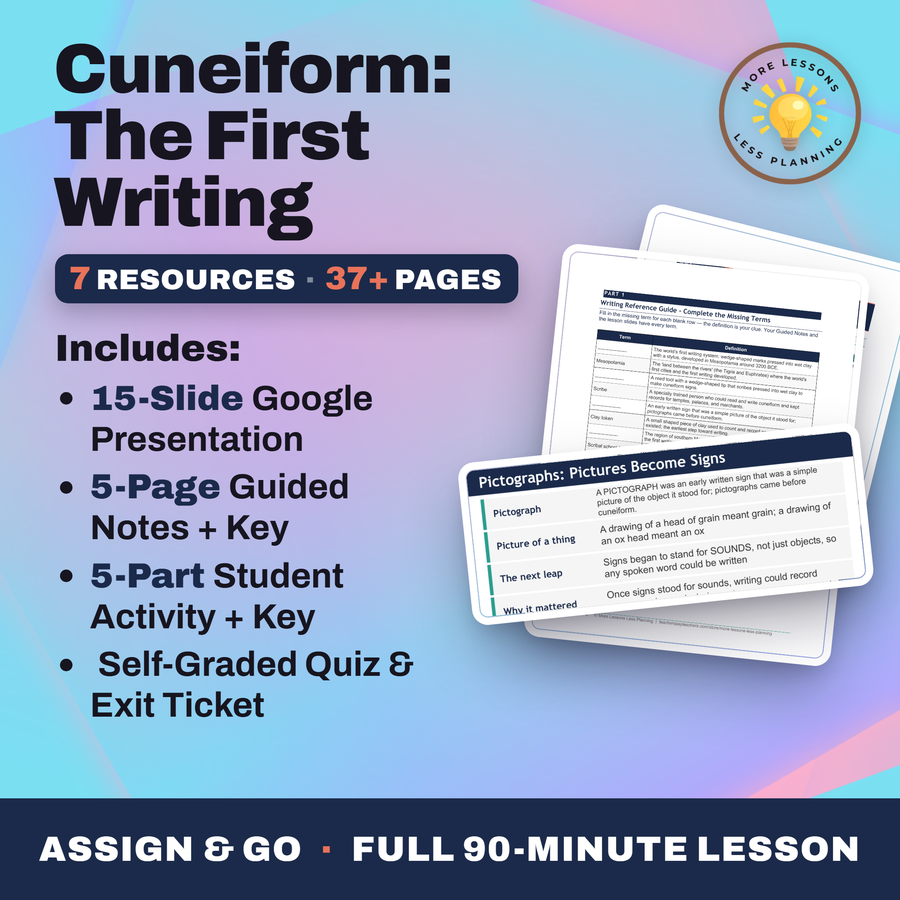
Cuneiform The First Writing
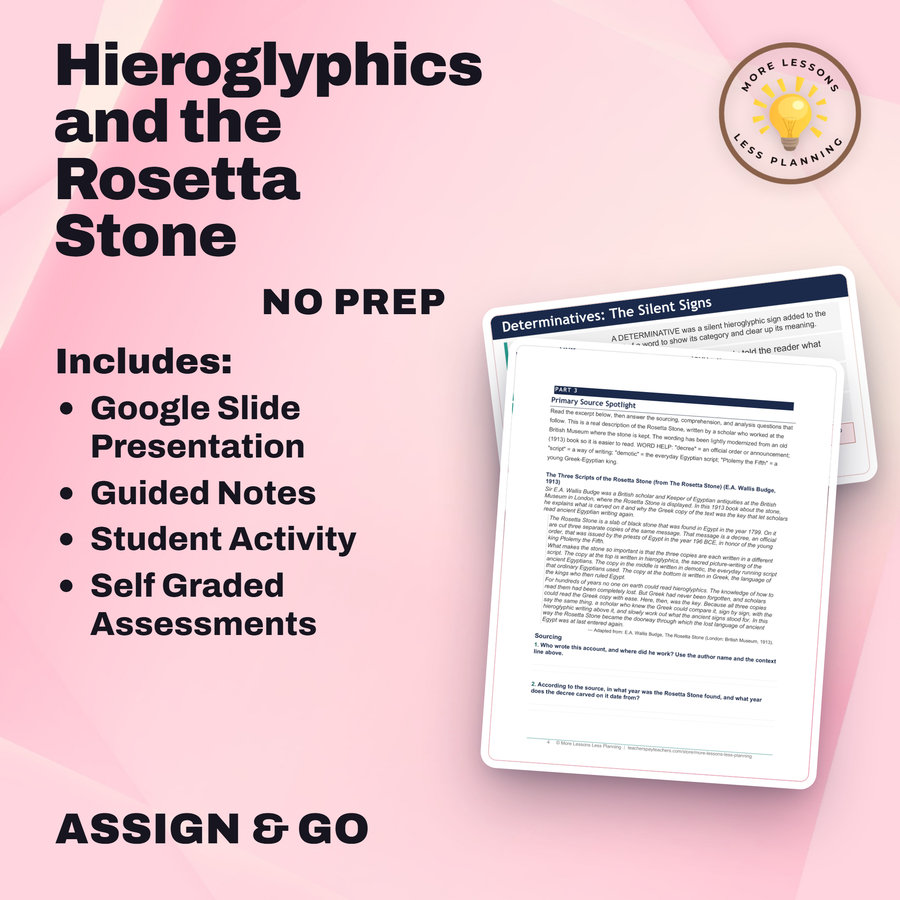
Hieroglyphics and the Rosetta Stone
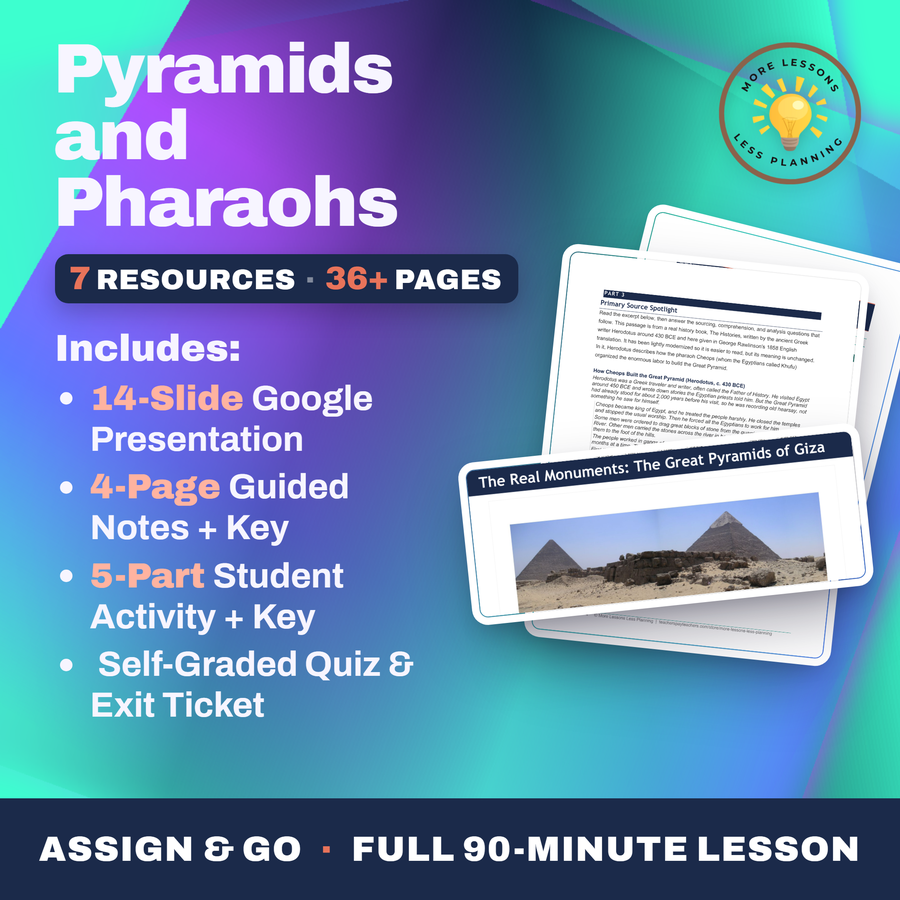
Pyramids and Pharaohs
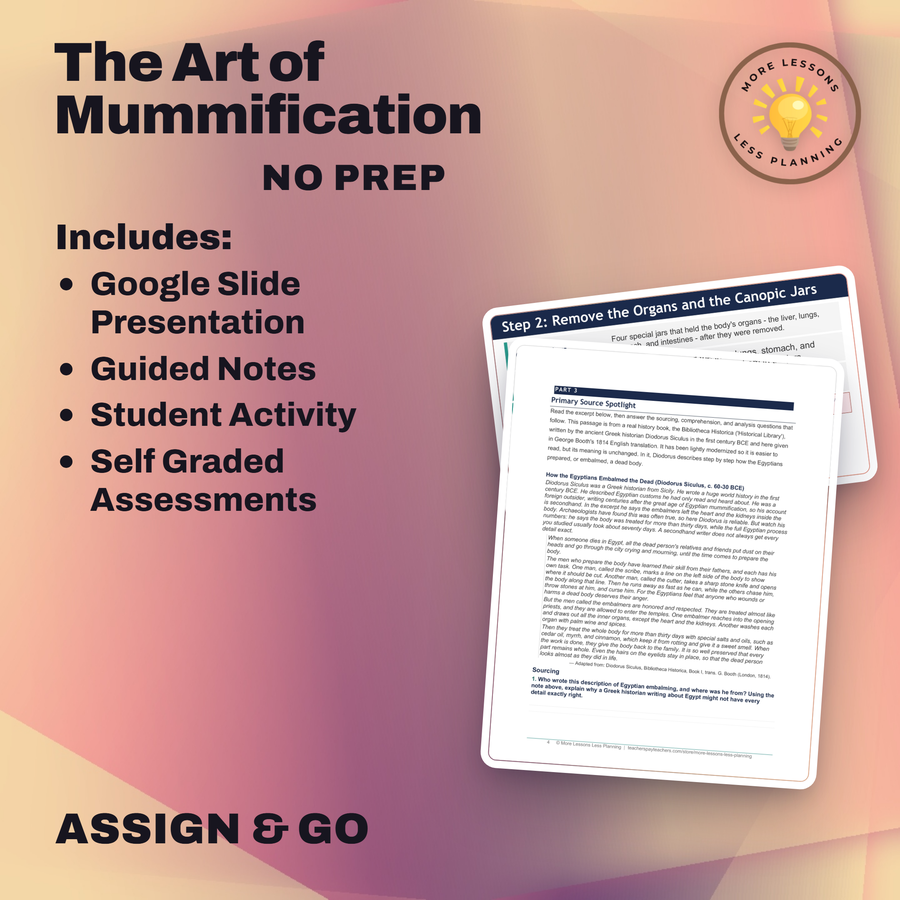
The Art of Mummification
The Code of Hammurabi
The Epic of Gilgamesh
Every lesson on this site is free to download and use. If one of them saved you a prep period, you can chip in a few bucks toward my three kids' daycare fund. That's genuinely where tips go.