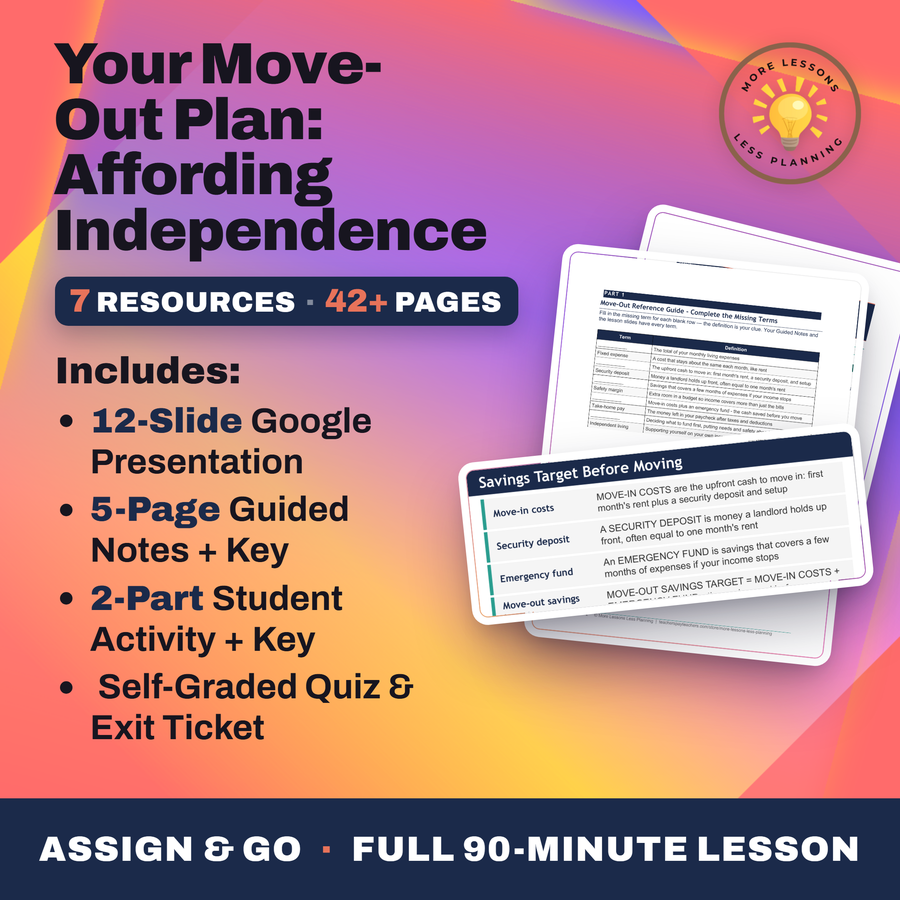
Your Move-Out Plan - Affording Independence
Quality reviewed September 2026
- Grades
- Grades 9-12
- Time
- About two 50-minute class periods
- Includes
- 11 ready-to-teach files
- Format
- Word (.docx) · PowerPoint (.pptx)
- Slide deck
- Guided notes
- Guided notes teacher key
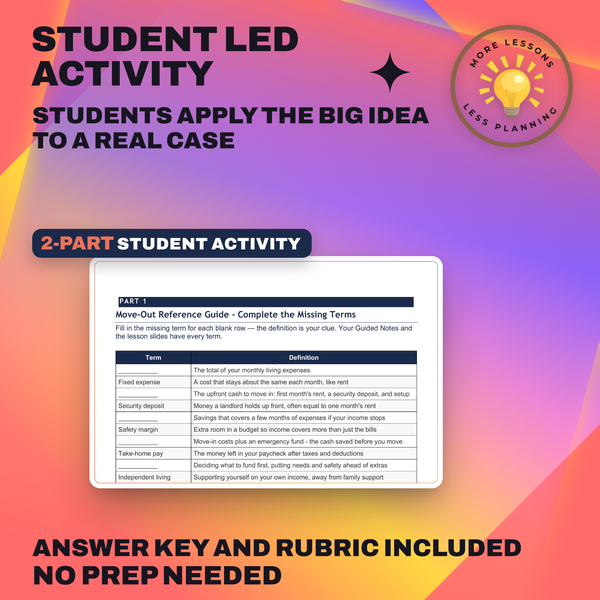
- Activity + answer key
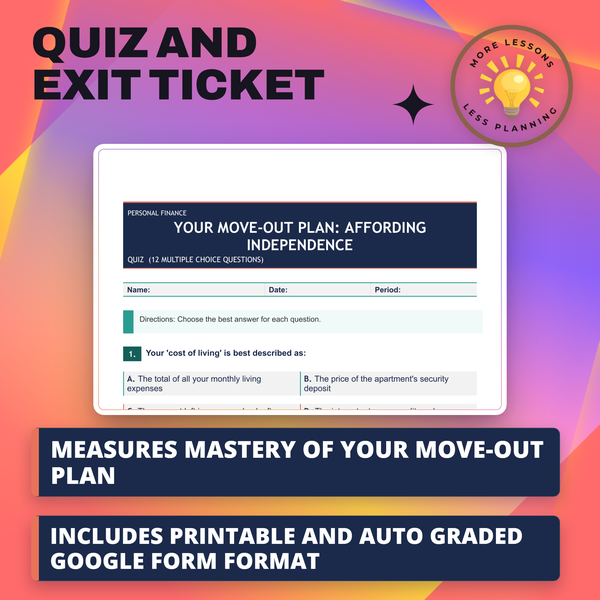
- Quiz + answer key
- Exit ticket + answer key
- Teacher guide
- Teacher presentation notes
What students do
- Add six budget categories to find a monthly cost of living, then calculate take-home income needed with a safety margin
- Calculate a move-out savings target by adding move-in costs to a three-month emergency fund
- Read a bar chart of six budget categories and identify rent as the biggest lever for lowering cost of living
- Build a full move-out plan for a client, running a five-part readiness checklist to recommend moving now or saving longer
What it covers
- The monthly cost of living formula, built from six real budget categories
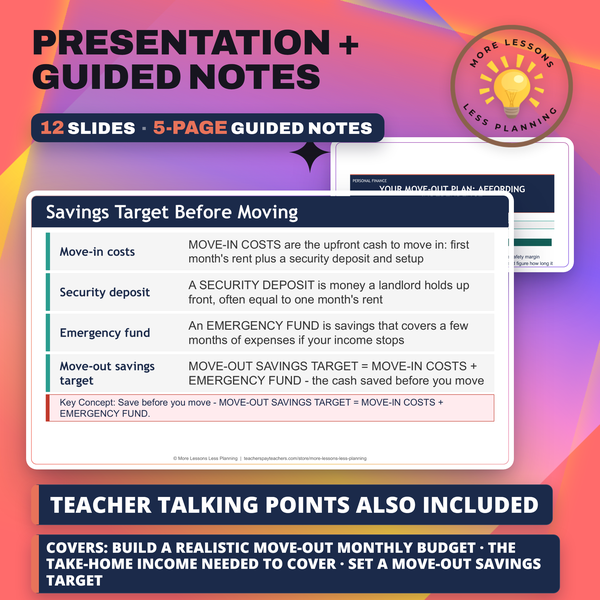
- The move-out savings target formula, move-in costs plus a three-month emergency fund
- A bar chart of six budget categories that identifies rent as the biggest lever for lowering cost of living
- A five-part readiness checklist used to recommend moving now or saving longer for a real client
Learning targets
- Build a realistic move-out monthly budget and find its total cost of living
- Calculate the take-home income needed to cover the cost of living with a safety margin
- Set a move-out savings target (move-in costs plus an emergency fund) and figure how long it takes to save
- Use a budget bar chart and a readiness checklist to decide whether you can afford to move out yet
Peek inside
Independent living
INDEPENDENT LIVING means supporting yourself on your own income, away from family support
Moving out is a plan
Moving out is a plan you build and save for, not something you rush into
Meet Devon
What Independence Means
INDEPENDENT LIVING means supporting yourself on your own , away from family support.
Moving out is a you build and save for, not something you rush into.
Meet Devon
Devon Brooks wants to move out; independence coach Priya helps him build a realistic plan.
Affording independence takes steady income, a real budget, and before you go.
Why this matters
Save twice as much each month and the wait to move out doesn't just shrink in theory, it actually does, right there in the numbers a student builds for a client named Jasmine. That's the payoff of this capstone: every formula from earlier in the unit gets used for real instead of practiced in isolation.
What tends to surprise students is which number turns out bigger, the move-in costs or the three-month emergency fund sitting behind them. Once they've added a real client's six budget categories and watched rent alone dwarf every other line, saving for months instead of weeks stops feeling unfair and starts feeling like arithmetic they already trust.
From one teacher to another
This capstone lesson runs on two formulas I make students apply over and over until they're automatic: monthly cost of living is just the sum of your expenses, and your move-out savings target is move-in costs plus an emergency fund. Working through Devon Brooks's real numbers, students add six actual budget categories to find his monthly cost of living, then build in a 10% safety margin to see whether his real paycheck actually clears the number they just calculated. The savings target is where the lesson delivers its real surprise, because once students add Devon's move-in costs to a full emergency fund, they see for themselves which piece is actually bigger, which is exactly why saving up takes months and not weeks. They read an actual bar chart of his six spending categories too, confirming rent dwarfs everything else and reasoning through why it's the first lever to pull if the numbers don't work. The final task hands them a second client, Jasmine, and asks for a full written recommendation, complete with a savings timeline at two different monthly rates, so students see for themselves that doubling what you save each month cuts the wait in half.
Every file in this toolkit
-
Activity (Student)
Devon Brooks wants to move out but is not sure he can afford it, so Priya Raman totals his monthly cost of living, checks his $2,400 paycheck against what he needs with a safety margin, then builds a full plan for a second client, Jasmine.
-
Activity (Answer Key)
$2,000 a month in cost of living needs a $200 safety margin before Devon's $2,400 income counts as enough, and that same arithmetic stacks a $2,500 move-in cost on top of a $6,000 emergency fund for an $8,500 target he can hit in 10 months at $850.
-
Exit Ticket (Student)
Adding a 10 percent safety margin to a $1,600 cost of living becomes the opening calculation, beside combining $1,900 in move-in costs with a $4,800 emergency fund and naming the smartest sequence for actually moving out. Cost of living, income needed, and savings target belong in the response.
-
Exit Ticket (Answer Key)
$1,760 is the correct income-needed answer, scored together with the rubric for the written answer and a sample response using cost of living, income needed, and savings target correctly.
-
Guided Notes (Student)
Devon Brooks builds a $2,000 monthly cost of living across six budget categories, with rent as the tallest bar at $1,050, before adding a 10 percent safety margin and an $8,500 savings target.
-
Guided Notes (Teacher Key)
$2,500 in move-in costs, a $6,000 emergency fund, and a 10-month savings timeline complete Devon's six budget categories, building to his $8,500 total savings target before he can move out.
-
Quiz (Student)
Summing Devon's six budget categories into a cost of living and his move-in costs plus emergency fund into a savings target run through this set, ending on whether Jasmine should keep saving with only $2,000 of her $6,700 goal banked so far.
-
Quiz (Answer Key)
Income of $2,200 gets the nod as the correct figure Devon needs to cover his bills, and why Jasmine should keep saving toward her $6,700 target before she moves out finishes the page.
-
Slides
Coach Priya Raman helps Devon Brooks budget $2,000 a month, and these slides add a 10 percent safety margin before setting his savings target at $8,500: $2,500 for move-in costs plus a three-month, $6,000 emergency fund, rent the tallest bar at $1,050.
-
Teacher Guide
Ten months at $850 a month is what Devon Brooks needs to save $8,500 before he can afford to move out, the readiness math coach Priya Raman teaches. Extensions total a personal move-out number, compare living alone against a roommate split, and interview someone who has already made the move.
-
Teacher Presentation Notes
Rent alone runs $1,050 of Devon Brooks's $2,000-a-month move-out budget, building to the $2,200 in take-home pay he needs once a 10 percent safety margin gets added on top.
Download
Where should I send the next one?
Everything here is free and it stays that way. Leave your email and I'll send you the new lessons as they go up. You can unsubscribe from any one of them.
Related resources
Furnishing on a Budget: Needs First
Negotiating Big Purchases: Getting a Better Deal
Renting Your First Apartment - Leases Deposits and Roommates
Renting vs Buying: Which Makes Sense When?
Utilities & Setup: Turning On the Lights
Banking Basics: Checking, Savings, and Debit Cards Explained
Every lesson on this site is free to download and use. If one of them saved you a prep period, you can chip in a few bucks toward my three kids' daycare fund. That's genuinely where tips go.