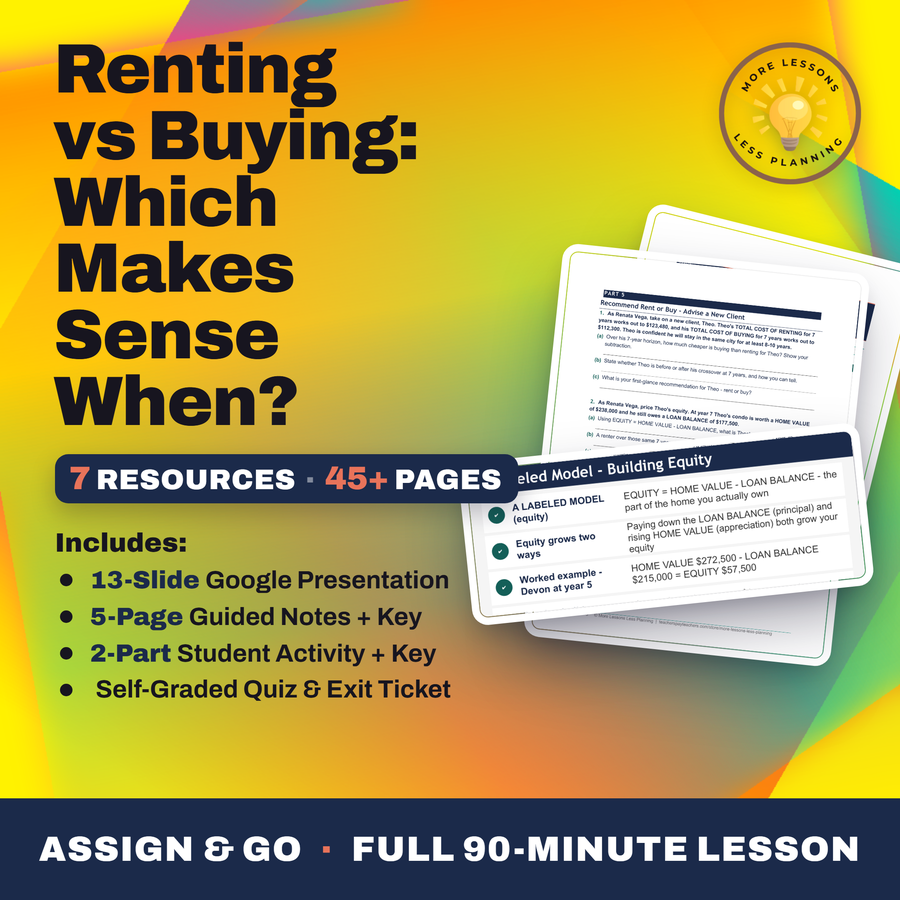
Renting vs Buying: Which Makes Sense When?
Quality reviewed September 2026
- Grades
- Grades 9-12
- Time
- About two 50-minute class periods
- Includes
- 11 ready-to-teach files
- Format
- Word (.docx) · PowerPoint (.pptx)
- Slide deck
- Guided notes
- Guided notes teacher key
- Activity + answer key
- Quiz + answer key
- Exit ticket + answer key
- Teacher guide
- Teacher presentation notes
What students do
- Calculate the total cost of renting and the total cost of buying using two labeled models
- Compare a renter's equity of zero against a buyer's equity after five years
- Find the crossover year where buying's total cost drops below renting's
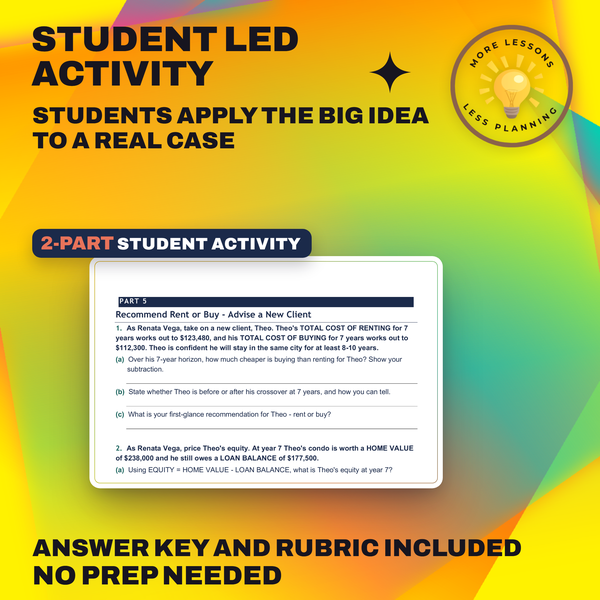
- Recommend rent or buy for a client based on how long they plan to stay
What it covers
- The total cost of renting and total cost of buying formulas, including equity and appreciation
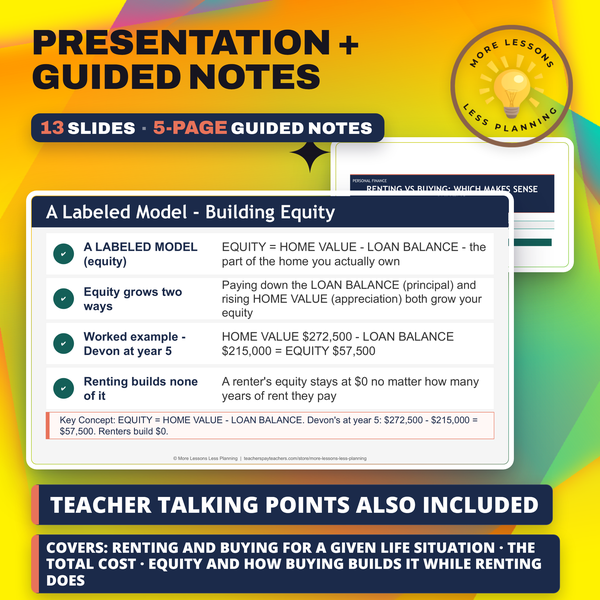
- What equity is and why renting builds none of it
- The five-year rule and how to read the crossover chart
Learning targets
- Compare renting and buying for a given life situation
- Calculate the total cost of renting and the total cost of buying over time
- Explain equity and how buying builds it while renting does not
- Use the crossover year and the 5-year rule to recommend rent or buy
Peek inside
✔
There is no single right answer
Whether renting or buying makes sense depends on your SITUATION - mainly how long you will stay
✔
Compare the total cost over time
1. Q1. The full amount you pay to rent over a number of years, with no equity back, is the .
Why this matters
Renting for five years leaves you with exactly nothing to show for it, no equity, no asset, nothing to sell later. Buying those same five years leaves you with something, even after every cost of owning is counted, and the year those two paths cross is the actual answer to a question most people only guess at.
Students want to treat renting or buying as a lifestyle choice until they build both cost formulas themselves and watch the buying line drop below the renting line around year five. What changes their mind is realizing the right answer depends on how long someone plans to stay, not which option sounds more grown up.
From one teacher to another
By the end of this lesson, my students can size up a real rent-or-buy decision and back it with numbers instead of a gut call. They build out both cost formulas for the same client, Devon, watch his renting total and buying total cross around year five, and use that crossover to tell him whether he should sign another lease or put money down on a condo. What I want them to leave with is that it isn't about which option sounds better, it's about how long Devon's staying.
Every file in this toolkit
-
Activity (Student)
Devon Marsh's lease is ending at 24, so Renata Vega totals five years of renting at $1,500 a month against buying with a $20,000 down payment, then finds the crossover year on a ten-year chart before checking a client who might move in two years.
-
Activity (Answer Key)
Renting adds up to $91,200 for Devon's 5-year total against $90,500 buying, with $57,500 in home equity built along the way, while a second client planning only a 2-year stay would pay $11,720 more to buy than to rent.
-
Exit Ticket (Student)
A $272,500 home value against a $215,000 loan balance becomes an equity calculation, beside naming the year Devon's renting and buying costs cross and what renting protects that owning does not. Total cost, crossover year, and equity run through the closing paragraph.
-
Exit Ticket (Answer Key)
The crossover year and Devon's $57,500 equity number carry three answer choices, and the written-response rubric checks for total cost, crossover year, and equity all showing up correctly.
-
Guided Notes (Student)
Devon's rent-or-buy plan works through flexibility versus equity across nine sections, tracking a $91,200 five-year renting total against buying's cost before reaching his $57,500 equity and the crossover year.
-
Guided Notes (Teacher Key)
$91,200 is Devon's five-year renting total set against a $90,500 buying total, plus his $57,500 equity at year five and the crossover point where owning finally costs less.
-
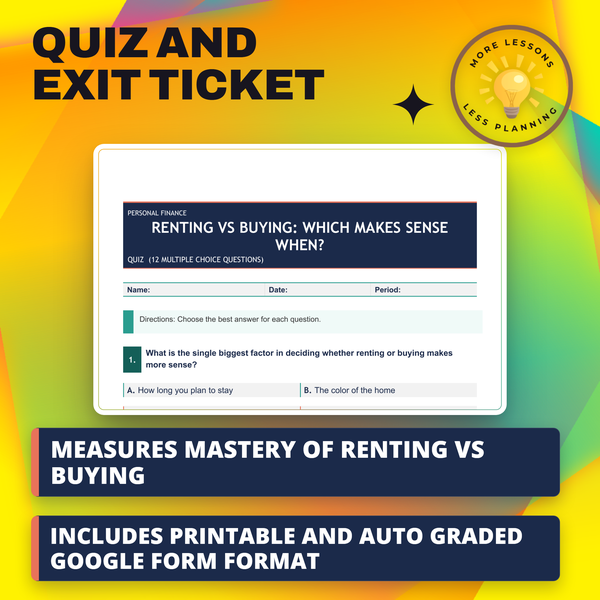
Quiz (Student)
A rent-or-buy decision tests total-cost and equity math, asking students to calculate a five-year renting total, find the equity built at year five, and read the crossover year off a chart.
-
Quiz (Answer Key)
$91,200 as the five-year renting total is checkmarked, alongside the $57,500 equity answer and the year-five crossover call on this total-cost rent-or-buy comparison chart.
-
Slides
Equity hits $57,500 for Devon by year five once his home value outgrows his loan balance, a figure these slides set against a renter's equity of zero and a full $91,200 spent over the same five years with nothing coming back.
-
Teacher Guide
Crossover year math anchors this 55-point guide, showing Devon Marsh's renting and buying costs cross at $91,200 against $90,500 in year five. Extensions locate a personal crossover year, weigh flexibility against equity, and track one renter's decision across four life stages.
-
Teacher Presentation Notes
Total cost of renting crosses total cost of buying around year five for Devon, at $91,200 versus $90,500, the crossover behind the equity formula, home value minus loan balance, and the 5-year rule.
Download
Where should I send the next one?
Everything here is free and it stays that way. Leave your email and I'll send you the new lessons as they go up. You can unsubscribe from any one of them.
Related resources
Furnishing on a Budget: Needs First
Negotiating Big Purchases: Getting a Better Deal
Renting Your First Apartment - Leases Deposits and Roommates
Utilities & Setup: Turning On the Lights
Your Move-Out Plan - Affording Independence
Banking Basics: Checking, Savings, and Debit Cards Explained
Every lesson on this site is free to download and use. If one of them saved you a prep period, you can chip in a few bucks toward my three kids' daycare fund. That's genuinely where tips go.