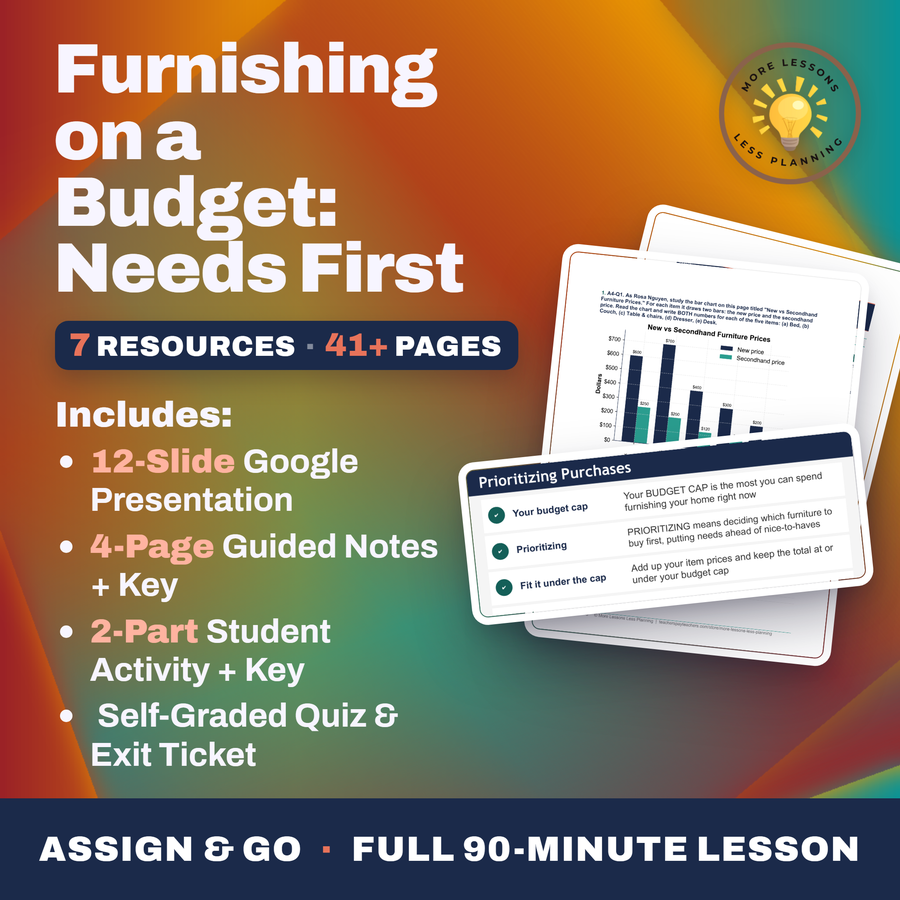
Furnishing on a Budget: Needs First
Quality reviewed September 2026
- Grades
- Grades 9-12
- Time
- About two 50-minute class periods
- Includes
- 11 ready-to-teach files
- Format
- Word (.docx) · PowerPoint (.pptx)
- Slide deck
- Guided notes
- Guided notes teacher key
- Activity + answer key
- Quiz + answer key
- Exit ticket + answer key
- Teacher guide
- Teacher presentation notes
What students do
- Sort furniture into needs and nice-to-haves and explain why needs get bought first
- Calculate savings from buying secondhand using new price minus secondhand price across five items
- Fit a furnishing list under a client's budget cap, deciding what to purchase first and what to defer
- Write a needs-first furnishing plan for a new client, including a warning against rent-to-own financing
What it covers
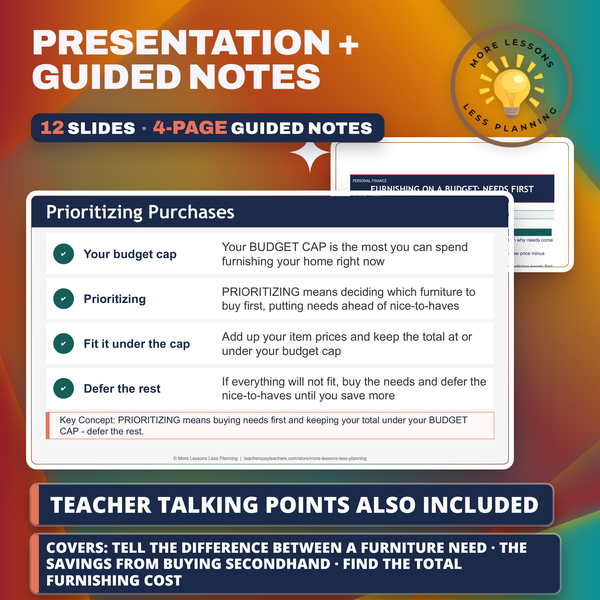
- The needs-first rule, and the test for telling an essential from a nice-to-have
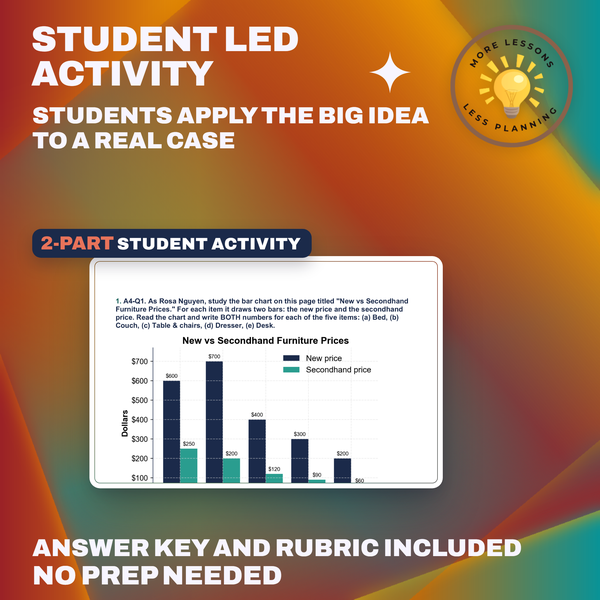
- A bar chart comparing new and secondhand prices on five items, from a $700 couch to a $200 desk
- Why renting-to-own a couch at $40 a week for a year can cost $2,080, nearly three times the new price
- Building a full furnishing plan under a real budget cap, deciding what to purchase first and what can wait
Learning targets
- Tell the difference between a furniture need and a nice-to-have, and explain why needs come first
- Calculate the savings from buying secondhand using the labeled model (new price minus secondhand price)
- Find the total furnishing cost of a list and keep it under a budget cap by prioritizing needs first
- Use a bar chart of new versus secondhand prices, and avoid furniture-financing traps, to furnish a first home cheaply
Peek inside
Need vs Nice-to-Have
A NEED is essential furniture you cannot run a home without, like a bed or a kitchen .
A NICE-TO-HAVE is furniture that adds comfort but is not , like a coffee table.
Meet Theo
Furnishing a first home means buying the needs first and adding nice-to-haves .
Theo Castellano is furnishing his first ; advisor Rosa Nguyen helps him buy smart.
Why this matters
Whether a couch counts as a need or a want is a question half of my students answer "need" without blinking. The rent-to-own comparison changes their mind fast: the same $700 couch costs nearly three times as much over a year of weekly payments, which is what finally convinces the holdouts that financing furniture is rarely a shortcut.
Handing a client a fixed amount and a full shopping list is where the real learning happens for me. It forces students to rank needs against each other, and deciding what gets bought now versus what waits is a skill most of them will use before they furnish a place of their own.
From one teacher to another
I put one number on the board before anything else: a couch that costs $700 new can run you $2,080 on a rent-to-own plan, at $40 a week for a year, and that's the number that gets students actually caring about a lesson on furnishing an apartment. From there it's mostly arithmetic with real stakes. They sort a shopping list into needs and nice-to-haves, then work a bar chart showing five pieces of furniture at both their new and secondhand prices, calculating the savings item by item and across the full list themselves. The part I like best is the budget-cap constraint: a client with a fixed amount to spend has to decide which essentials come first and which pieces wait, which turns "needs before wants" from a slogan into a math problem they have to solve.
Every file in this toolkit
-
Activity (Student)
Theo Castellano is tempted to finance a whole apartment of new furniture, so Rosa Nguyen prices his $700 couch secondhand at $200, totals five items, then fits his needs under a $500 budget cap.
-
Activity (Answer Key)
A secondhand couch saves Theo $500 against its $700 new price, and the same subtraction applies to all five items, a $720 total against $2,200 new, before his $460 in needs fits under a $500 cap with $40 left over.
-
Exit Ticket (Student)
A $700 couch marked down to $200 secondhand becomes a savings calculation, beside Maya working her $600 cap around three needs before any nice-to-have. Need, secondhand, and budget cap turn up in a brief written response.
-
Exit Ticket (Answer Key)
Buying needs before nice-to-haves, choosing secondhand to stretch a dollar, and staying under Maya's $600 budget cap each score a rubric point built on her couch and needs math.
-
Guided Notes (Student)
Theo Castellano's couch costs $700 new or $200 secondhand, and that $500 gap carries through a four-step plan sorting needs from nice-to-haves before checking the total against a budget cap.
-
Guided Notes (Teacher Key)
$500 is what Theo saves buying his couch secondhand, worked out alongside the rent-to-own trap that turns the same $700 couch into $2,080 over a year of weekly payments at $40 each.
-
Quiz (Student)
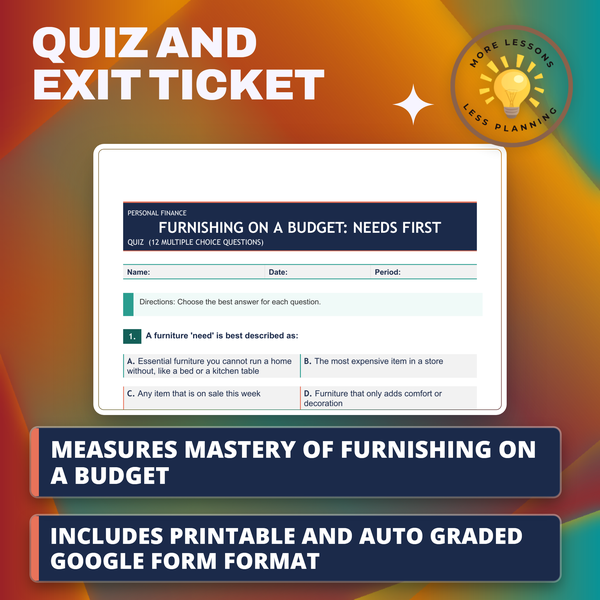
$600 buys a bed new versus $250 secondhand, the savings math this quiz opens with, before totaling three secondhand needs into a furnishing budget and testing why a $40-a-week rent-to-own couch runs $2,080 a year.
-
Quiz (Answer Key)
The $350 saved on a secondhand bed and Maya's $460 needs total under her $600 budget cap are both marked correct, closing with a full letter-by-letter answer list for grading the whole set.
-
Slides
$700 is what Theo's couch costs new, just $200 used, the chart anchoring this deck, part of five furniture items totaling $720 secondhand against $2,200 new, while advisor Rosa Nguyen sorts his list into needs before nice-to-haves under a budget cap.
-
Teacher Guide
$1,480 is what Theo Castellano saves furnishing his first apartment secondhand instead of new, the math behind this 55-point guide. Extensions price a real rent-to-own offer against buying new and build a free-furniture plan from buy-nothing groups and move-out piles.
-
Teacher Presentation Notes
A bed and a table count as needs while a couch can wait, the sorting rule ahead of the secondhand savings formula, new price minus secondhand price, that puts $500 back in pocket on one couch alone.
Download
Where should I send the next one?
Everything here is free and it stays that way. Leave your email and I'll send you the new lessons as they go up. You can unsubscribe from any one of them.
Related resources
Negotiating Big Purchases: Getting a Better Deal
Renting Your First Apartment - Leases Deposits and Roommates
Renting vs Buying: Which Makes Sense When?
Utilities & Setup: Turning On the Lights
Your Move-Out Plan - Affording Independence
Banking Basics: Checking, Savings, and Debit Cards Explained
Every lesson on this site is free to download and use. If one of them saved you a prep period, you can chip in a few bucks toward my three kids' daycare fund. That's genuinely where tips go.