Renting Your First Apartment - Leases Deposits and Roommates
Quality reviewed September 2026
- Grades
- Grades 9-12
- Time
- About two 50-minute class periods
- Includes
- 11 ready-to-teach files
- Format
- Word (.docx) · PowerPoint (.pptx)
- Slide deck
- Guided notes
- Guided notes teacher key
- Activity + answer key
- Quiz + answer key
- Exit ticket + answer key
- Teacher guide
- Teacher presentation notes
What students do
- Read a sample residential lease to find the monthly rent, security deposit, application fee, late fee, and lease term
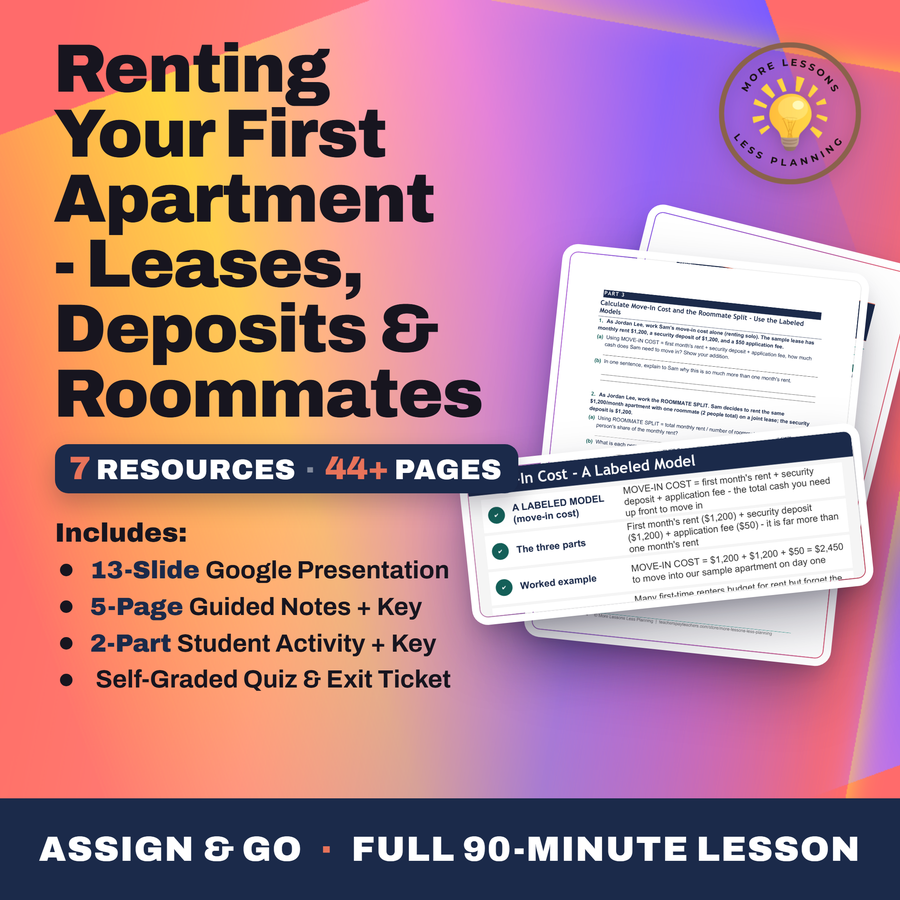
- Calculate move-in cost as first month's rent plus security deposit plus application fee on a $1,200/month unit
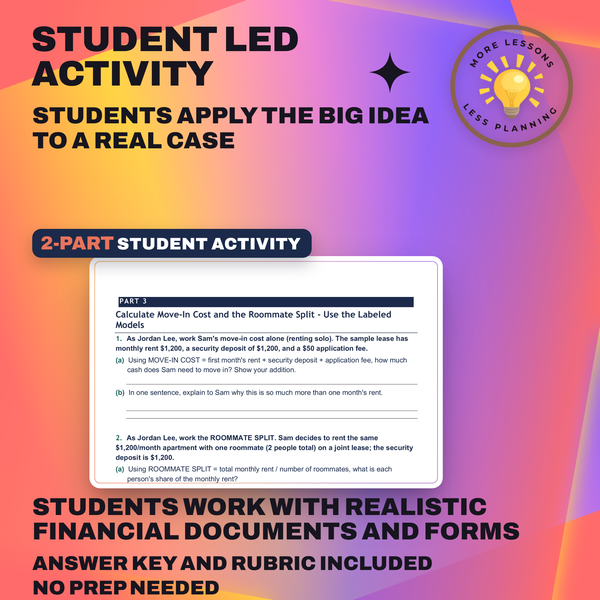
- Split both rent and the security deposit between two roommates and calculate each person's move-in share
- Advise a first-time renter in writing, warning that a joint lease makes each roommate liable for the full rent
What it covers
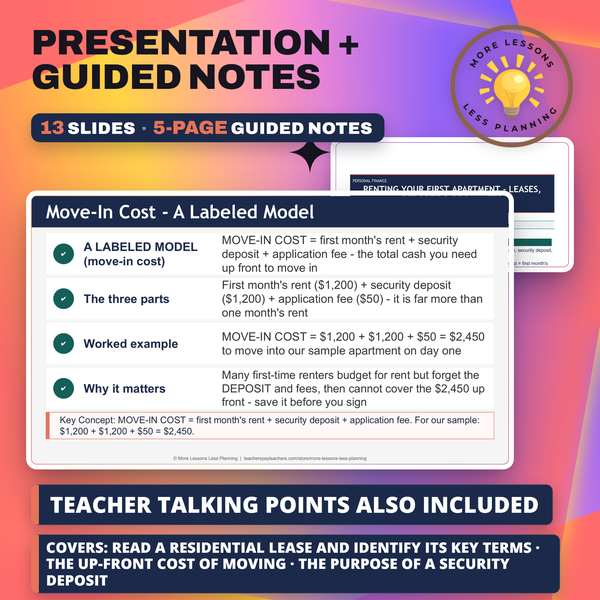
- The move-in cost model, first month's rent plus security deposit plus application fee, applied to a $1,200/month unit
- Reading an actual sample lease to find the late fee and lease term
- Normal wear versus real damage, and what a landlord can legally deduct from a security deposit
- Why a joint lease makes each roommate liable for the full rent, not just their own half
Learning targets
- Read a residential lease and identify its key terms: monthly rent, lease term, security deposit, late fee, and tenant obligations
- Calculate the up-front cost of moving in using a labeled model (move-in cost = first month's rent + security deposit + application fee)
- Explain the purpose of a security deposit and the conditions under which a tenant does or does not get it back
- Split rent and a shared security deposit among roommates and explain the risks of a shared (joint) lease
Peek inside
✔
You rent, you do not own
When you RENT, you pay a landlord to live in their property; you do NOT own it, so the LANDLORD owns the building
✔
The lease is a binding contract
Renting and the Lease
When you RENT, you pay a landlord to live in their property; you do NOT it.
A LEASE is a binding contract between a landlord and TENANT that sets the rent, the term, and the of renting a home.
Tenant and Rent
The person who rents and lives in the home is the - signing the lease makes you legally responsible for its terms.
You pay RENT every month for the LEASE TERM, which is the length of time the lease lasts, often months, during which the rent is locked in.
1. The binding contract between a landlord and tenant that sets the rent, term, and rules for renting a home is a .
Why this matters
Most first-time renters read a lease looking for one number, the monthly rent, and stop there. This lesson makes them read the whole document instead: the security deposit, the application fee, and the late fee that never shows up until it's already been charged.
Splitting the rent in half feels simple, until the liability question comes up. Students assume splitting rent means splitting risk, but a joint lease makes each person liable for the full amount if the other one stops paying. Once that lands, the deposit stops looking like a formality and starts looking like a contract worth reading before signing.
From one teacher to another
Almost every student in this lesson guesses that moving into a $1,200-a-month apartment costs about $1,200, so the labeled move-in cost model, first month's rent plus security deposit plus application fee, lands hard once they add it up themselves. From there they read an actual sample lease to pull out the late fee and lease term, work out what counts as normal wear versus real damage on a security deposit, and split both the rent and the deposit between two roommates to see exactly how much cheaper it gets per person. The last stretch is the one I care about most: they have to warn a first-time renter, in writing, that a joint lease means each roommate owes the whole rent if the other one stops paying, not just their half.
Every file in this toolkit
-
Activity (Student)
Sam has never signed a lease, so Jordan Lee adds a $1,200 deposit and a $50 application fee to the first month's rent for a $2,450 move-in total, then splits that cost with a roommate using the sample lease on the page.
-
Activity (Answer Key)
Sam's solo move-in adds up to $2,450 between first month, deposit, and fee, and splitting that same apartment with one roommate cuts it to $1,225 each, a joint lease that also divides the $1,200 rent and $1,200 deposit down the middle.
-
Exit Ticket (Student)
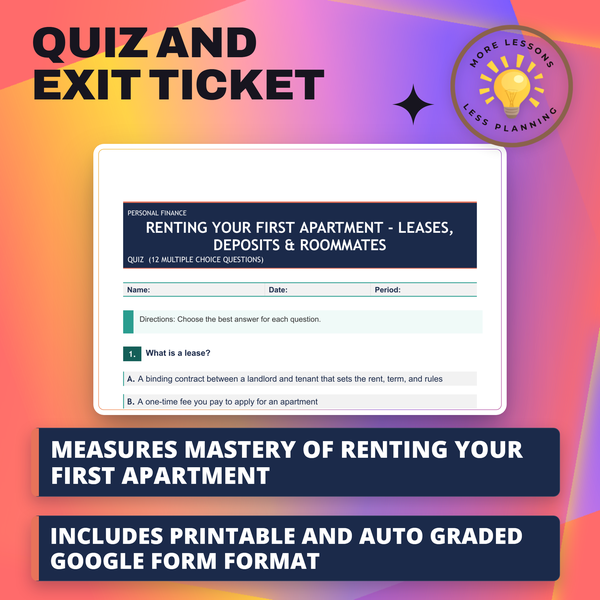
What a security deposit is actually for comes up first, then $1,200 rent, a $1,200 deposit, and a $50 fee get added into one move-in number. A joint lease item asks who owes rent if a roommate stops paying, closing with lease, security deposit, and move-in cost.
-
Exit Ticket (Answer Key)
Building the $2,450 move-in cost from rent, deposit, and fee decides three answer choices, and the rubric checks the written response for lease, security deposit, and move-in cost all appearing correctly.
-
Guided Notes (Student)
A sample lease with $1,200 monthly rent runs through eight sections, covering the security deposit, a $2,450 move-in cost, the rental application and credit check, and how roommates split rent down to $600 each.
-
Guided Notes (Teacher Key)
$2,450 is the total move-in cost, built from a $1,200 first month's rent, an equal security deposit, and a $50 application fee, plus the joint-lease rule that leaves each roommate owing the whole rent.
-
Quiz (Student)
A first lease tests vocabulary and move-in math, from pricing the move-in cost on a $1,200 apartment to splitting the rent between two roommates and naming what a landlord can deduct.
-
Quiz (Answer Key)
$2,450 as the move-in cost and $600 as each roommate's rent split are both checkmarked, next to what a landlord can legally deduct from a tenant's security deposit at move-out.
-
Slides
Rent locks in at $1,200 for a 12-month term on this deck's sample lease, with a $50 late fee, and the move-in math adds that rent to a matching security deposit and a $50 application fee for $2,450 owed on day one.
-
Teacher Guide
Moving into a $1,200-a-month apartment costs $2,450 up front, more than double the rent, the surprise this 55-point guide's move-in math is built to catch. Extensions budget three sample apartments, read a real lease clause by clause, and draft a roommate agreement that splits the deposit fairly.
-
Teacher Presentation Notes
Rent, deposit, and fee figures in this sample lease run $1,200, $1,200, and $50, adding to a $2,450 move-in cost, before coverage of what a landlord can keep from a deposit and how roommates split the bill.
Download
Where should I send the next one?
Everything here is free and it stays that way. Leave your email and I'll send you the new lessons as they go up. You can unsubscribe from any one of them.
Related resources
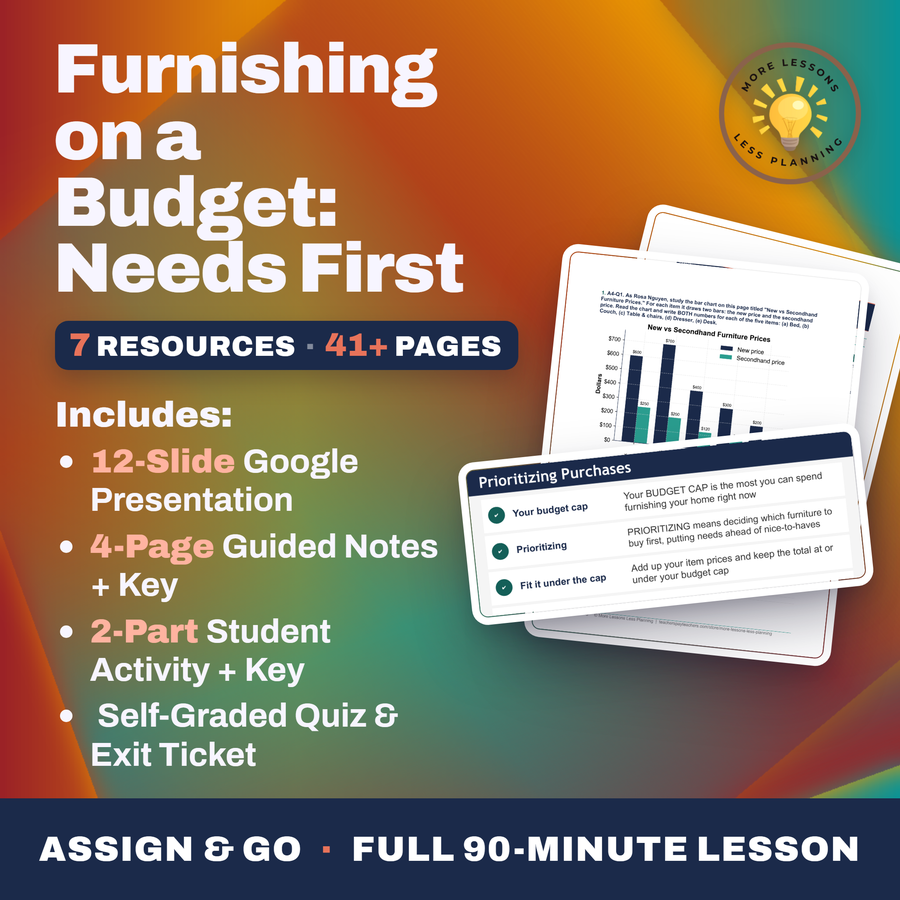
Furnishing on a Budget: Needs First
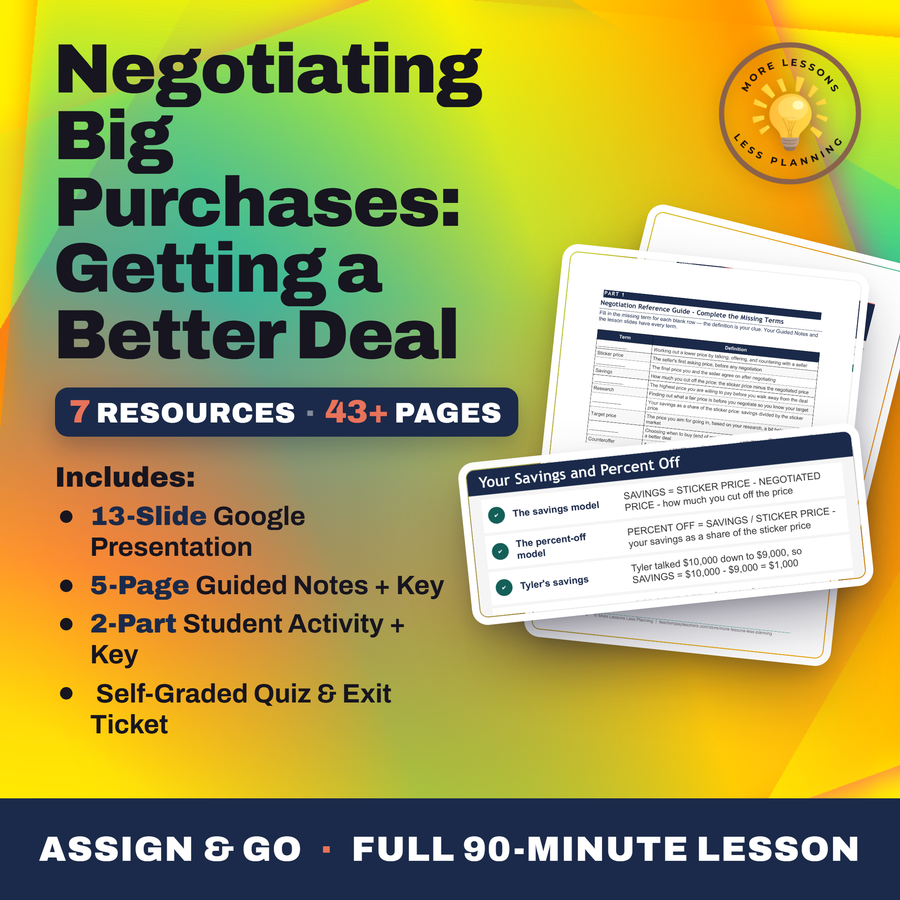
Negotiating Big Purchases: Getting a Better Deal
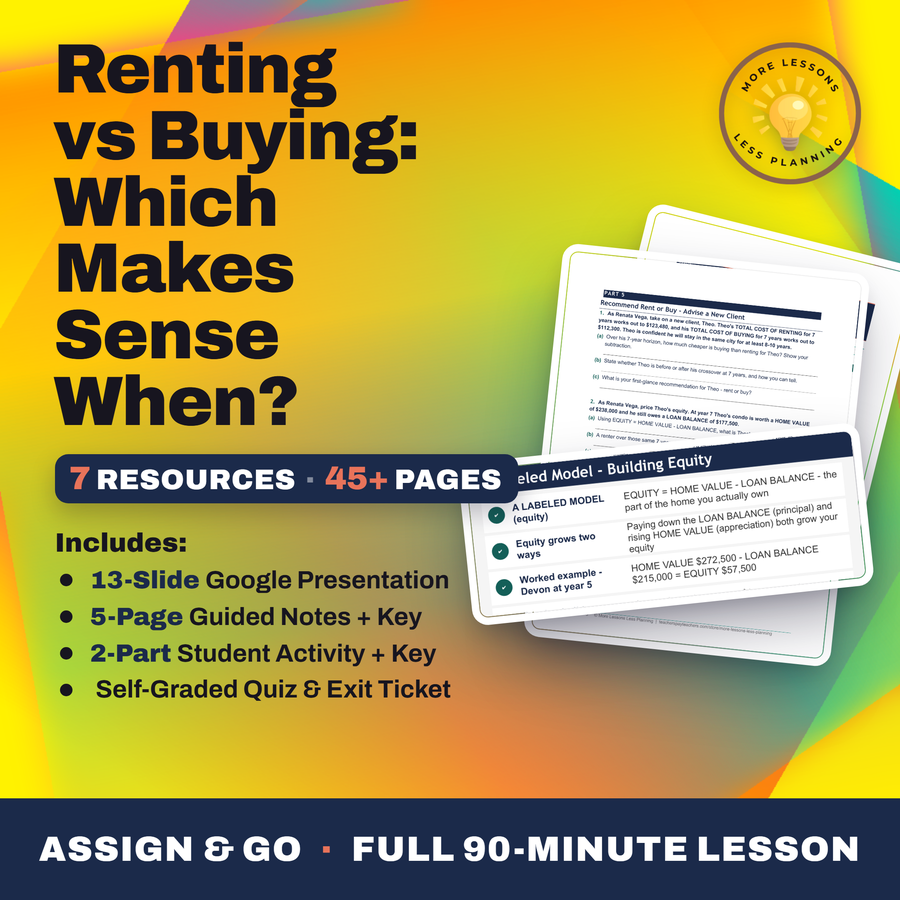
Renting vs Buying: Which Makes Sense When?
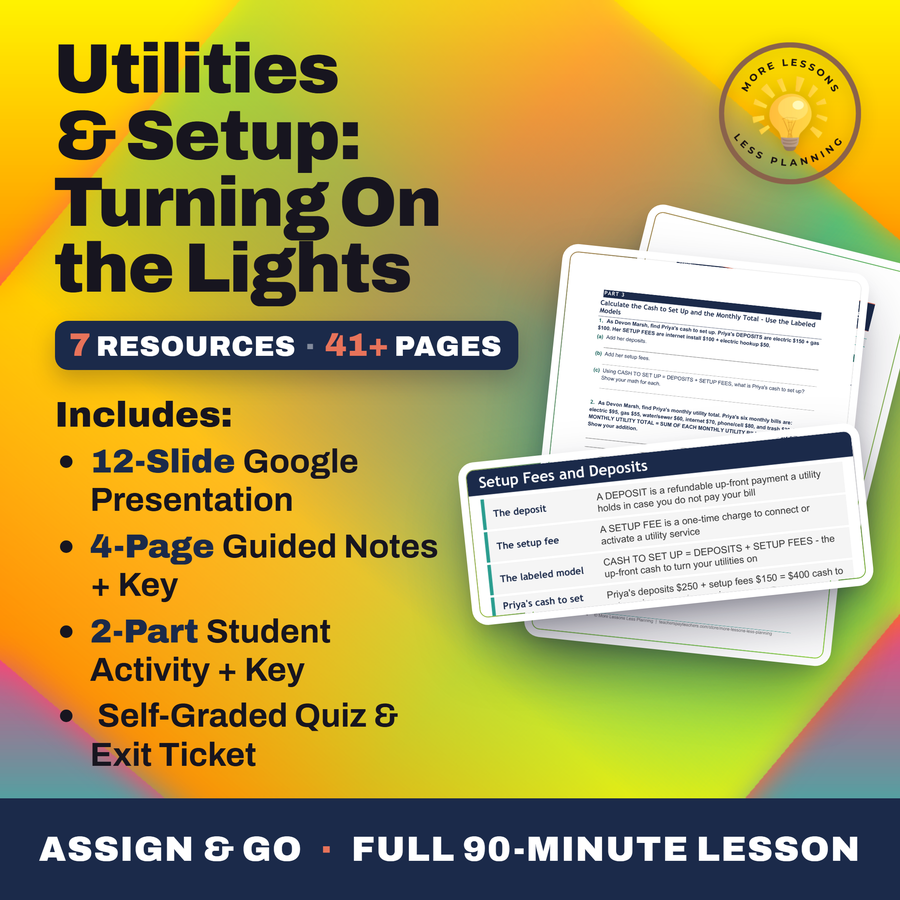
Utilities & Setup: Turning On the Lights
Your Move-Out Plan - Affording Independence
Banking Basics: Checking, Savings, and Debit Cards Explained
Every lesson on this site is free to download and use. If one of them saved you a prep period, you can chip in a few bucks toward my three kids' daycare fund. That's genuinely where tips go.