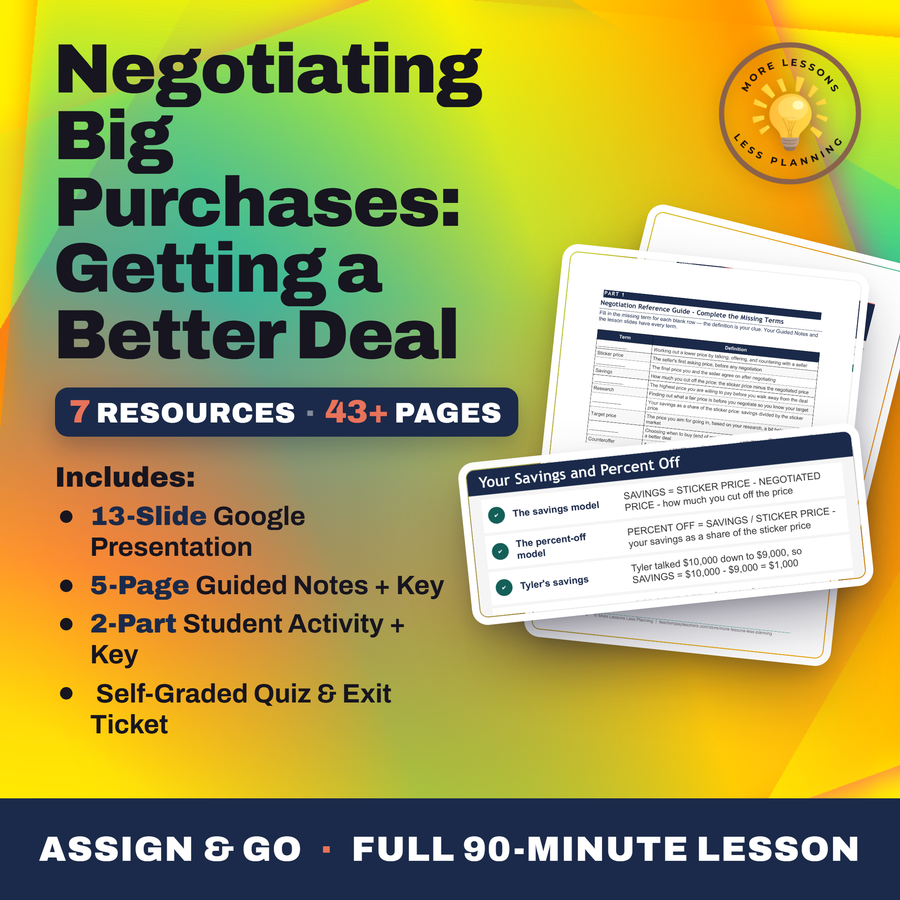
Negotiating Big Purchases: Getting a Better Deal
Quality reviewed September 2026
- Grades
- Grades 9-12
- Time
- About two 50-minute class periods
- Includes
- 11 ready-to-teach files
- Format
- Word (.docx) · PowerPoint (.pptx)
- Slide deck
- Guided notes
- Guided notes teacher key
- Activity + answer key
- Quiz + answer key
- Exit ticket + answer key
- Teacher guide
- Teacher presentation notes
What students do
- Calculate savings and percent off using the sticker price and the negotiated price
- Set a target price and a walk-away price from research before making an offer
- Read a bar chart comparing average savings across six purchase categories
- Run and score a new client's negotiation using the walk-away decision rule
What it covers
- Why the sticker price is a starting point, not a final price
- The savings and percent-off formulas and the walk-away decision rule
- Which purchases have the most room to negotiate, from used cars to electronics
Learning targets
- Explain why the sticker price is a starting point and what makes a big purchase negotiable
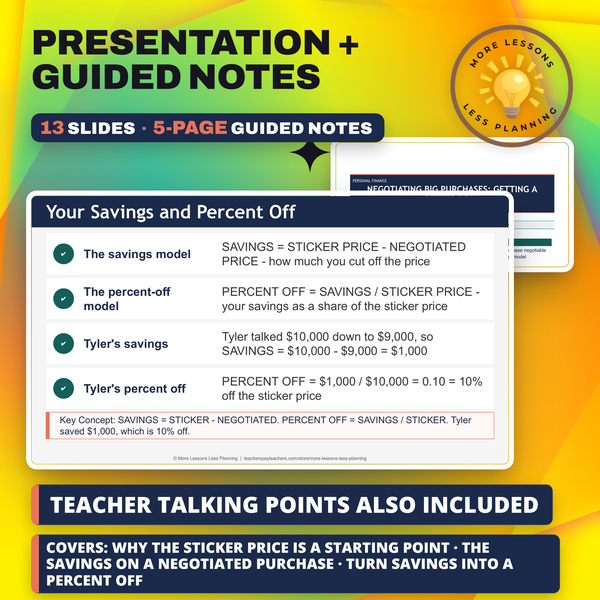
- Calculate the savings on a negotiated purchase using the labeled savings model
- Turn savings into a percent off using the labeled percent-off model
- Set a walk-away price and use research, timing, and a bar chart of average savings to judge a deal
Peek inside
What Negotiation Is
NEGOTIATION is working out a lower price by talking, offering, and countering with a .
The STICKER PRICE is the seller's first asking price, before any .
The Price You Agree On
The NEGOTIATED PRICE is the final price you and the seller agree on after .
Tyler Brooks is buying his first ; his coach Rosa Delgado shows him the sticker price can come down.
Why this matters
A price tag looks official, printed and final, which is exactly why most people never think to question it. This lesson takes that apart: research a fair price, set a walk-away number before opening your mouth, and only then start talking, so the tag becomes a starting point instead of an order.
What I like about scoring the final negotiation against that walk-away rule is that it turns nerve into a decision already made on paper. Students stop measuring success by whether they said something clever and start measuring it by the actual percent they saved, the only number that matters once the deal is done.
From one teacher to another
The price on the tag isn't the price you have to pay, and that's the whole lesson buried in one sentence. Students follow a first-time car buyer as he researches a fair price, sets a walk-away number before he ever opens his mouth, and talks the seller down enough to save real money. It turns something that feels intimidating into a method they can actually run themselves.
Every file in this toolkit
-
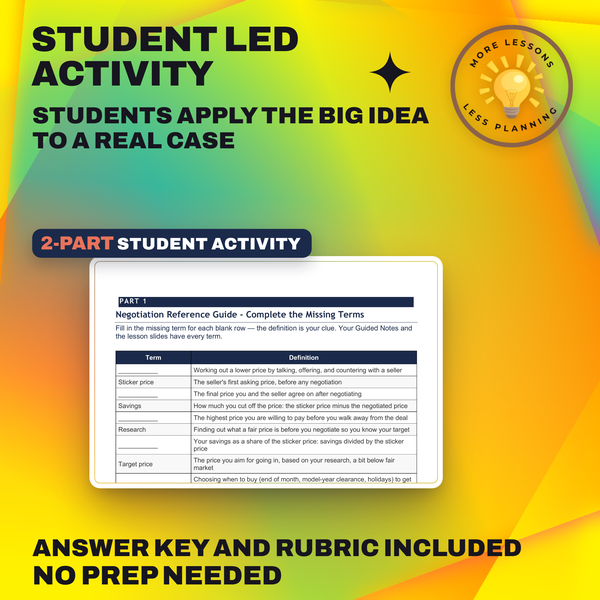
Activity (Student)
Tyler Brooks talks a $10,000 sticker price down to $9,000, and Rosa Delgado has students turn that thousand-dollar gap into a percent off before reading which of six purchase categories negotiates down the most.
-
Activity (Answer Key)
$10,000 talked down to $9,000 by Tyler is a $1,000 savings just under the chart's $1,200 average for used-car deals, and that same chart's $75 average for electronics sits $1,125 below it, the widest gap on the whole chart.
-
Exit Ticket (Student)
A $12,000 sticker price talked down to $10,200 becomes a savings calculation, beside judging a deal against a set walk-away number and naming what actually gives a buyer the upper hand. Sticker price, walk-away price, and negotiate get worked into the response.
-
Exit Ticket (Answer Key)
A $12,000 deal negotiated to $10,200 scores against three answer choices, while the written response gets checked for sticker price, walk-away price, and negotiate used correctly together.
-
Guided Notes (Student)
Tyler Brooks negotiates his first car down from a $10,000 sticker price, and nine sections build his target price, his walk-away number, and the percent-off math behind the final deal.
-
Guided Notes (Teacher Key)
$1,000 saved off Tyler's $10,000 sticker price works out to 10 percent, next to his $9,200 walk-away price and the used-car bar that tops the savings chart at about $1,200.
-
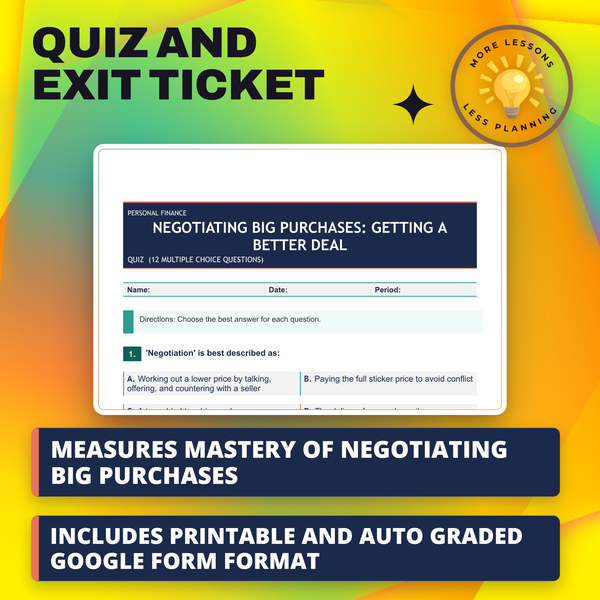
Quiz (Student)
A car deal tests vocabulary and math together, from finding the savings on a $10,000-to-$9,000 negotiation and its percent off to judging a $9,200 walk-away call on the same purchase.
-
Quiz (Answer Key)
The $1,000-savings answer and the 10%-off answer are checkmarked on this car deal, next to the walk-away call and which purchase category tops the average-savings-by-category chart.
-
Slides
An $8,500 target set before Tyler talked the $10,000 sticker down to $9,000 anchors these slides, a $1,000 savings converted into a 10 percent-off figure, then checked against his $9,200 walk-away price and a slide on timing the purchase.
-
Teacher Guide
$10,000 talked down to $9,000 on a car sticker, still under Tyler Brooks's walk-away price, is the negotiation this 55-point guide is built around. Extensions plan a real personal negotiation, rank which purchases actually have room to move, and research when prices drop.
-
Teacher Presentation Notes
Rosa Delgado coaches Tyler Brooks from a $10,000 sticker price down to $9,000, a $1,000 save behind the savings formula, before a six-category chart shows used cars saving the most and electronics the least.
Download
Where should I send the next one?
Everything here is free and it stays that way. Leave your email and I'll send you the new lessons as they go up. You can unsubscribe from any one of them.
Related resources
Furnishing on a Budget: Needs First
Renting Your First Apartment - Leases Deposits and Roommates
Renting vs Buying: Which Makes Sense When?
Utilities & Setup: Turning On the Lights
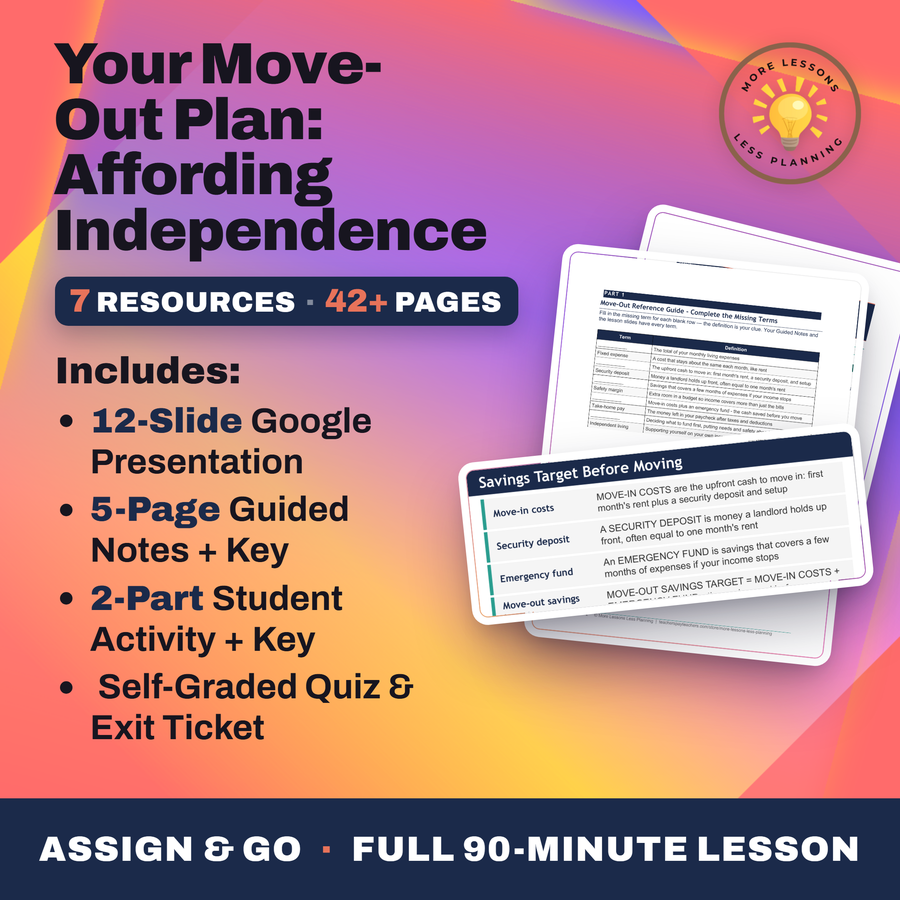
Your Move-Out Plan - Affording Independence
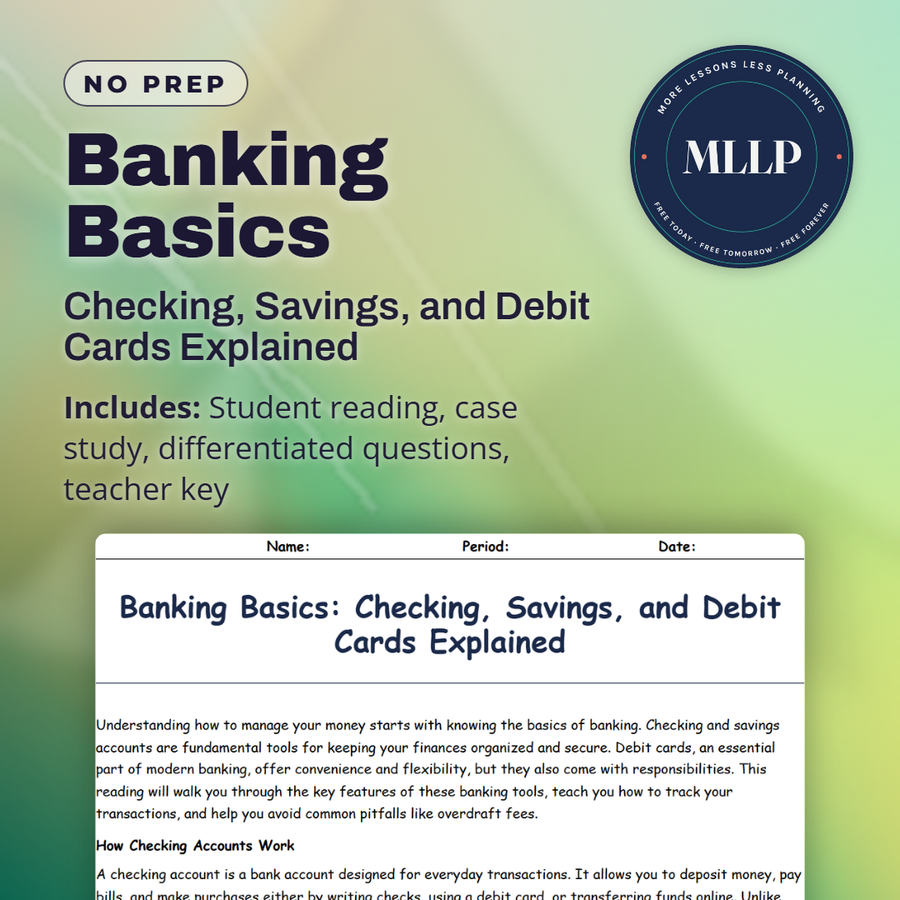
Banking Basics: Checking, Savings, and Debit Cards Explained
Every lesson on this site is free to download and use. If one of them saved you a prep period, you can chip in a few bucks toward my three kids' daycare fund. That's genuinely where tips go.