Utilities & Setup: Turning On the Lights
Quality reviewed September 2026
- Grades
- Grades 9-12
- Time
- About two 50-minute class periods
- Includes
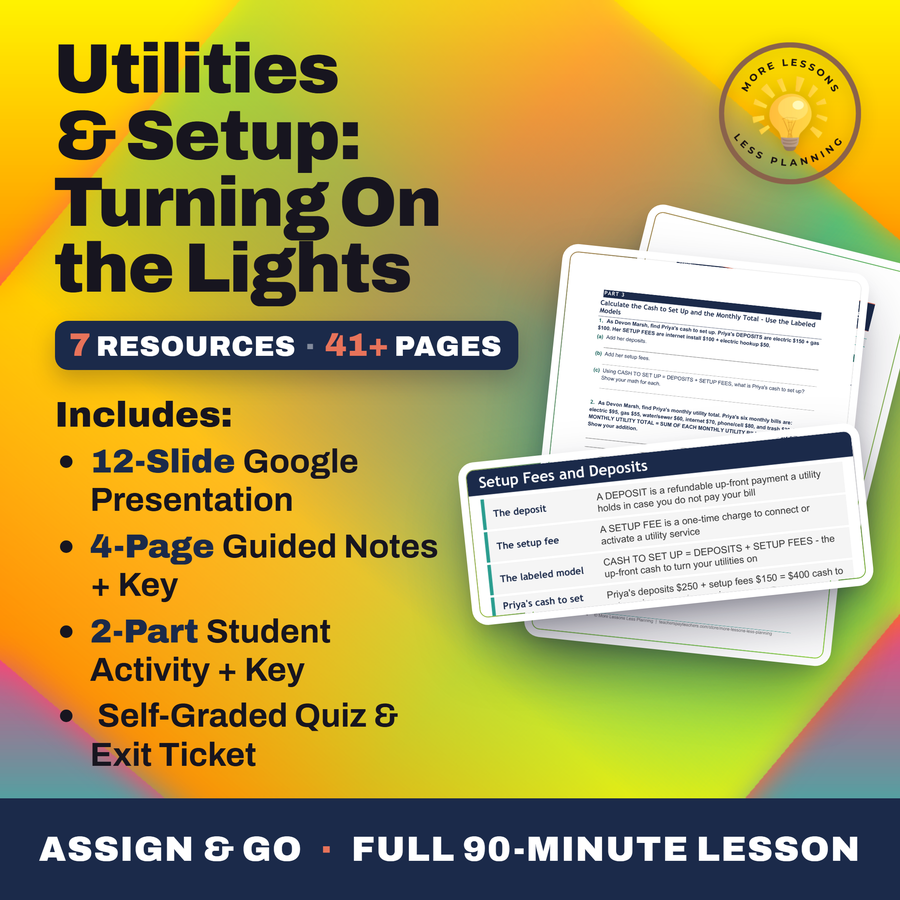
- 11 ready-to-teach files
- Format
- Word (.docx) · PowerPoint (.pptx)
- Slide deck
- Guided notes
- Guided notes teacher key
- Activity + answer key
- Quiz + answer key
- Exit ticket + answer key
- Teacher guide
- Teacher presentation notes
What students do
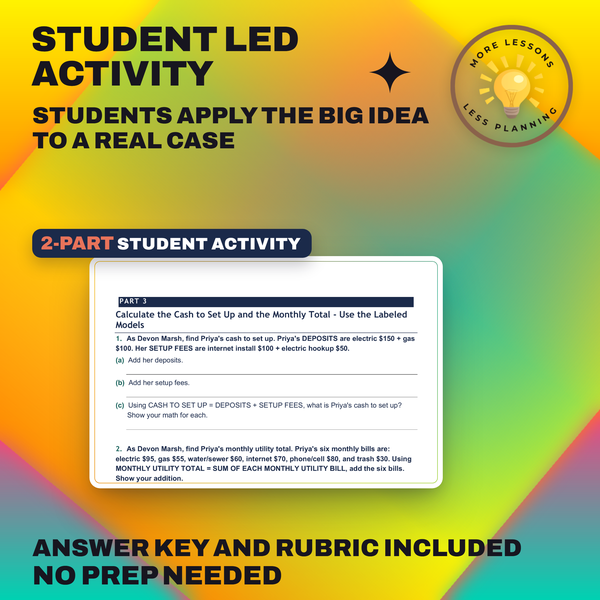
- Calculate the cash needed to set up utilities from deposits and setup fees
- Add six monthly bills into a total covering electricity, gas, water, internet, phone, and trash
- Read a bar chart to identify the biggest and smallest monthly utility bill
- Judge whether a renter has saved enough to cover the first month of utilities
What it covers
- What each home utility covers and who provides it
- The difference between a fixed cost and a variable cost
- Ways to lower a utility bill, from energy efficiency to shopping providers
Learning targets
- Name the utilities a first home needs and who provides them
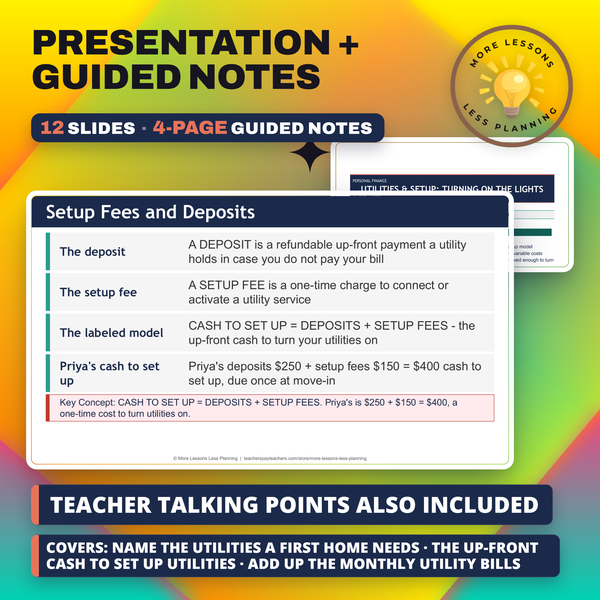
- Calculate the up-front cash to set up utilities using the labeled cash-to-set-up model
- Add up the monthly utility bills into a monthly utility total and tell fixed from variable costs
- Read a bar chart of monthly utility costs and judge whether a renter has saved enough to turn everything on
Peek inside
Utilities Keep a Home Running
UTILITIES are the basic services a home needs to run: electricity, gas, water, internet, phone, and .
Turning on utilities costs CASH up front - a deposit and a setup fee - before you get a single .
Then a Bill Every Month
After setup, each utility sends a monthly BILL you have to budget for on top of your .
Priya Nair is moving into her first ; her setup coach Devon Marsh helps her plan the cash she needs.
1. Q1. The basic services a home needs to run - electricity, gas, water, internet, phone, and trash - are called .
Why this matters
Nobody warns a new renter that the lights don't turn on for free. Before a single monthly bill arrives, there are deposits and setup fees due just to get electricity, gas, and water connected, and students who have never budgeted for that upfront cash are the ones most likely to get caught short in their first month out.
I run this right after the lease unit because the apartment is only where the spending starts. Adding up all six bills, electricity, gas, water, internet, phone, and trash, together for the first time is usually the moment a student realizes fixed costs alone can eat a paycheck before anything fun gets budgeted for.
From one teacher to another
Nobody warns first-time renters about the cash it takes just to turn the lights on before a single bill even arrives, and that gap is exactly what this lesson closes. Students work through a real move-in budget, add up six separate utility bills, and decide whether a renter has actually saved enough to be ready. It's the lesson that follows right after renting a first apartment, because the lease is only where the cost starts.
Every file in this toolkit
-
Activity (Student)
Priya Nair needs $250 in refundable deposits and $150 in setup fees before her first apartment turns on, and Devon Marsh adds six monthly bills into one utility total before judging whether a new client has saved enough.
-
Activity (Answer Key)
Getting utilities running costs Priya $400, $250 in refundable deposits plus $150 in one-time setup fees, and her six monthly bills settle into a $390 total once electric's $95 and trash's $30 mark the tallest and shortest bars on the chart.
-
Exit Ticket (Student)
Adding $400 in setup cash to a $390 monthly total becomes the opening calculation, beside the real fix for a high electric bill and whether $500 in savings covers a $680 first-month target. Cash to set up, deposits, and setup fees turn up in the response.
-
Exit Ticket (Answer Key)
A $400 setup cost and a $390 monthly total combining into $790 of first-month cash decides one answer choice, while the rubric grades the written response on cash to set up, deposits, and setup fees.
-
Guided Notes (Student)
Priya Nair needs $400 in deposits and setup fees before her lights even turn on, and her six monthly bills, from a $95 electric bill down to a $30 trash bill, add up to $390.
-
Guided Notes (Teacher Key)
$400 cash to set up and a $390 monthly total across six bills get worked out for Priya, with the $95 electric bill topping the chart and the $30 trash bill sitting at the bottom.
-
Quiz (Student)
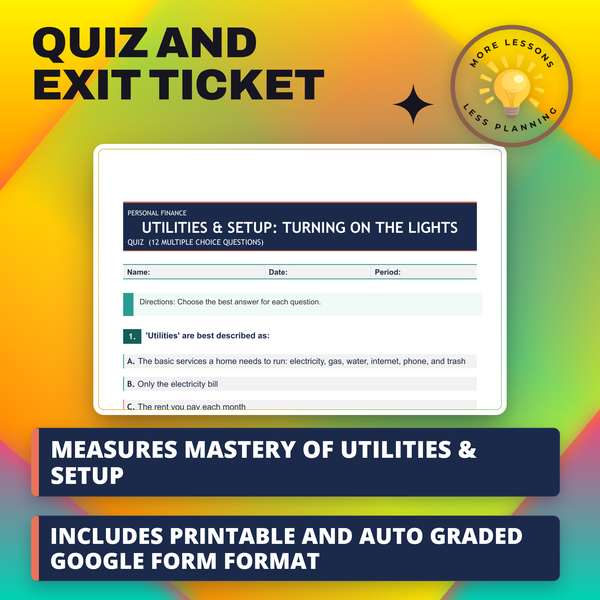
Vocabulary and math together drive this utility-setup quiz, asking students to calculate cash to set up from $250 in deposits and $150 in fees, add six monthly bills led by a $95 electric charge, and judge a renter who saved $500 toward a $680 need.
-
Quiz (Answer Key)
$400 as Priya's cash to set up and $390 as her monthly bill total are both checkmarked, alongside which of her six monthly utilities counts as the one steady, fixed bill each month.
-
Slides
Move-in costs of $400 in deposits and setup fees hit Priya before a single bill arrives, and her six monthly utilities on these slides run from a $30 trash bill up to a $95 electric one, adding to $390 a month once coach Devon Marsh helps her total them.
-
Teacher Guide
Deposits and setup fees cost Priya Nair $400 before her six monthly bills even start, adding up to $390 a month, the two-cost split this 55-point guide opens with. Extensions price a personal move-in, sort bills as variable or fixed, and shop real internet and phone providers.
-
Teacher Presentation Notes
Setup costs of $400 in deposits and fees hit Priya Nair before her first bill even arrives, and her six monthly utility bills add up to $390 once they do, with electric the biggest single line at $95.
Download
Where should I send the next one?
Everything here is free and it stays that way. Leave your email and I'll send you the new lessons as they go up. You can unsubscribe from any one of them.
Related resources
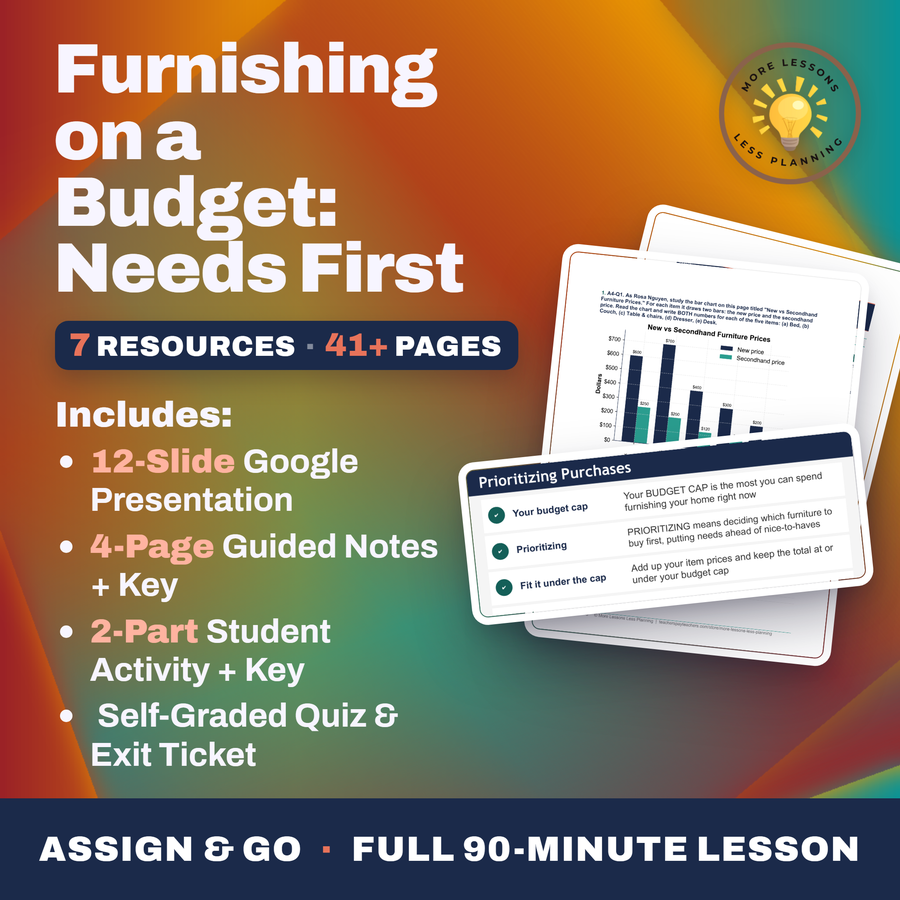
Furnishing on a Budget: Needs First
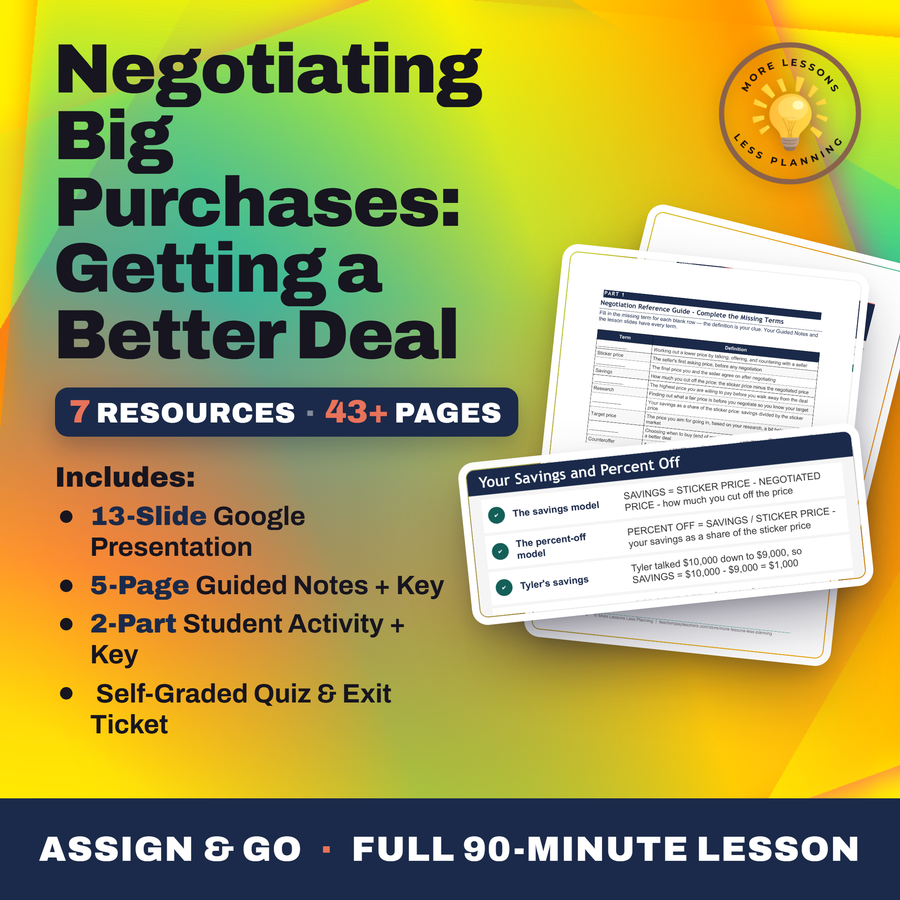
Negotiating Big Purchases: Getting a Better Deal
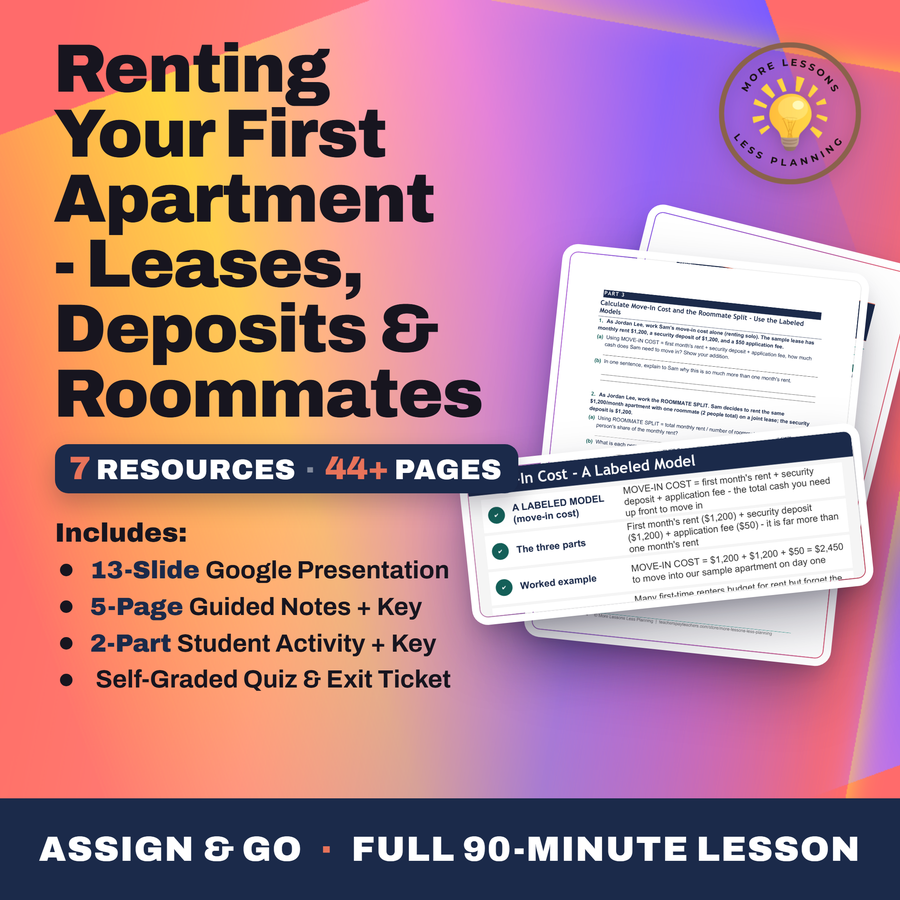
Renting Your First Apartment - Leases Deposits and Roommates
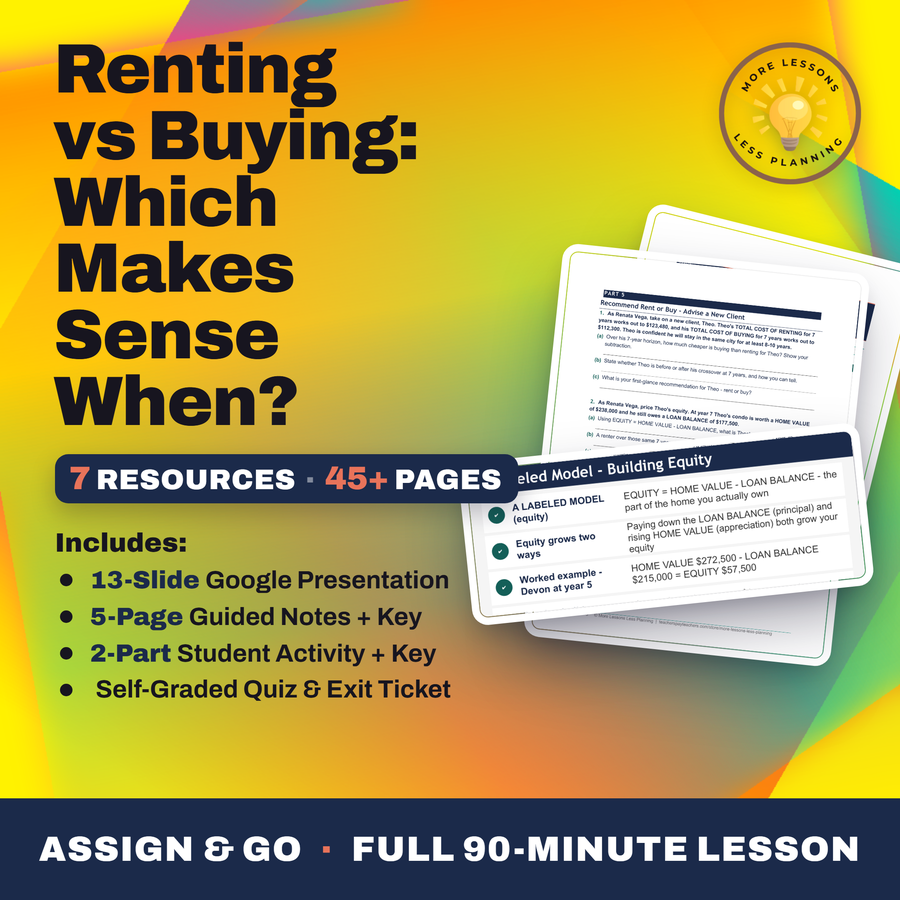
Renting vs Buying: Which Makes Sense When?
Your Move-Out Plan - Affording Independence
Banking Basics: Checking, Savings, and Debit Cards Explained
Every lesson on this site is free to download and use. If one of them saved you a prep period, you can chip in a few bucks toward my three kids' daycare fund. That's genuinely where tips go.