Your First 1000 Invested - Building a Plan
Quality reviewed September 2026
- Grades
- Grades 9-12
- Time
- About two 50-minute class periods
- Includes
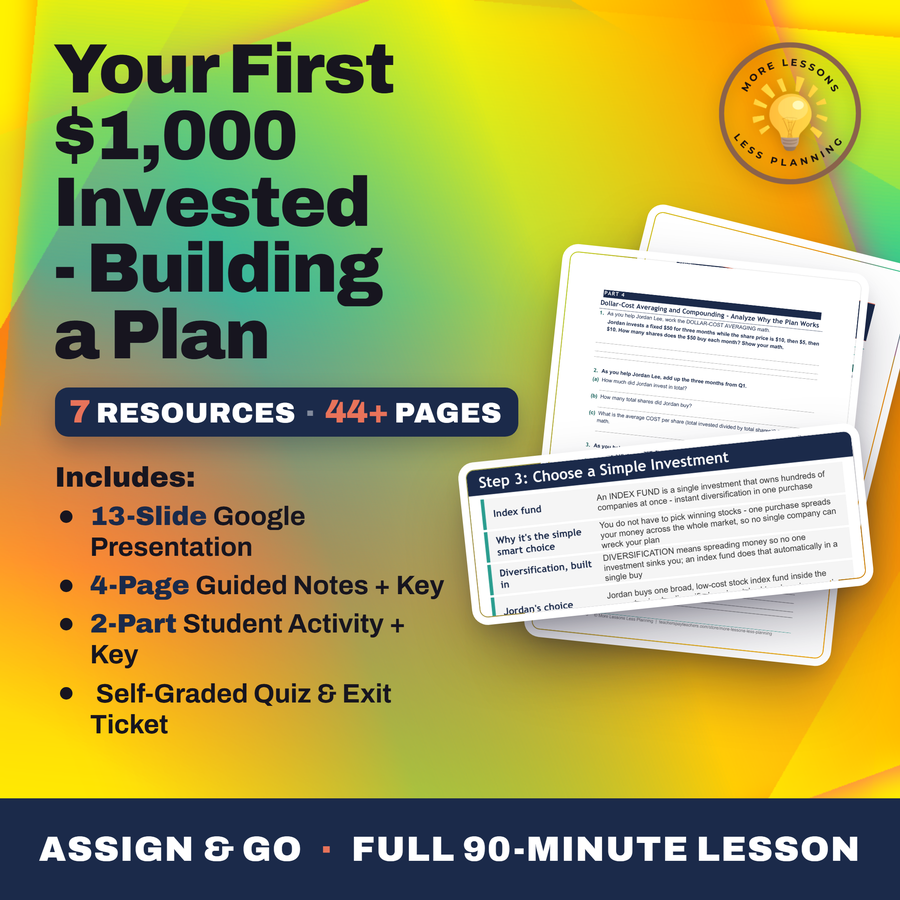
- 11 ready-to-teach files
- Format
- Word (.docx) · PowerPoint (.pptx)
- Slide deck
- Guided notes
- Guided notes teacher key
- Activity + answer key
- Quiz + answer key
- Exit ticket + answer key
- Teacher guide
- Teacher presentation notes
What students do
- Explain why starting small beats waiting to invest until you have more money
- Set a financial goal and let its time horizon guide how much investment risk actually makes sense
- Compare a brokerage account to a Roth IRA and explain why a diversified index fund is a simple first investment
- Build a full investment plan, automate a fixed monthly amount, and read how it grows over 10, 20, and 30 years
What it covers
- Why Jordan's $1,000 plus $50 a month is enough to start, and what waiting a few years to begin actually costs
- The difference between a brokerage account and a Roth IRA, and why a long time horizon points toward one over the other
- Dollar-cost averaging, and why a fixed $50 a month buys more shares when prices drop and fewer when they climb
- How much of a 30-year balance ends up being growth the investor never actually deposited
Learning targets
- Build a simple, realistic first-investment plan that applies the unit's concepts - set a goal, pick an account, choose an investment, automate it, and let it grow
- Explain why you do not need to be rich to start investing (starting small) and how a clear financial goal sets your time horizon
- Explain how to pick the right account type (brokerage vs a Roth IRA) and why a diversified index fund is a simple smart first choice
- Explain dollar-cost averaging and compounding, and read how a $1,000 + $50/month plan grows over 10, 20, and 30 years
Peek inside
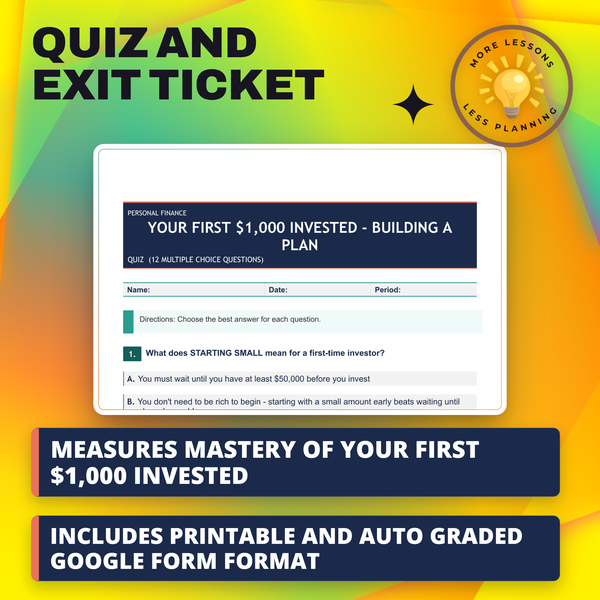
1. Q1. A simple written plan for how you will invest - your goal, your account, what you buy, and how much you add and how often - is your .
Why this matters
How much money does a person need before investing makes sense? This lesson answers with Jordan Lee's real numbers, $1,000 saved and $50 a month, walking students through the order a beginner should decide things in: pick a goal first, let its horizon choose the account, then pick one diversified index fund instead of hand-picking winners.
Dollar-cost averaging is where students push back, assuming timing the market beats automating a fixed amount monthly. I let the math settle it: that same $50 buys more shares when prices drop and fewer when they climb, and by Jordan's 30-year projection, students can name how much of that balance is deposits versus untouched growth.
From one teacher to another
Jordan Lee is 22, has $1,000 saved, and can add about $50 a month, and doesn't want to chase hot stocks, just a plan that actually works, so that's exactly what students build with Jordan's real numbers. The lesson walks through the plan in the order a beginner should actually make these decisions, set a goal first since it determines the time horizon, pick the account that matches that horizon, then choose one diversified index fund instead of trying to hand-pick winners. Dollar-cost averaging is the piece I spend the most time on, because most students assume timing the market is smarter than automating a fixed amount every month, and the math on buying more shares when prices dip says otherwise. By the time they get to Jordan's 10, 20, and 30-year projections, I want them able to point to how much of that final balance is money Jordan actually put in versus money compounding built on its own.
Every file in this toolkit
-
Activity (Student)
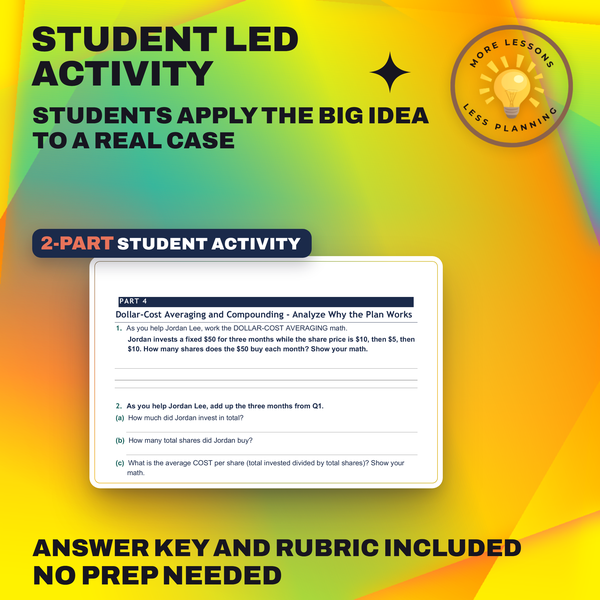
Twenty-two-year-old Jordan Lee starts with $1,000 and $50 a month, and a growth chart carries that plan out to 30 years before students run dollar-cost-averaging math on three months of $10, $5, and $10 share prices.
-
Activity (Answer Key)
Jordan's $50-a-month plan grows to $10,664 by year 10 and $69,115 by year 30, a curve adding $39,030 in its last ten years against only $19,421 in the middle stretch, and the same $50 habit buys 5, then 10, then 5 shares in a dollar-cost-averaging example where the price bounces between $10 and $5.
-
Exit Ticket (Student)
What starting small means for Jordan is the opening item, then one diversified index fund gets weighed against picking individual stocks before a $19,000-to-$69,115 gap over 30 years gets explained. Dollar-cost averaging and either index fund or compounding get folded into the write.
-
Exit Ticket (Answer Key)
The Roth IRA, the index fund, and the $19,000-to-$69,115 growth that compounding builds once Jordan's plan runs untouched are what a full-credit sample response names on this rubric.
-
Guided Notes (Student)
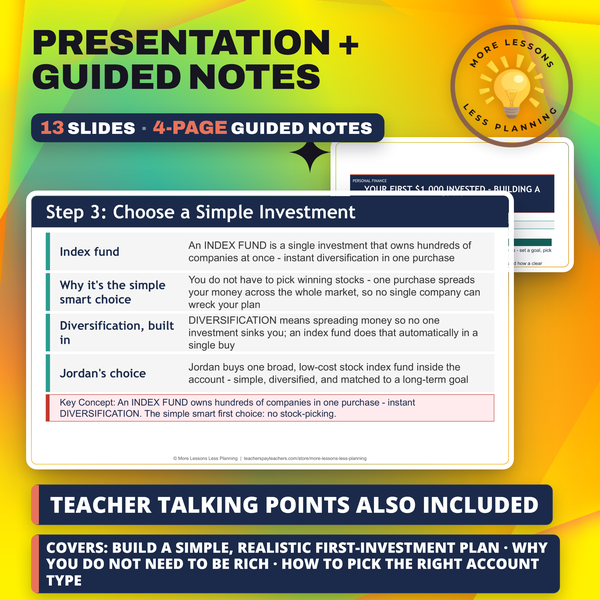
Jordan starts with $1,000 saved and $50 a month to add, and five steps build the plan from setting a goal and picking a Roth IRA to dollar-cost averaging's $7.50 average cost per share.
-
Guided Notes (Teacher Key)
The Roth IRA choice, the index fund's hundreds of companies, and a $7.50 average cost against an $8.33 average price get worked out for Jordan's plan, which grows to about $69,115 after 30 years.
-
Quiz (Student)
Explaining why $1,000 plus $50 a month is enough to start gets tested, along with matching a Roth IRA to a decades-away goal and reading Jordan's $150 dollar-cost-averaging math into a lower average cost.
-
Quiz (Answer Key)
Starting small and choosing a Roth IRA for a long-off retirement goal get the nod as correct, while how $19,000 invested actually grows to $69,115 through compounding finishes the set.
-
Slides
Starting with $1,000 saved at 22 and $50 a month to add, these slides route Jordan's plan into a Roth IRA holding one broad index fund, then show dollar-cost averaging buying more shares when the price dips and fewer when it climbs.
-
Teacher Guide
A first $1,000 plus $50 a month grows into $69,115 by year 30 for Jordan Lee through dollar-cost averaging, the case this 56-point guide's growth chart makes. Extensions turn that into a personal five-step plan, a new averaging story problem, and the cost of waiting ten years to start.
-
Teacher Presentation Notes
A first $1,000 becomes a five-step plan for Jordan Lee, adding $50 a month toward retirement, and the chart that follows tracks that habit reaching about $10,664 in the first ten years alone.
Download
Where should I send the next one?
Everything here is free and it stays that way. Leave your email and I'll send you the new lessons as they go up. You can unsubscribe from any one of them.
Related resources
Bonds - Lending to Governments and Companies
Risk vs Reward - Why You Can't Win Without Risk
Stocks 101 - Owning a Piece of a Company
The Stock Market - How It Works and Why It Moves
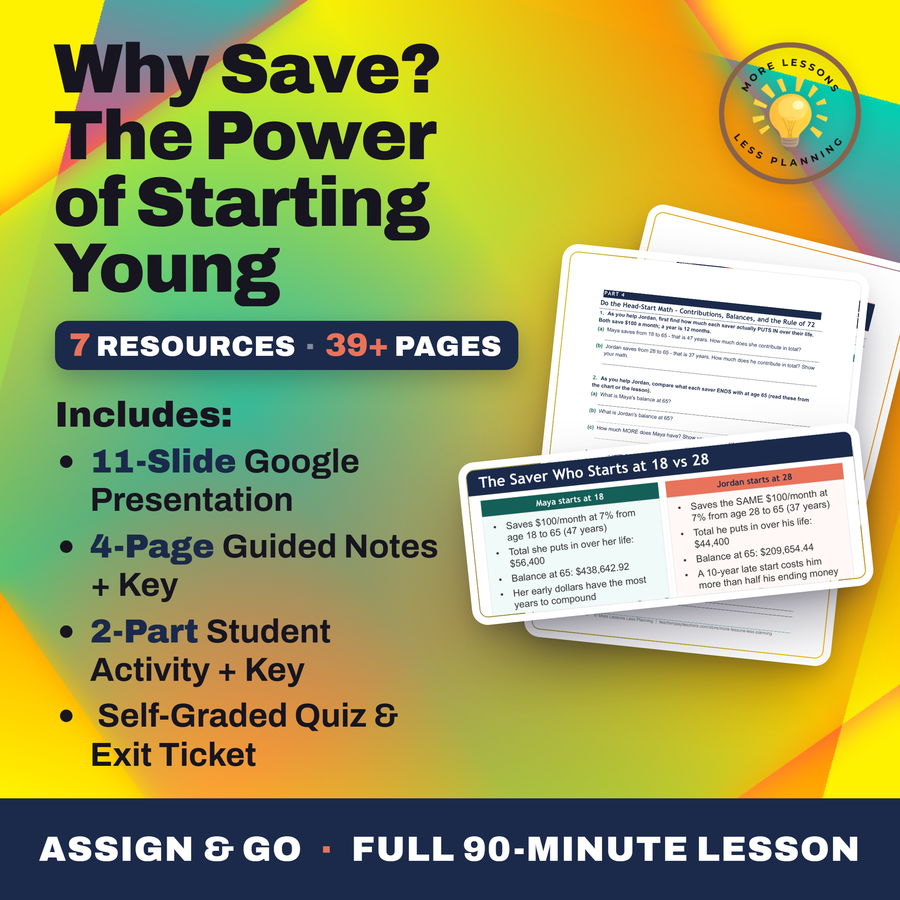
Why Save - The Power of Starting Young
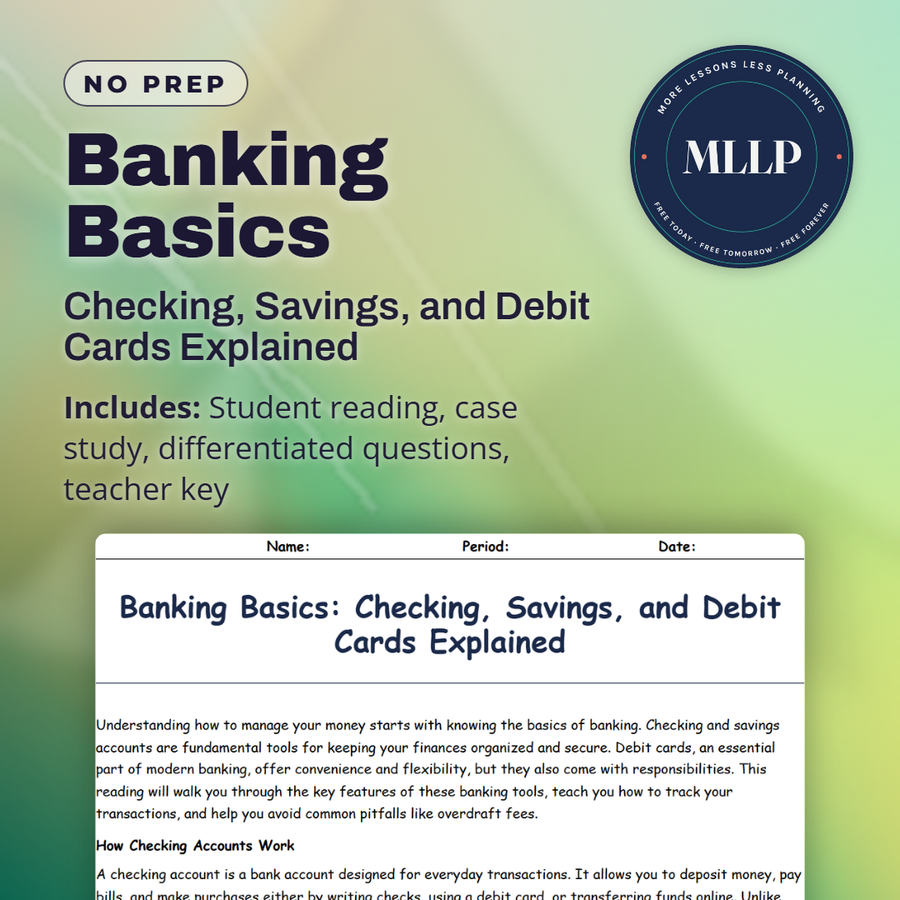
Banking Basics: Checking, Savings, and Debit Cards Explained
Every lesson on this site is free to download and use. If one of them saved you a prep period, you can chip in a few bucks toward my three kids' daycare fund. That's genuinely where tips go.