Risk vs Reward - Why You Can't Win Without Risk
Quality reviewed September 2026
- Grades
- Grades 9-12
- Time
- About two 50-minute class periods
- Includes
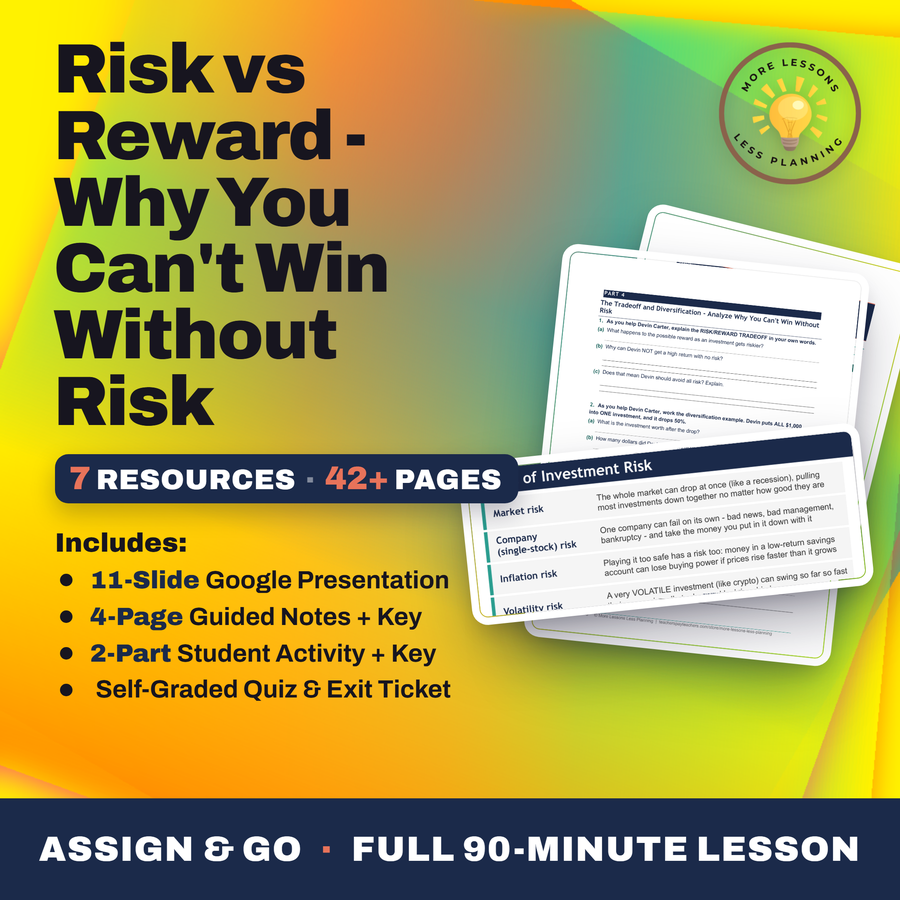
- 11 ready-to-teach files
- Format
- Word (.docx) · PowerPoint (.pptx)
- Slide deck
- Guided notes
- Guided notes teacher key
- Activity + answer key
- Quiz + answer key
- Exit ticket + answer key
- Teacher guide
- Teacher presentation notes
What students do
- Read a grouped bar chart comparing typical return and risk across four places to invest
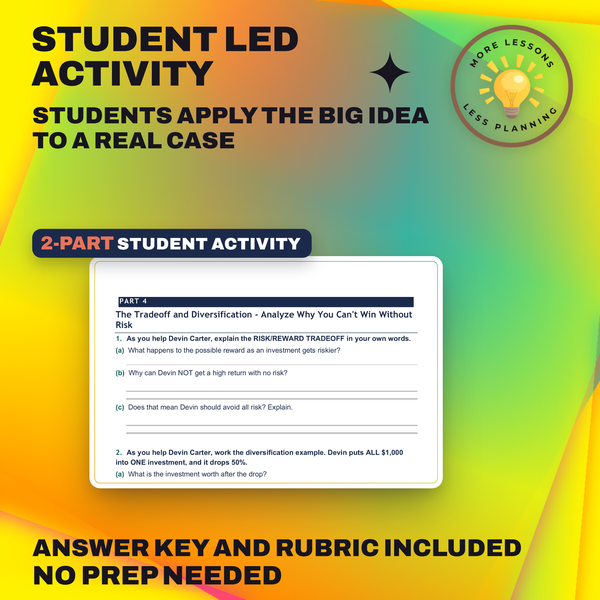
- Calculate the loss from a 50% drop on a single investment versus the same drop split across ten
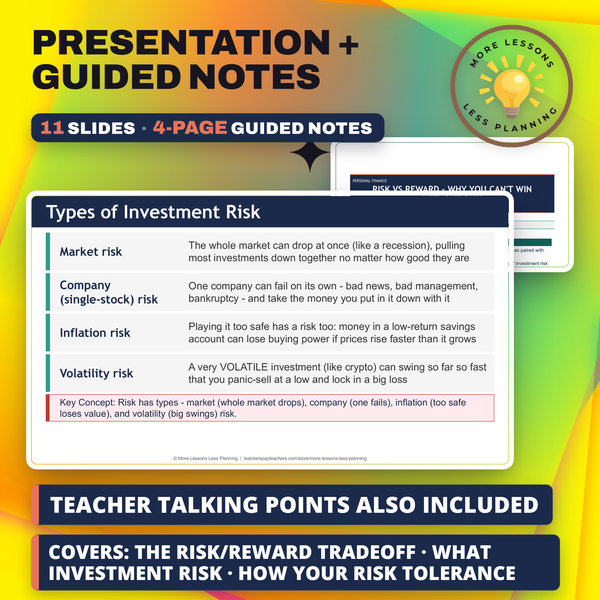
- Sort types of investment risk into market, company, inflation, and volatility risk
- Recommend an investment mix based on a given time horizon and risk tolerance
What it covers
- The risk/reward tradeoff and why a safer choice always earns less
- Volatility as the everyday face of risk, from a savings account to crypto
- How time horizon and risk tolerance decide how much risk actually fits a person
- Diversification as a way to lower risk without giving up much return
Learning targets
- Explain the risk/reward tradeoff - why a higher possible reward always comes paired with higher risk, and why you cannot win without risk
- Explain what investment risk and volatility are and identify different types of investment risk
- Explain how your risk tolerance and time horizon decide how much investment risk fits you
- Explain how diversification lowers risk and describe an investment mix that fits your goals
Peek inside
Risk
RISK is the chance that an investment loses value or does not earn what you hoped - the possibility that you get back less than you put in
Return
RETURN is the money you earn on an investment, usually shown as a percent per year - the reward side of investing
The pairing
Risk and Return
RISK is the chance that an investment loses value or does not earn what you hoped - the possibility that you get back than you put in.
RETURN is the money you earn on an investment, usually shown as a per year - the reward side of investing.
You Cannot Win Without Risk
Safe places to put money (a savings account) earn a return; the chance of a big return always comes with the chance of a big loss.
The only way to earn almost no return is to take almost no risk - so to money you must accept some risk.
1. Q1. The rule that a higher possible reward always comes paired with higher risk - so safe investments earn little - is the .
Why this matters
A 50% drop costs $500 if a student's only investment is one stock, but only $50 if that same $1,000 sits in ten different ones. That comparison is the whole case for diversification, and students calculate both numbers themselves instead of accepting that spreading money around is just generically smart.
Students arrive treating risk as something to avoid entirely, so I use Devin Carter's $1,000 and his 40-year horizon to show the safest option isn't automatically the right one. A forty-year runway absorbs volatility a five-year goal can't, and once that clicks, students stop asking what's safest and start asking what fits their own timeline.
From one teacher to another
One number does more convincing than I could in an hour: a 50% drop costs $500 if it's your only investment, but only $50 if that same money is split across ten. Students read the risk-versus-return chart across four real options and watch the reward climb slower than the risk does, then use Devin Carter's $1,000 and his 40-year time horizon to decide how much risk actually fits him. I don't want them dodging risk after this, I want them managing it on purpose.
Every file in this toolkit
-
Activity (Student)
Devin Carter has $1,000 to invest across savings, bonds, stocks, or crypto, and a chart of return against risk sets up two contrasting bets, one all in on a single pick and one split ten ways, to show what diversification actually saves.
-
Activity (Answer Key)
A 50% drop costs Devin $500 when his full $1,000 sits in one investment, but only $50 once that same $1,000 is split ten ways, a diversification lesson that sits beside crypto's chart-topping 70% swing against a savings account's 1%.
-
Exit Ticket (Student)
What a very safe account like savings actually earns is checked first, then Devin spreads $1,000 across ten investments instead of one and a question asks which pair of factors sets a person's risk level. Diversification and either time horizon or risk tolerance show up in the response.
-
Exit Ticket (Answer Key)
Naming diversification and either time horizon or risk tolerance earns credit across four rubric points, together with a sample response tying Devin's $1,000 split across ten investments to the risk/reward tradeoff he can't avoid.
-
Guided Notes (Student)
Devin weighs four investment choices across seven sections, working through market, company, inflation, and volatility risk before splitting $1,000 across ten investments so one 50 percent drop costs only $50.
-
Guided Notes (Teacher Key)
Crypto's roughly 15 percent return against its 70 percent swing gets defined here, next to the four risk types Devin faces and the $900 that stays untouched when money is spread across ten investments instead of one.
-
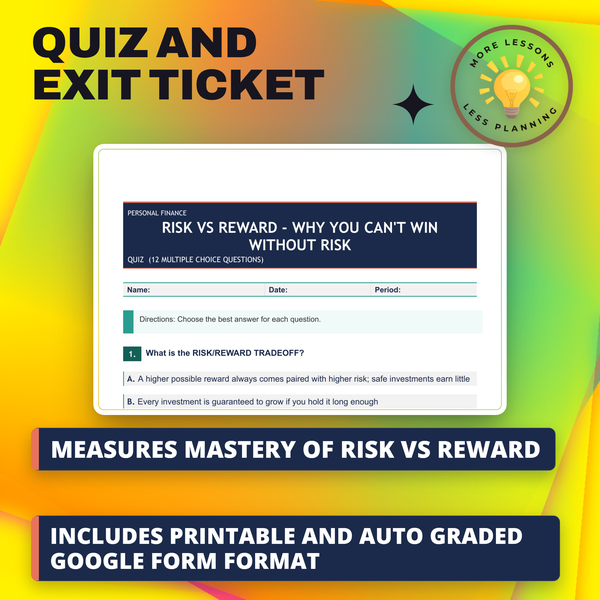
Quiz (Student)
The risk-reward tradeoff anchors this savings-versus-crypto quiz, testing what volatility actually measures and how splitting $1,000 across ten investments changes a single 50% drop's cost for Devin.
-
Quiz (Answer Key)
The risk-reward tradeoff and volatility as a value swing both come out correct, and Devin's loss dropping from $500 all the way to $50 once diversified finishes out the set.
-
Slides
Savings return about 4 percent with barely a 1 percent swing on Devin's chart, while crypto reaches for 15 percent and swings 70, and these slides use that spread to teach risk tolerance, time horizon, and why diversification spreads the bet.
-
Teacher Guide
Splitting $1,000 across savings, bonds, stocks, and crypto is Devin Carter's example, where a 50% drop costs $500 alone but only $50 spread across ten investments, the math this 56-point guide teaches. Extensions design a personal asset mix, research volatility, and write a diversification problem.
-
Teacher Presentation Notes
First-time investing with $1,000 sets up Devin Carter's choice among five earlier toolkits at once, the setup for showing how splitting that money across ten investments turns a $500 loss into just $50.
Download
Where should I send the next one?
Everything here is free and it stays that way. Leave your email and I'll send you the new lessons as they go up. You can unsubscribe from any one of them.
Related resources
Bonds - Lending to Governments and Companies
Stocks 101 - Owning a Piece of a Company
The Stock Market - How It Works and Why It Moves
Why Save - The Power of Starting Young
Your First 1000 Invested - Building a Plan
Banking Basics: Checking, Savings, and Debit Cards Explained
Every lesson on this site is free to download and use. If one of them saved you a prep period, you can chip in a few bucks toward my three kids' daycare fund. That's genuinely where tips go.