Stocks 101 - Owning a Piece of a Company
Quality reviewed September 2026
- Grades
- Grades 9-12
- Time
- About two 50-minute class periods
- Includes
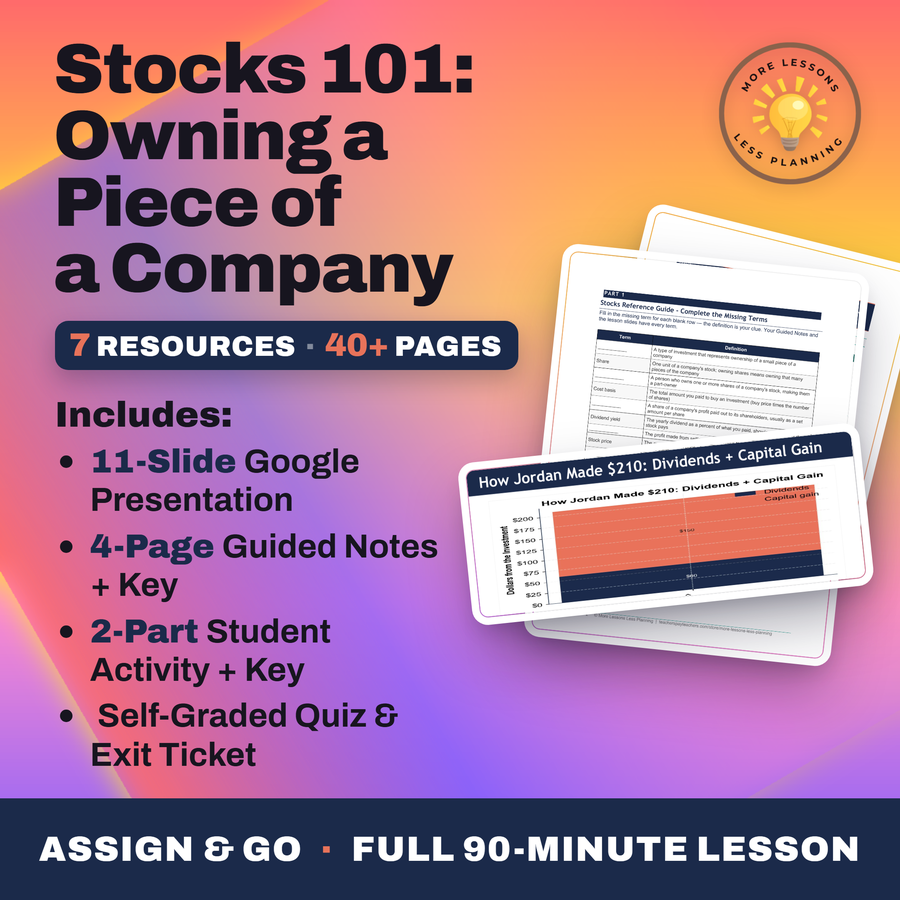
- 11 ready-to-teach files
- Format
- Word (.docx) · PowerPoint (.pptx)
- Slide deck
- Guided notes
- Guided notes teacher key
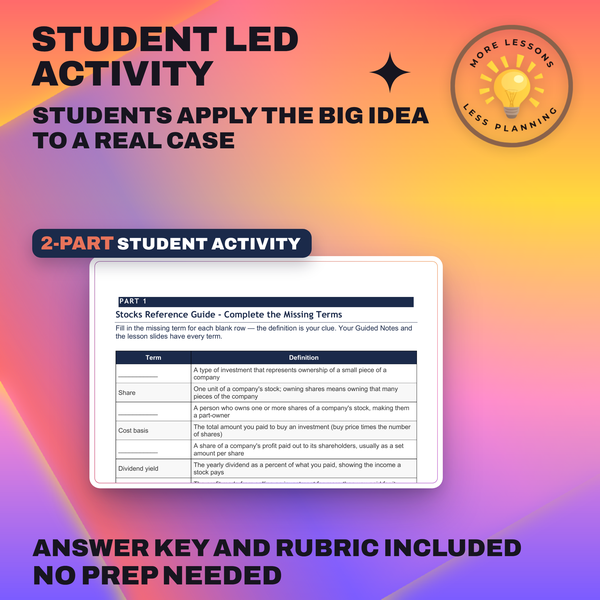
- Activity + answer key
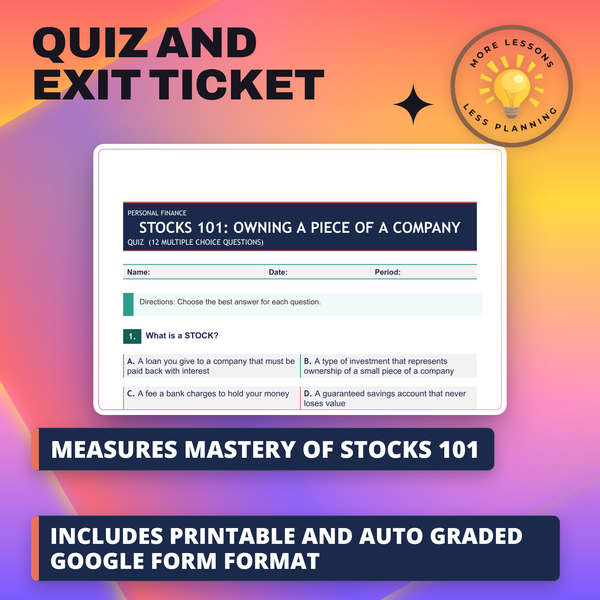
- Quiz + answer key
- Exit ticket + answer key
- Teacher guide
- Teacher presentation notes
What students do
- Calculate a $500 cost basis on 10 shares and the resulting total return using Total Return = Capital Gain + Dividends
- Distinguish dividends, which are collected without selling, from a capital gain, which only locks in once a share is sold
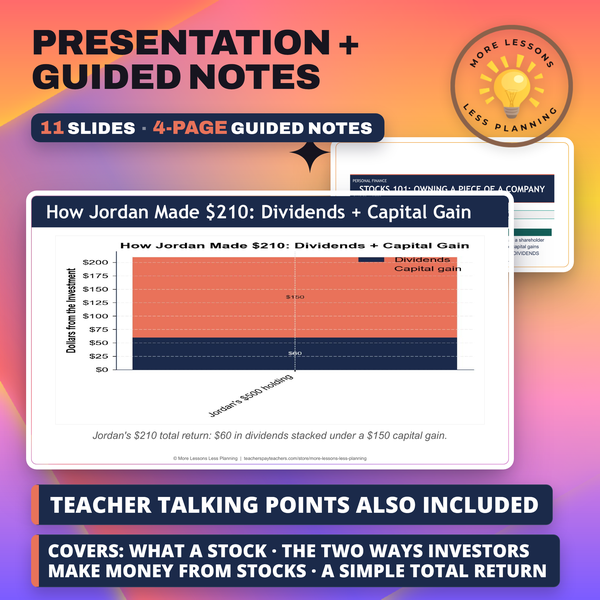
- Read a stacked bar chart showing how a $60 dividend total and a $150 capital gain add up to a $210 total return
- Calculate a capital loss on a falling stock to see that a stock is not a guaranteed return like a savings account
What it covers
- Total Return = Capital Gain + Dividends, applied to a real 10-share stock purchase
- The difference between a dividend, collected just for holding a share, and a capital gain, locked in only at sale
- Reading a stacked bar chart that breaks a total return into its dividend and capital-gain pieces
- Running the same math on a losing stock to test whether dividends alone can save a trade from a net loss
Learning targets
- Explain what a stock is and what it means to own a share of a company as a shareholder
- Describe the two ways investors make money from stocks: dividends and capital gains
- Calculate a simple total return using TOTAL RETURN = CAPITAL GAIN + DIVIDENDS
- Explain why stock prices rise and fall, so a stock is not a guaranteed return
Peek inside
Stock and Share
A STOCK is a type of investment that represents OWNERSHIP of a small of a company - buying it makes you a part-owner, not a lender.
A SHARE is one unit of a company's stock; owning 10 shares means you own 10 small of that company.
Why Companies Sell Stock
Companies sell shares of stock to raise to grow; in return, buyers get a piece of the company and a claim on its future success.
The STOCK PRICE is what one share costs right now; Jordan buys GreenLeaf Foods at a $50 stock price, so 10 shares cost $ .
Why this matters
Owning ten shares of a $50 stock is a legal claim on a piece of that company, not a bet, and this lesson holds students to that distinction. They track a $500 purchase two ways, the $60 in dividends paid just for holding shares and the $150 capital gain locked in only once shares sell, then add both for a $210 total return.
Most students want to stop at that total and skip the part where a return isn't guaranteed. The last calculation runs identical math on a stock that drops instead of climbs, and every student finds out for themselves whether a dividend alone can rescue a losing trade.
From one teacher to another
The picture in most students' heads when they hear "the stock market" is closer to a casino than an actual ownership stake in a company, so this lesson starts by making that concrete: buying 10 shares at $50 each makes you a shareholder, a part-owner, full stop. From there they track a single $500 investment two ways, the $60 in dividends collected just for holding the shares and the $150 capital gain locked in only once the shares are sold at $65, then add them with Total Return = Capital Gain + Dividends to land on $210, a 42% return. I don't let them walk away thinking stocks are a sure thing either, so the last calculation runs the same math on a stock that loses value instead of gaining it, and students find out for themselves whether dividends alone are enough to save the trade from a net loss.
Every file in this toolkit
-
Activity (Student)
Jordan Reyes buys 10 shares of GreenLeaf Foods at $50 each, and a stacked bar chart splits the $210 total return into dividends and capital gain before a second saver's shares fall from $40 to $34 to test whether dividends alone cover the loss.
-
Activity (Answer Key)
Ten GreenLeaf shares turn Jordan's $500 cost basis into a $210 total return, $150 from selling at $65 and $60 in dividends stacked on the chart, while a friend's falling stock locks in a $30 capital loss that $10 in dividends only partly offsets.
-
Exit Ticket (Student)
Owning one share of a company gets defined early, then the quiz names the two ways an investor actually gets paid before adding Jordan's $150 capital gain to his $60 in dividends. Shareholder, dividend, and capital gain drive the closing paragraph.
-
Exit Ticket (Answer Key)
Walking $60 in dividends and a $150 capital gain into Jordan's exact $210 total return is what earns full marks here, together with correct use of shareholder, dividend, and capital gain in the written response.
-
Guided Notes (Student)
Jordan buys 10 shares of GreenLeaf Foods at $50 each, and the shareholder and dividend terms build toward TOTAL RETURN equals CAPITAL GAIN plus DIVIDENDS and Jordan's final answer.
-
Guided Notes (Teacher Key)
$500 cost basis, $60 in dividends over three years, and a $150 capital gain make up the pieces here, so a teacher can check Jordan's $210 total return line at a glance without redoing the math.
-
Quiz (Student)
Ten GreenLeaf shares move this set from what a dividend is to calculating a capital gain on a sale from $50 to $65 and a total return combining that gain with dividends, then close on why holding for years beats reacting to swings.
-
Quiz (Answer Key)
GreenLeaf questions on Jordan's $150 gain, $20 dividend year, and $30 capital loss are all marked correct, with a full letter-by-letter answer list at the end for grading the whole set.
-
Slides
GreenLeaf shares bought at $50 each open this deck's opening slide for Jordan, who then collects $60 in dividends over three years before selling at $65 for a $150 capital gain, the two pieces these slides add into a $210 total return.
-
Teacher Guide
A $500 purchase of GreenLeaf Foods turns into a $210 total return between dividends and a sale at $65 a share for Jordan Reyes, the math this 48-point guide is built around. Extensions price shares of a real company, sort dividend from capital-gain statements, and build a three-stock mini-portfolio.
-
Teacher Presentation Notes
A $500 cost basis on Jordan's 10 shares returns $210 total, $60 in dividends stacked on a $150 capital gain, before the steps for opening a brokerage account and placing a first order.
Download
Where should I send the next one?
Everything here is free and it stays that way. Leave your email and I'll send you the new lessons as they go up. You can unsubscribe from any one of them.
Related resources
Bonds - Lending to Governments and Companies
Risk vs Reward - Why You Can't Win Without Risk
The Stock Market - How It Works and Why It Moves
Why Save - The Power of Starting Young
Your First 1000 Invested - Building a Plan
Banking Basics: Checking, Savings, and Debit Cards Explained
Every lesson on this site is free to download and use. If one of them saved you a prep period, you can chip in a few bucks toward my three kids' daycare fund. That's genuinely where tips go.