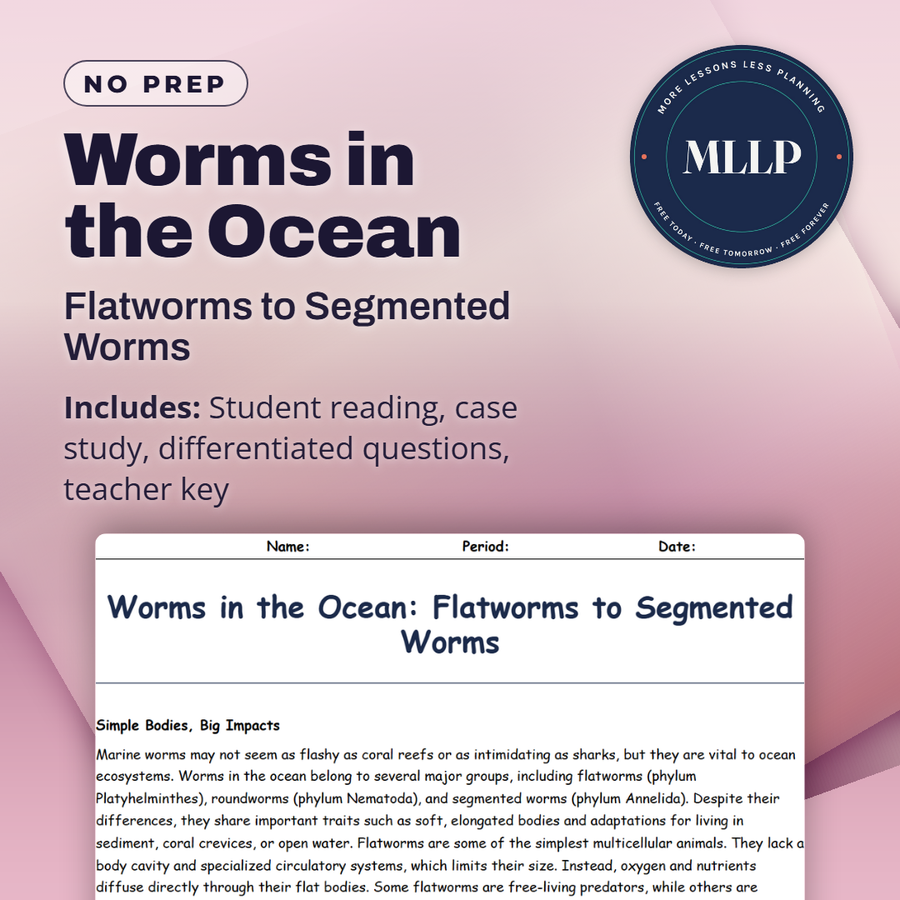
Worms in the Ocean: Flatworms to Segmented Worms
Quality reviewed September 2026
Facts verified September 14, 2026
- Subject
- Science
- Grades
- Grades 9-12
- Length
- 5-page student worksheet
- Time
- About one 50-minute class period
- Great for
- Sub plans and independent work
- Includes
- Reading passage, comprehension questions + full answer key
- Format
- Print-and-go PDF
What students do
- Match terms like flatworms, roundworms, polychaetes, annelids, and segmentation to their correct definitions
- Fill in the blank sentences on how flatworms exchange oxygen, how polychaetes help seagrass, and where roundworms are most abundant
- Answer multiple choice questions on what makes annelids more advanced than flatworms, which worms dominate marine sediments, and the ecological role of marine worms
- Write short answers on why worms count as ecosystem engineers, how flatworms use coloration for defense, how flatworm and roundworm digestion differs, and how polychaete worms affect seagrass bed health
What it covers
- The three worm phyla found in the ocean, flatworms, roundworms, and segmented polychaete worms
- How burrowing worms oxygenate sediment and recycle nutrients for other marine life
- A case study on polychaete worms burrowing in seagrass beds and their effect on seagrass health
Start reading this worksheet
Simple Bodies, Big Impacts
Marine worms may not seem as flashy as coral reefs or as intimidating as sharks, but they are vital to ocean ecosystems. Worms in the ocean belong to several major groups, including flatworms (phylum Platyhelminthes), roundworms (phylum Nematoda), and segmented worms (phylum Annelida). Despite their differences, they share important traits such as soft, elongated bodies and adaptations for living in sediment, coral crevices, or open water. Flatworms are some of the simplest multicellular animals. They lack a body cavity and specialized circulatory systems, which limits their size. Instead, oxygen and nutrients diffuse directly through their flat bodies. Some flatworms are free-living predators, while others are parasites. Their bright colors often serve as warnings to potential predators that they may contain toxins. Roundworms, in contrast, have a complete digestive tract with both a mouth and anus, making them more efficient at processing food. Many live in sediments, where they play important roles in nutrient recycling. Others are parasitic, living inside fish or invertebrates. Segmented worms, or annelids, are the most complex of the three. Their bodies are divided into repeating segments, allowing for greater flexibility and mobility. Marine annelids include polychaetes, which have bristle-like appendages for movement and respiration. Polychaetes are critical ecosystem engineers, as they burrow into sediments, mix nutrients, and create habitats for other organisms.
Like what you read? The full reading, the case study, and every question set are in the free download below, along with the answer key.
Why this matters
No student picks a worm as their favorite ocean animal, which is exactly the gap this reading is built to close. Flatworms move oxygen through their bodies by simple diffusion, polychaetes are segmented and burrow through the seafloor, and that burrowing does something coral reefs and sharks never get credit for: it oxygenates sediment and recycles nutrients for everything else living there.
The seagrass bed case study is where this pays off in class. Polychaete burrowing releases the nutrients that grow denser, healthier seagrass, and that cause and effect runs in reverse just as cleanly: pollution or oxygen loss cutting the worm population would leave the whole bed worse off.
From one teacher to another
Marine worms rarely get attention next to coral reefs or sharks, but flatworms, roundworms, and segmented polychaetes quietly keep sediment ecosystems running. This worksheet compares the three groups, from the simple diffusion-based bodies of flatworms to the segmented, burrowing polychaetes that oxygenate the seafloor. The case study looks at polychaete worms in seagrass beds, where their burrowing releases nutrients that support denser, healthier seagrass growth. Students weigh how a small, overlooked organism can shape an entire habitat once pollution or oxygen loss cuts its population.
What you get
Download
Where should I send the next one?
Everything here is free and it stays that way. Leave your email and I'll send you the new lessons as they go up. You can unsubscribe from any one of them.
Related resources
Adaptations for Survival: Camouflage, Shells, and Toxins
Arthropods of the Sea: Crabs, Lobsters, and Shrimp
Cnidarians: Corals, Jellyfish, and Sea Anemones
Echinoderms: Sea Stars and Sea Urchins
Exploring Marine Invertebrates: Diversity Beneath the Waves
Invertebrates in Food Webs: Ecosystem Engineers of the Sea
Every lesson on this site is free to download and use. If one of them saved you a prep period, you can chip in a few bucks toward my three kids' daycare fund. That's genuinely where tips go.