Cnidarians: Corals, Jellyfish, and Sea Anemones
Quality reviewed September 2026
Facts verified September 14, 2026
- Subject
- Science
- Grades
- Grades 9-12
- Length
- 6-page student worksheet
- Time
- About one 50-minute class period
- Great for
- Sub plans and independent work
- Includes
- Reading passage, comprehension questions + full answer key
- Format
- Print-and-go PDF
What students do
- Match terms like nematocyst, coral reef, sea anemone, zooxanthellae, and medusa to their correct definitions
- Fill in the blank sentences on how coral polyps build reefs, how jellyfish move, and the algae living inside coral tissue
- Answer multiple choice questions on cnidocytes, which cnidarian partners with clownfish, and what causes coral bleaching
- Write short answers on jellyfish blooms, the coral-zooxanthellae partnership, why cnidarians succeed despite simple bodies, and what repeated coral bleaching events mean for reef ecosystems
What it covers
- How stinging cnidocytes let jellyfish, corals, and sea anemones capture prey and defend themselves
- The coral-zooxanthellae partnership that builds reefs and the bleaching that happens when it breaks down
- A case study on the 2016 coral bleaching event on the Great Barrier Reef
Start reading this worksheet
Ancient Survivors of the Sea
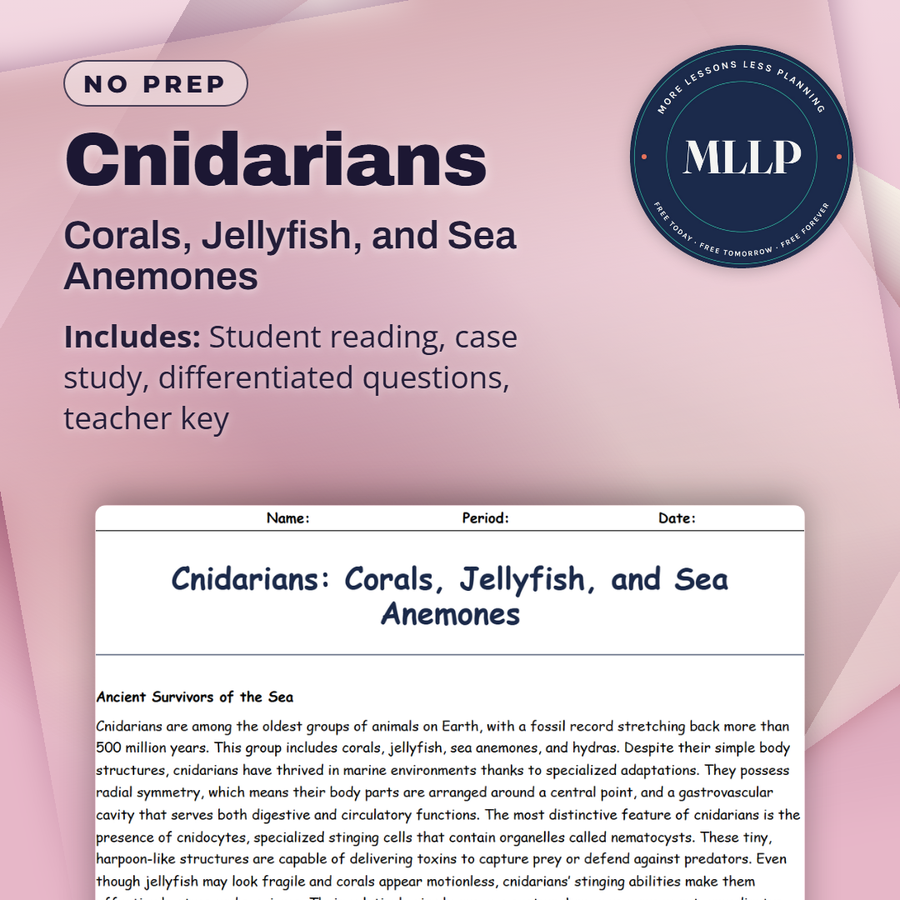
Cnidarians are among the oldest groups of animals on Earth, with a fossil record stretching back more than 500 million years. This group includes corals, jellyfish, sea anemones, and hydras. Despite their simple body structures, cnidarians have thrived in marine environments thanks to specialized adaptations. They possess radial symmetry, which means their body parts are arranged around a central point, and a gastrovascular cavity that serves both digestive and circulatory functions. The most distinctive feature of cnidarians is the presence of cnidocytes, specialized stinging cells that contain organelles called nematocysts. These tiny, harpoon-like structures are capable of delivering toxins to capture prey or defend against predators. Even though jellyfish may look fragile and corals appear motionless, cnidarians’ stinging abilities make them effective hunters and survivors. Their relatively simple nervous system, known as a nerve net, coordinates swimming, feeding, and defense behaviors, showing how complexity is not always necessary for success.
Corals and Reef Building
Corals are perhaps the most ecologically important cnidarians because they create coral reefs, which support vast marine biodiversity. Reef-building corals form colonies of tiny animals called polyps, which secrete a calcium carbonate skeleton. Over thousands of years, these skeletons accumulate and create massive reef structures such as the Great Barrier Reef. A unique and vital partnership underlies coral survival. Corals live in symbiosis with microscopic algae called zooxanthellae. These algae perform photosynthesis and provide the coral with essential nutrients, while corals supply the algae with protection and access to sunlight. This relationship fuels reef growth and enables coral ecosystems to thrive in nutrient-poor tropical waters. However, when stressed by rising temperatures or pollution, corals may expel their symbiotic algae, leading to coral bleaching. Without their algae, corals lose color and risk starvation, endangering the entire reef ecosystem.
Like what you read? The full reading, the case study, and every question set are in the free download below, along with the answer key.
Why this matters
An animal with no brain and one opening that serves as mouth and exit does not sound built for survival, yet cnidarians manage it by relying on stinging cells instead of complexity. Cnidocytes let jellyfish, corals, and sea anemones capture prey and defend themselves, and coral polyps partner with zooxanthellae to build entire reefs.
The 2016 Great Barrier Reef bleaching event makes that partnership feel fragile instead of clever, showing what happens the moment rising temperatures break the bond between coral and its algae. I like starting with the sting and ending with the bleaching, moving from one cell's structure to an ecosystem's collapse.
From one teacher to another
Cnidarians look simple, with no brain and a body built around one central opening, but their stinging cells make them effective hunters and survivors. The worksheet covers how cnidocytes work, how coral polyps build reefs with the help of zooxanthellae, and how jellyfish and sea anemones use the same basic body plan in very different ways. The case study on the Great Barrier Reef's 2016 bleaching event shows what happens when rising temperatures break the coral-algae partnership apart. Students move from cellular structure to ecosystem consequences within one reading.
What you get
Download
Where should I send the next one?
Everything here is free and it stays that way. Leave your email and I'll send you the new lessons as they go up. You can unsubscribe from any one of them.
Related resources
Adaptations for Survival: Camouflage, Shells, and Toxins
Arthropods of the Sea: Crabs, Lobsters, and Shrimp
Echinoderms: Sea Stars and Sea Urchins
Exploring Marine Invertebrates: Diversity Beneath the Waves
Invertebrates in Food Webs: Ecosystem Engineers of the Sea
Marine Invertebrate Reproduction: Strategies and Life Cycles
Every lesson on this site is free to download and use. If one of them saved you a prep period, you can chip in a few bucks toward my three kids' daycare fund. That's genuinely where tips go.