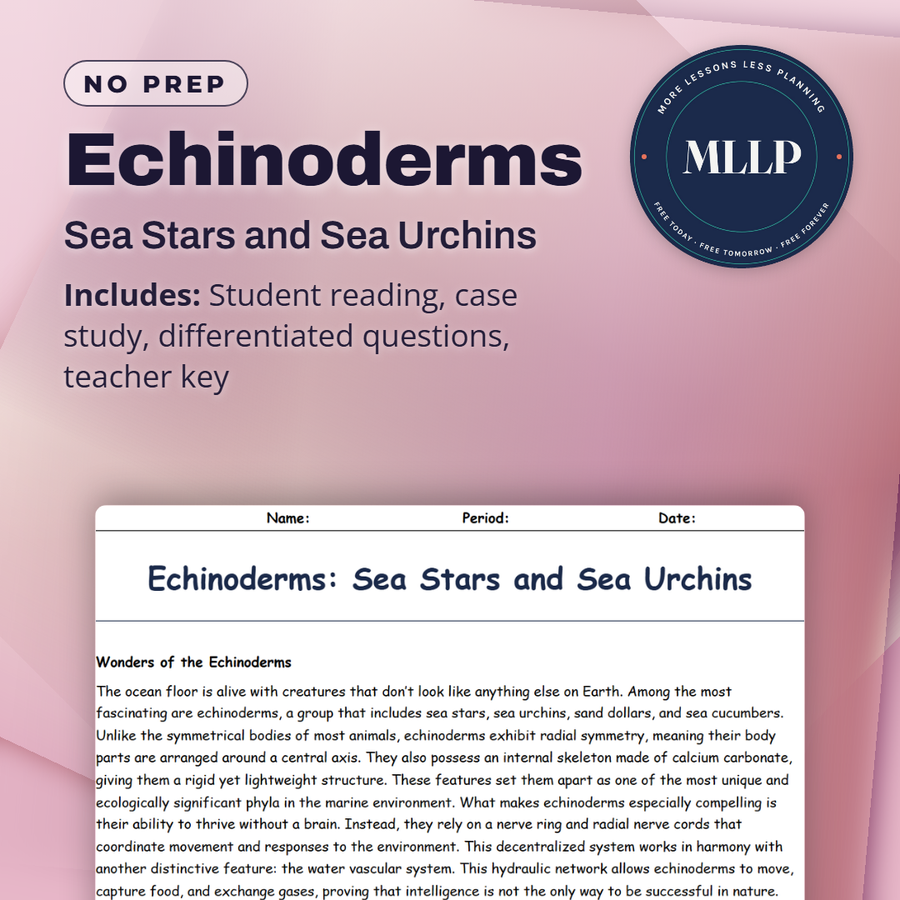
Echinoderms: Sea Stars and Sea Urchins
Quality reviewed September 2026
Facts verified September 14, 2026
- Subject
- Science
- Grades
- Grades 9-12
- Length
- 7-page student worksheet
- Time
- About one 50-minute class period
- Great for
- Sub plans and independent work
- Includes
- Reading passage, comprehension questions + full answer key
- Format
- Print-and-go PDF
What students do
- Match terms like water vascular system, tube feet, regeneration, sea urchin spines, and keystone predator to their correct definitions
- Fill in the blank sentences on the madreporite, the echinoderm skeleton, and how sea cucumbers defend themselves
- Answer multiple choice questions on the water vascular system, Aristotle's lantern, and why sea stars count as keystone predators
- Write short answers on how tube feet pry open shells, what happens when sea urchins overpopulate kelp forests, why scientists study echinoderm regeneration, and how Sea Star Wasting Disease affected rocky shore biodiversity
What it covers
- How the water vascular system powers tube feet for movement, feeding, and prying open shells
- How sea stars and sea urchins act as keystone species that keep mussels and algae in check
- A case study on Sea Star Wasting Disease and its effect on rocky shore ecosystems
Start reading this worksheet
Wonders of the Echinoderms
The ocean floor is alive with creatures that don’t look like anything else on Earth. Among the most fascinating are echinoderms, a group that includes sea stars, sea urchins, sand dollars, and sea cucumbers. Unlike the symmetrical bodies of most animals, echinoderms exhibit radial symmetry, meaning their body parts are arranged around a central axis. They also possess an internal skeleton made of calcium carbonate, giving them a rigid yet lightweight structure. These features set them apart as one of the most unique and ecologically significant phyla in the marine environment. What makes echinoderms especially compelling is their ability to thrive without a brain. Instead, they rely on a nerve ring and radial nerve cords that coordinate movement and responses to the environment. This decentralized system works in harmony with another distinctive feature: the water vascular system. This hydraulic network allows echinoderms to move, capture food, and exchange gases, proving that intelligence is not the only way to be successful in nature.
The Water Vascular System
At the heart of echinoderm biology is the water vascular system, a network of canals powered by seawater. Water enters through a sieve-like structure called the madreporite, travels through canals, and extends into tube feet. These tube feet act like suction cups, enabling echinoderms to cling to rocks, open shells, and slowly crawl across the sea floor. The water vascular system is a perfect example of evolutionary innovation. It allows echinoderms to survive in environments ranging from sandy shallows to deep-sea habitats. For sea stars, the ability to exert steady pressure with tube feet gives them the power to pry open tightly shut clams and mussels. For sea urchins, the system helps coordinate movement of their spines and feeding structures, called Aristotle’s lantern, which scrape algae from rocks. This unique way of moving and feeding is unlike anything found in vertebrates. It highlights how adaptation can take many forms, especially in the demanding environment of the ocean.
Regeneration and Survival
One of the most well-known abilities of echinoderms is regeneration. If a sea star loses an arm, it can regrow it over time. In some cases, a single lost arm can even grow into a whole new individual, provided part of the central disk is attached. This ability provides a powerful survival advantage, allowing echinoderms to escape predators and recover from injury. Sea cucumbers take regeneration to the extreme. When threatened, some species expel their internal organs to distract predators, later regenerating the lost parts. This process, though shocking, is an effective way to survive in a hostile environment. Regeneration also makes echinoderms valuable for scientific study. Researchers investigate these mechanisms to better understand tissue repair, with potential implications for medical science and regenerative therapies. What may look like a simple starfish arm on the beach is, in fact, a gateway to new insights into biology and medicine.
Like what you read? The full reading, the case study, and every question set are in the free download below, along with the answer key.
Why this matters
Sea stars and sea urchins move, feed, and pry open shellfish without blood or a brain, relying on a hydraulic water vascular system that powers their tube feet. That system lets a sea star regrow a lost arm, and explains why removing a keystone predator like a sea star can let sea urchins overrun a kelp forest.
I bring up Sea Star Wasting Disease right after the anatomy section, because an animal this simple seems like it should be hard to wipe out in large numbers. Watching mussel populations shift once sea stars disappeared from the Pacific Coast turns keystone species from a term into something that happened.
From one teacher to another
Sea stars and sea urchins move and feed without a single drop of blood or a brain, relying instead on a hydraulic water vascular system that powers their tube feet. The worksheet explains how that system works, how sea stars regenerate lost arms, and why sea urchins can overgraze kelp forests if nothing keeps their numbers in check. The case study on Sea Star Wasting Disease documents a real die-off along the Pacific Coast and what happened to mussel populations once sea stars disappeared. Students connect anatomy to ecosystem-level consequences in a single reading.
What you get
Download
Where should I send the next one?
Everything here is free and it stays that way. Leave your email and I'll send you the new lessons as they go up. You can unsubscribe from any one of them.
Related resources
Adaptations for Survival: Camouflage, Shells, and Toxins
Arthropods of the Sea: Crabs, Lobsters, and Shrimp
Cnidarians: Corals, Jellyfish, and Sea Anemones
Exploring Marine Invertebrates: Diversity Beneath the Waves
Invertebrates in Food Webs: Ecosystem Engineers of the Sea
Marine Invertebrate Reproduction: Strategies and Life Cycles
Every lesson on this site is free to download and use. If one of them saved you a prep period, you can chip in a few bucks toward my three kids' daycare fund. That's genuinely where tips go.