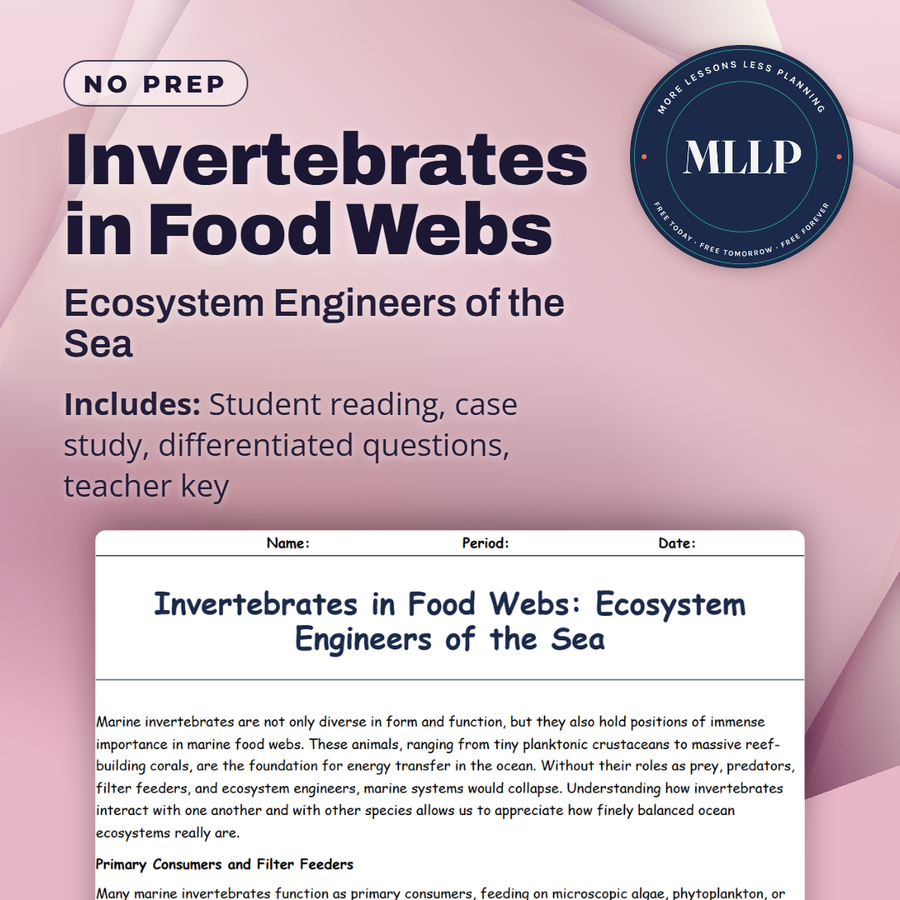
Invertebrates in Food Webs: Ecosystem Engineers of the Sea
Quality reviewed September 2026
Facts verified September 14, 2026
- Subject
- Science
- Grades
- Grades 9-12
- Length
- 7-page student worksheet
- Time
- About one 50-minute class period
- Great for
- Sub plans and independent work
- Includes
- Reading passage, comprehension questions + full answer key
- Format
- Print-and-go PDF
What students do
- Match terms like copepods, coral reefs, sea urchin barrens, detritivores, and keystone predator to their correct definitions
- Fill in the blank sentences on the sea urchin population boom after otters declined, copepods and krill, and coral reefs as ecosystem engineers
- Answer multiple choice questions on why sea stars are keystone predators, which invertebrates filter feed, and what detritivores like sea cucumbers do
- Write short answers on how filter feeders keep water clear, how removing one predator can cascade through a food web, why detritivores matter long term, and how the sea otter decline triggered a kelp forest collapse
What it covers
- The different roles invertebrates play in food webs, from primary consumers and filter feeders to predators and ecosystem engineers
- How detritivores like worms and sea cucumbers recycle nutrients and keep marine systems productive
- A case study on how the decline of sea otters caused a sea urchin population boom and the collapse of kelp forests
Start reading this worksheet
Marine invertebrates are not only diverse in form and function, but they also hold positions of immense importance in marine food webs. These animals, ranging from tiny planktonic crustaceans to massive reef-building corals, are the foundation for energy transfer in the ocean. Without their roles as prey, predators, filter feeders, and ecosystem engineers, marine systems would collapse. Understanding how invertebrates interact with one another and with other species allows us to appreciate how finely balanced ocean ecosystems really are.
Primary Consumers and Filter Feeders
Many marine invertebrates function as primary consumers, feeding on microscopic algae, phytoplankton, or detritus. Small crustaceans such as copepods and krill are critical players at this level. By grazing on phytoplankton, they transfer energy from the sun (captured through photosynthesis by algae) up the food chain to fish, whales, and seabirds. Similarly, filter feeders such as sponges, bivalves, and tunicates clean the water as they feed, removing excess particles and maintaining water clarity. Their activity reduces harmful algal blooms and provides stability to coastal ecosystems. By occupying these roles, filter feeders not only support higher levels of the food web but also regulate their environments in ways that benefit countless other organisms.
Predators and Keystone Roles
Other marine invertebrates serve as predators, helping control populations and preventing any single species from dominating. Sea stars, for instance, are known as keystone predators because of their ability to regulate mussel populations. Without sea stars, mussels would outcompete other species and reduce biodiversity. Similarly, jellyfish feed on plankton and small fish, impacting fish populations and competing directly with humans in some areas for food resources. The predatory nature of these animals is essential to maintaining ecological balance. Predators prevent unchecked growth of prey species, fostering healthier and more resilient communities.
Like what you read? The full reading, the case study, and every question set are in the free download below, along with the answer key.
Why this matters
Whales, sharks, and dolphins are what students usually name first when asked about important ocean animals. Almost nobody says copepod or sea cucumber, yet this reading sorts invertebrates into five roles, primary consumers, filter feeders, predators, ecosystem engineers, and detritivores, and shows the system depends on all five, not just the ones with a face people recognize.
My students always want to skip the detritivores section because recycling nutrients sounds boring next to a sea star wrecking a mussel bed. I make them sit with the sea otter and urchin case study anyway: pull out one link, invertebrate or not, and the kelp forest collapses either way.
From one teacher to another
Marine invertebrates fill nearly every role in an ocean food web, from copepods grazing on plankton to sea stars regulating mussel beds. This worksheet breaks those roles into five categories, primary consumers, filter feeders, predators, ecosystem engineers, and detritivores, showing how each keeps the system balanced. The case study on sea otters and sea urchins traces a real chain reaction, where the loss of one predator let urchins overgraze entire kelp forests into barren rock. Students see how a single missing link can ripple through an entire ecosystem.
What you get
Download
Where should I send the next one?
Everything here is free and it stays that way. Leave your email and I'll send you the new lessons as they go up. You can unsubscribe from any one of them.
Related resources
Adaptations for Survival: Camouflage, Shells, and Toxins
Arthropods of the Sea: Crabs, Lobsters, and Shrimp
Cnidarians: Corals, Jellyfish, and Sea Anemones
Echinoderms: Sea Stars and Sea Urchins
Exploring Marine Invertebrates: Diversity Beneath the Waves
Marine Invertebrate Reproduction: Strategies and Life Cycles
Every lesson on this site is free to download and use. If one of them saved you a prep period, you can chip in a few bucks toward my three kids' daycare fund. That's genuinely where tips go.