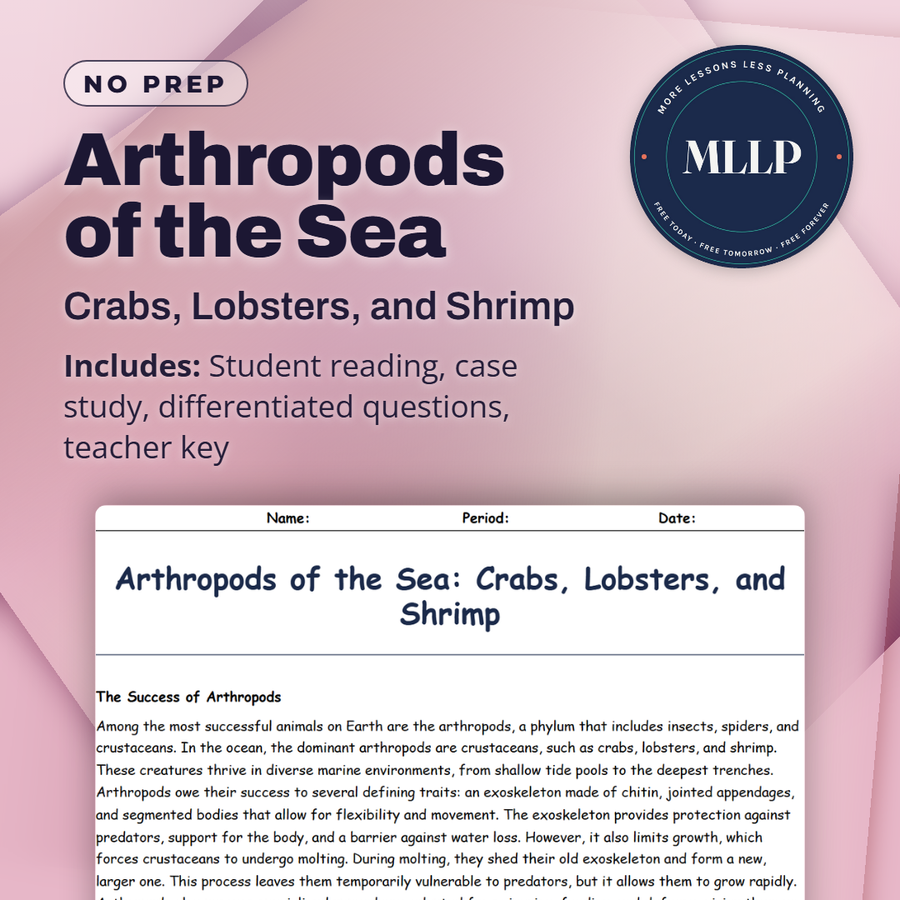
Arthropods of the Sea: Crabs, Lobsters, and Shrimp
Quality reviewed September 2026
Facts verified September 14, 2026
- Subject
- Science
- Grades
- Grades 9-12
- Length
- 6-page student worksheet
- Time
- About one 50-minute class period
- Great for
- Sub plans and independent work
- Includes
- Reading passage, comprehension questions + full answer key
- Format
- Print-and-go PDF
What students do
- Match terms like hermit crab, lobster, cleaner shrimp, blue crab, and pistol shrimp to their correct definitions
- Fill in the blank sentences on the crustacean exoskeleton, lobster claws, and the role shrimp play as prey
- Answer multiple choice questions on why crustaceans molt, how hermit crabs protect themselves, and what cleaner shrimp do for fish
- Write short answers on the risks of molting, the value of shrimp fisheries, how crabs, lobsters, and shrimp differ in what they eat, and why the blue crab is considered a keystone species in the Chesapeake Bay
What it covers
- How crabs, lobsters, and shrimp use their exoskeletons, claws, and molting cycles to grow and survive
- The different feeding roles of scavenging crabs, burrowing lobsters, and filter-feeding or cleaning shrimp
- A case study on the blue crab's decline in the Chesapeake Bay from overfishing, pollution, and habitat loss
Start reading this worksheet
The Success of Arthropods
Among the most successful animals on Earth are the arthropods, a phylum that includes insects, spiders, and crustaceans. In the ocean, the dominant arthropods are crustaceans, such as crabs, lobsters, and shrimp. These creatures thrive in diverse marine environments, from shallow tide pools to the deepest trenches. Arthropods owe their success to several defining traits: an exoskeleton made of chitin, jointed appendages, and segmented bodies that allow for flexibility and movement. The exoskeleton provides protection against predators, support for the body, and a barrier against water loss. However, it also limits growth, which forces crustaceans to undergo molting. During molting, they shed their old exoskeleton and form a new, larger one. This process leaves them temporarily vulnerable to predators, but it allows them to grow rapidly. Arthropods also possess specialized appendages adapted for swimming, feeding, and defense, giving them an edge in nearly every habitat. Crustaceans vary greatly in size and shape. Tiny copepods drift as plankton, forming a critical base for marine food webs. Larger species, such as lobsters and king crabs, are apex scavengers and predators in benthic ecosystems. Their ability to fill so many ecological roles makes them indispensable to ocean health.
Crabs: Masters of Adaptation
Crabs are among the most recognizable marine arthropods. With their flattened bodies, sideways walk, and powerful claws, they have adapted to a wide range of habitats. Some crabs live in tide pools and can tolerate exposure to air during low tides, while others inhabit coral reefs, sandy beaches, or the deep sea. Their chelae (claws) are used for defense, communication, and feeding, whether cracking open shells or tearing apart detritus. One of the most remarkable groups is the hermit crabs, which use abandoned snail shells for protection instead of producing their own. As they grow, hermit crabs must find larger shells, often competing with one another for this limited resource. This behavior demonstrates both the resourcefulness and adaptability of crabs. Crabs also play an important ecological role. Many are scavengers, cleaning up dead organisms and recycling nutrients back into the environment. Some species are predators, while others feed on algae, contributing to balance in ecosystems. Their wide range of diets allows them to maintain healthy marine communities.
Lobsters: Giants of the Crustaceans
Lobsters are another iconic group of marine arthropods. The American lobster, for example, is a major commercial species prized for its meat. Lobsters live in rocky or muddy seafloors, where they dig burrows or hide among crevices. They are primarily nocturnal, emerging at night to scavenge or hunt small fish and invertebrates. Lobsters are notable for their size, with some individuals weighing over 40 pounds. Their chelipeds (large front claws) are specialized: one is typically larger and functions as a “crusher,” while the other is slimmer and acts as a “cutter.” This division of labor allows them to handle a wide variety of prey and food sources. Like other crustaceans, lobsters must molt in order to grow. Young lobsters molt frequently, but as they age, the process slows. Some lobsters can live for decades, making them one of the longest-lived invertebrates in the ocean. Beyond their ecological role as predators and scavengers, lobsters are a cultural and economic cornerstone in many coastal communities. Their management and conservation are critical to preventing overfishing and ensuring sustainable harvests.
Like what you read? The full reading, the case study, and every question set are in the free download below, along with the answer key.
Why this matters
Growing out of your own skeleton sounds like science fiction, but a crab, lobster, or shrimp has to do exactly that to get bigger, leaving it soft and exposed until the new shell hardens. Hermit crabs solve the problem by borrowing shells instead of growing their own, while pistol shrimp and cleaner shrimp put similar bodies to very different use.
Students tend to lump crabs, lobsters, and shrimp into one seafood category until the Chesapeake Bay case study traces the blue crab's decline through overfishing, pollution, and lost seagrass habitat. One crustacean becomes an entry point for how several small pressures add up to a population crash.
From one teacher to another
Crabs, lobsters, and shrimp all share a hard exoskeleton and the awkward problem of outgrowing it. This worksheet covers how molting works, why hermit crabs borrow shells instead of growing their own, and how pistol shrimp and cleaner shrimp fill very different niches. The case study on the Chesapeake Bay's blue crab connects that biology to a real fishery, tracking how overfishing, pollution, and lost seagrass habitat have cut into the population. Students get a mix of vocabulary, function, and a resource management problem grounded in one species.
What you get
Download
Where should I send the next one?
Everything here is free and it stays that way. Leave your email and I'll send you the new lessons as they go up. You can unsubscribe from any one of them.
Related resources
Adaptations for Survival: Camouflage, Shells, and Toxins
Cnidarians: Corals, Jellyfish, and Sea Anemones
Echinoderms: Sea Stars and Sea Urchins
Exploring Marine Invertebrates: Diversity Beneath the Waves
Invertebrates in Food Webs: Ecosystem Engineers of the Sea
Marine Invertebrate Reproduction: Strategies and Life Cycles
Every lesson on this site is free to download and use. If one of them saved you a prep period, you can chip in a few bucks toward my three kids' daycare fund. That's genuinely where tips go.