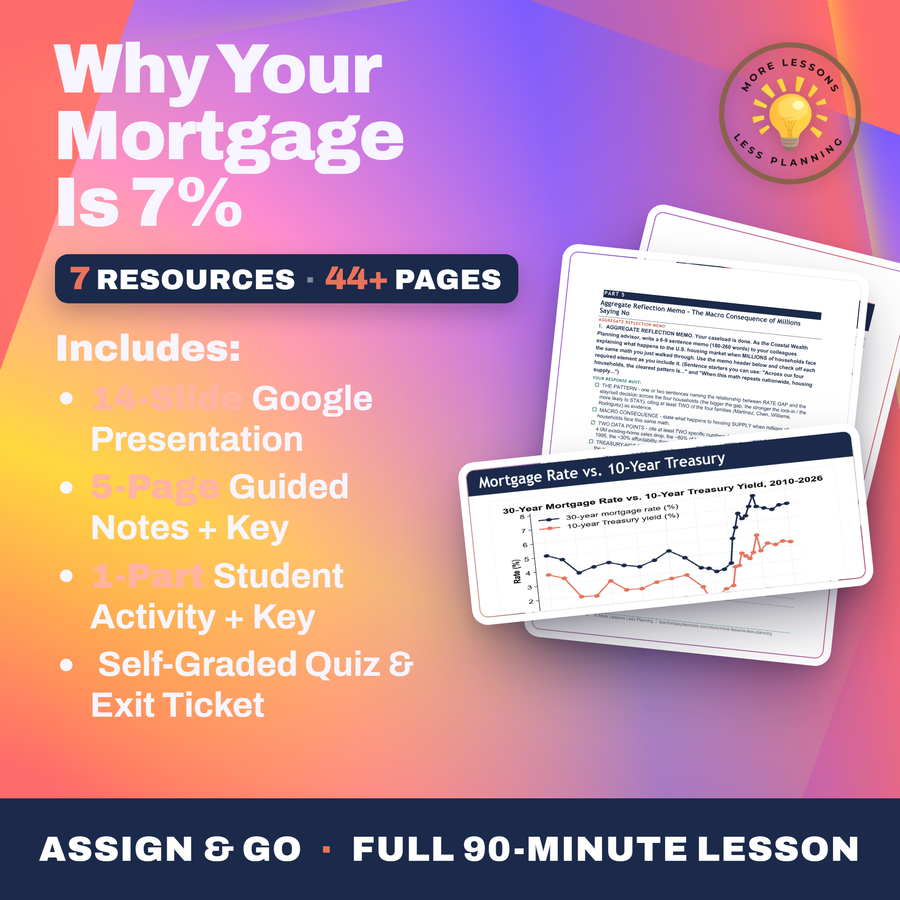

Why Your Mortgage Is 7%
Quality reviewed September 2026
- Grades
- Grades 9-12
- Time
- About two 50-minute class periods
- Includes
- 11 ready-to-teach files
- Format
- Word (.docx) · PowerPoint (.pptx)
- Slide deck
- Guided notes
- Guided notes teacher key
- Activity + answer key
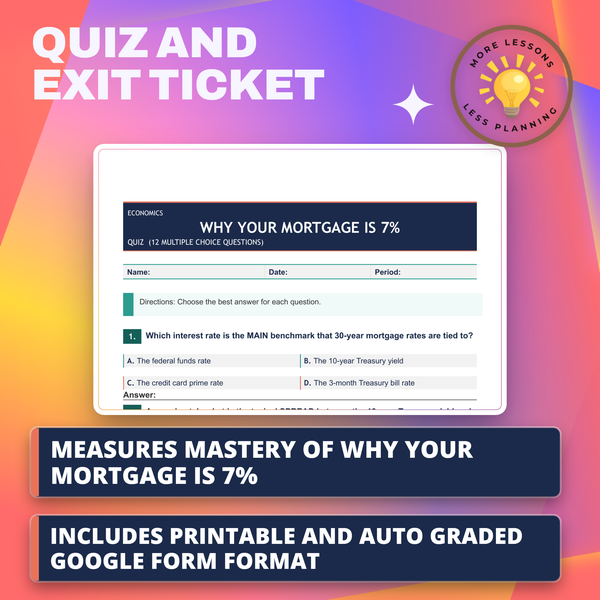
- Quiz + answer key
- Exit ticket + answer key
- Teacher guide
- Teacher presentation notes
What students do
- Explain why 30-year mortgages track the 10-year Treasury yield plus a spread rather than the federal funds rate
- Trace the 2022-2024 rate shock from a January 2021 low of 2.65% to an October 2023 peak of 7.79%
- Compute the rate gap and monthly payment delta for four households, then recommend stay or sell for each
- Write an aggregate memo on why Fed rate cuts alone won't unfreeze housing supply, citing real sales figures
What it covers
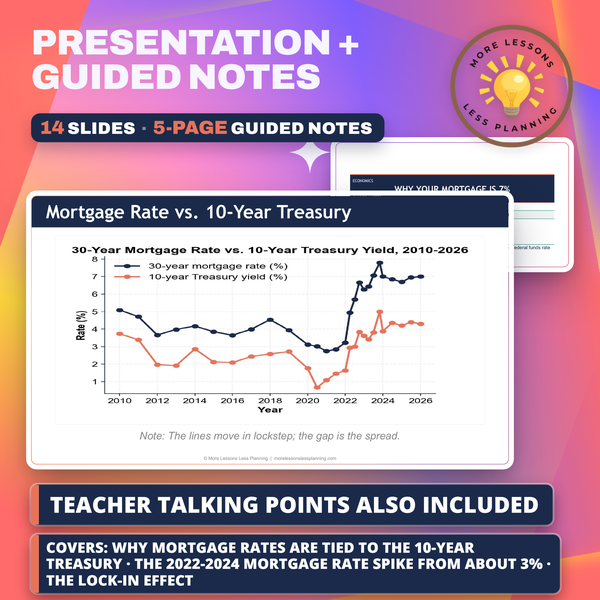
- Why 30-year mortgage rates track the 10-year Treasury yield plus a spread, not the federal funds rate directly
- The 2022-2024 rate shock, from a January 2021 low of 2.65% to an October 2023 peak of 7.79%
- The lock-in effect, where a low locked-in rate keeps homeowners from selling and re-borrowing at market rate
- Four households, the Martinezes, the Chens, the Williamses, and Maria Rodriguez, each testing the stay-or-sell math differently
Learning targets
- Explain why mortgage rates are tied to the 10-year Treasury yield, not the federal funds rate directly
- Trace the 2022-2024 mortgage rate spike from about 3% to about 7%
- Evaluate the lock-in effect: how a wide rate gap freezes housing supply
Peek inside
7%
Average 30-year mortgage rate, 2026
3%
Average 30-year mortgage rate, late 2020-2021
Did You Know? October 2023 saw 30-year mortgage rates hit 7.79% - the highest in 23 years (since 2000).
The Price Tag
In 2026 the average 30-year mortgage rate is about %.
In late 2020-2021 the same rate was only about %.
Rates more than between January 2022 and October 2023.
In October 2023 mortgage rates hit % - the highest in 23 years.
What the Doubling Costs You
1. The benchmark long-term interest rate that 30-year mortgage rates actually track - U.S. government debt that matures in a decade, considered the safest dollar investment in the world - is the .
Why this matters
Between January 2021 and October 2023 the 30-year mortgage rate went from a record 2.65 percent to 7.79 percent, the fastest doubling since 1981, and most people blame that on the Fed directly instead of the real driver, the 10-year Treasury yield plus a spread.
I built the Williams family specifically to break that pattern: a bigger rate gap looks like an easy call to sell, until downsizing changes what the same gap actually means for them. Running four households through identical math to four different answers is what finally convinces students that personal finance depends on your own numbers, not a rule of thumb.
From one teacher to another
This lesson exists to correct the single most common misconception about mortgages, that the Federal Reserve sets them directly, when the real formula is the 10-year Treasury yield plus a spread of about 150 to 200 basis points. Students trace the actual 2022-2024 shock themselves, watching the 30-year rate move from a record 2.65% low in January 2021 to a 7.79% peak in October 2023, the fastest doubling since 1981. The four-household activity is where the concept becomes real math: playing a financial advisor, students compute the rate gap and monthly payment delta for the Martinez family, the Chens, the Williamses, and Maria Rodriguez, and I built one household, the Williamses, specifically to test whether a bigger rate gap always has to mean stay, since they're downsizing and that changes what the numbers actually recommend. Students also work through why homeowners with a low locked-in rate refuse to sell, since moving means re-borrowing at market rate, and how that lock-in effect froze existing-home sales well below their 2021 peak. The closing memo makes them explain, in their own words, why a Fed rate cut alone doesn't fix this, tying it back to the Treasury yield connection rather than the fed funds rate everyone assumes controls it.
Every file in this toolkit
-
Activity (Student)
The Martinez, Chen, Williams, and Rodriguez families each bring a different reason to move. A financial advisor runs their numbers against a 7 percent loan, then writes an aggregate memo recommending whether each household should stay put or list their home.
-
Activity (Answer Key)
A 4.05 percentage point gap costs the Martinez family $19,368 a year to move, worked out in full. The Williams household saves $6,396 by downsizing instead, against a national pattern of existing-home sales falling from 6.1 million to 4.0 million.
-
Exit Ticket (Student)
Multiple-choice items name the benchmark 30-year mortgage rates track, estimate how far that rate climbed from its January 2021 low to its October 2023 peak, and describe the lock-in effect on the 2023-2024 housing market. Students explain the Treasury-yield link and the freeze with real data.
-
Exit Ticket (Answer Key)
Ten-year Treasury yields are the real benchmark, roughly 2.65 percent up to 7.79 percent marks the recorded jump, and homeowners staying put instead of re-borrowing at a higher rate names the lock-in effect. The benchmark, the mechanism, the freeze explanation, and one data point round it out.
-
Guided Notes (Student)
A $400,000 loan at 3 percent costs $1,686 a month against $2,661 at 7 percent, and students trace that $975 gap through the Treasury-plus-spread formula, October 2023's 4.99 percent yield plus a 2.80 point spread equaling 7.79 percent. They test the lock-in effect against real 2024 sales figures.
-
Guided Notes (Teacher Key)
The January 2021 low of 2.65 percent against the October 2023 peak of 7.79 percent, and the Treasury math behind it, 4.99 percent plus a 2.80 point spread, stand worked out step by step. The lock-in effect's 80 percent of homeowners below 5 percent carries its full figures.
-
Quiz (Student)
Which rate 30-year mortgages actually track is the benchmark item, and a household question asks what a $400,000 loan's payment does when a 3 percent rate becomes 7 percent.
-
Quiz (Answer Key)
Treasury's 10-year yield stands as the real benchmark mortgages track, that household's payment climbs somewhere near $900 to $1,000, and this marks the fastest rate doubling since 1981.
-
Slides
The 10-year Treasury yield with about 1.5 to 2 percentage points added on top explains the climb from 2.65 percent in January 2021 to 7.79 percent in October 2023, and a later slide shows existing home sales falling from 6.1 million to about 4.0 million as owners lock in place.
-
Teacher Guide
One activity has students build a stay-or-sell calculator from the loan-payment formula and the guide's thresholds, under 1 percent means sell and over 3 percent means stay, then test it on the four households. A question asks why the September 2024 Fed cut barely moved mortgage rates.
-
Teacher Presentation Notes
A 30 year rate hitting 7.79 percent in October 2023 opens one card, then the deck ties it to the 10 year Treasury yield instead of the overnight fed funds number, with the connecting spread scripted at roughly 150 basis points wide.
Download
Where should I send the next one?
Everything here is free and it stays that way. Leave your email and I'll send you the new lessons as they go up. You can unsubscribe from any one of them.
Related resources
Deflation: Why Falling Prices Are Bad

Hyperinflation: Weimar, Zimbabwe, Venezuela
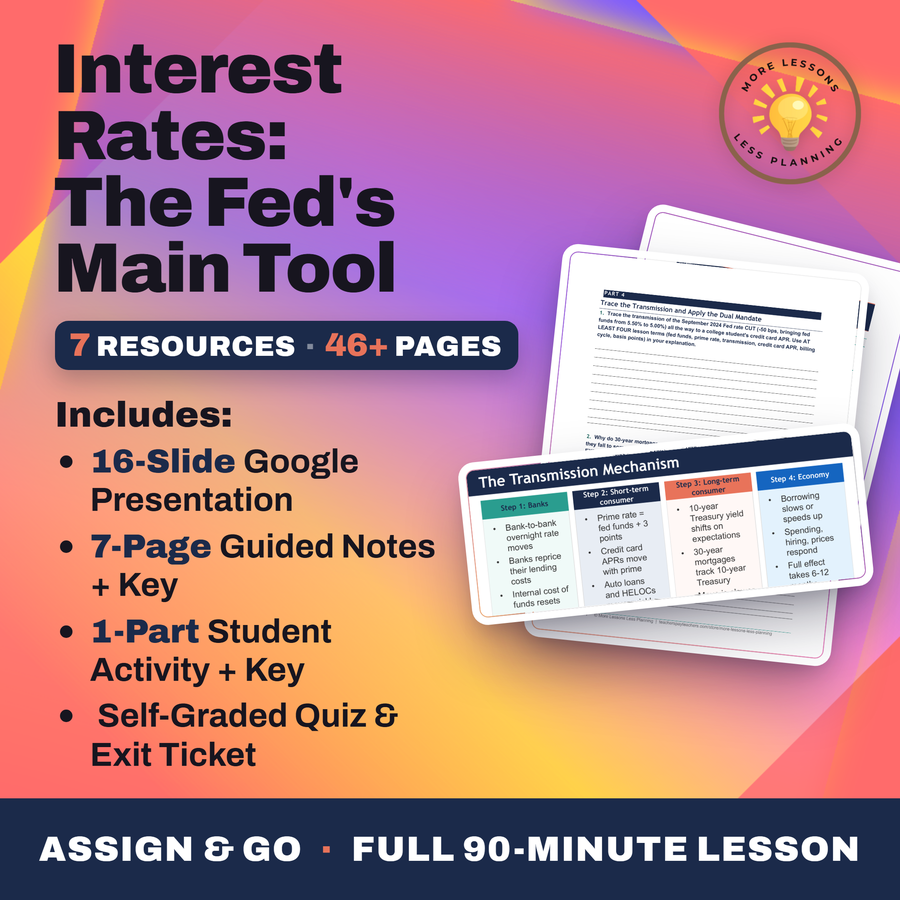
Interest Rates: The Fed's Main Tool

Jerome Powell: The Most Powerful Person You've Never Heard Of
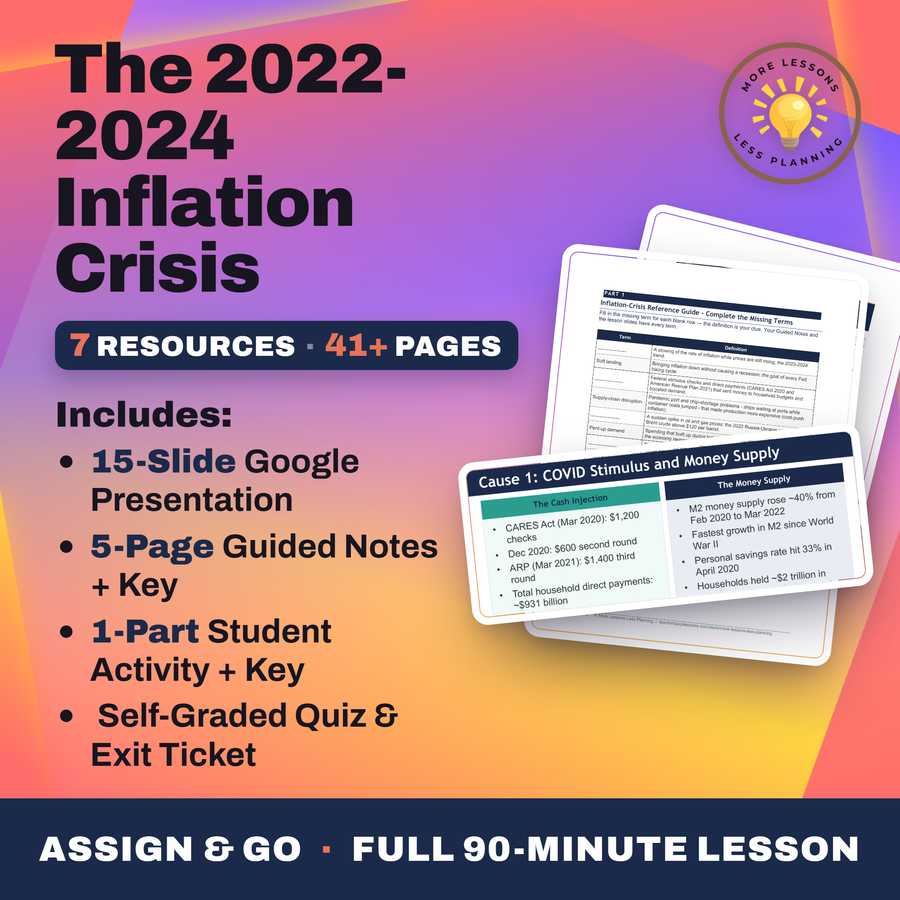
The 2022-2024 Inflation Crisis
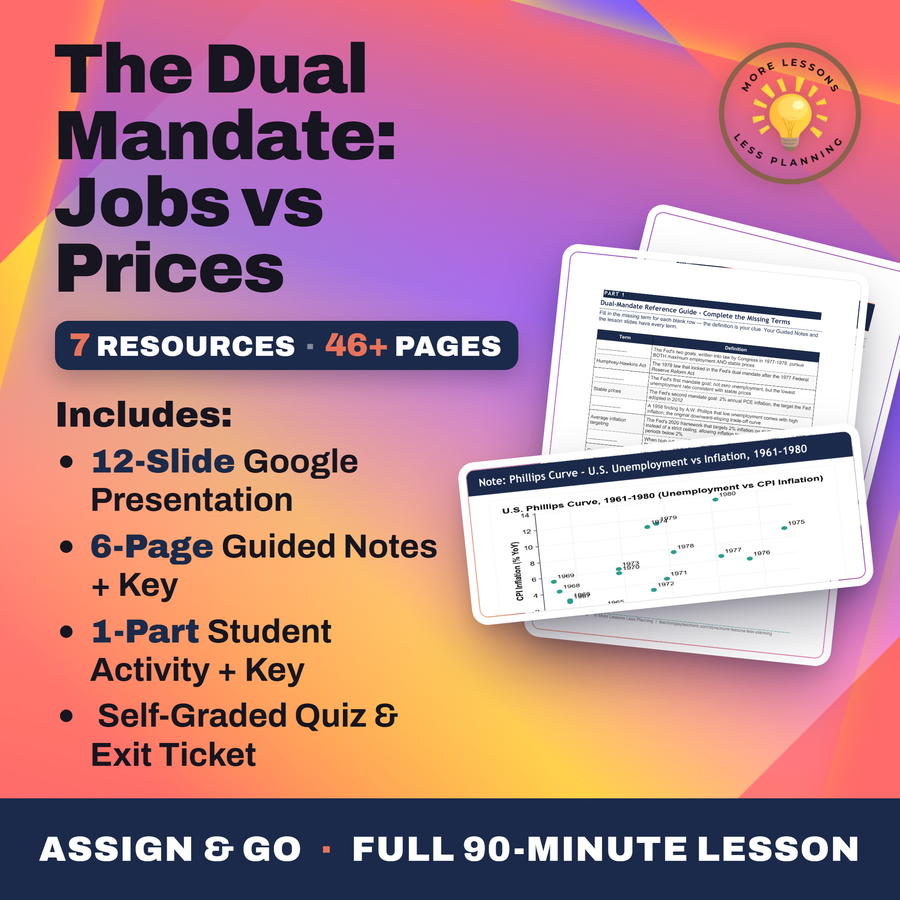
The Dual Mandate: Jobs vs Prices
Every lesson on this site is free to download and use. If one of them saved you a prep period, you can chip in a few bucks toward my three kids' daycare fund. That's genuinely where tips go.