Interest Rates: The Fed's Main Tool
Quality reviewed September 2026
Facts verified September 21, 2026
- Grades
- Grades 9-12
- Time
- About two 50-minute class periods
- Includes
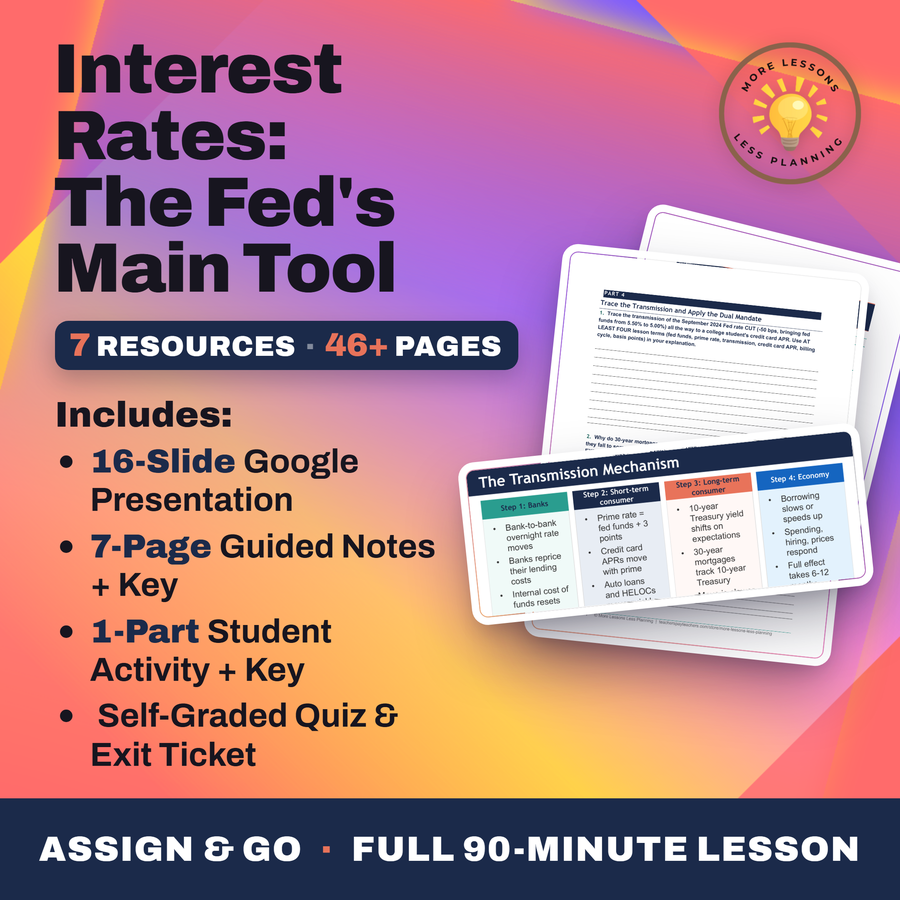
- 11 ready-to-teach files
- Format
- Word (.docx) · PowerPoint (.pptx)
- Slide deck
- Guided notes
- Guided notes teacher key
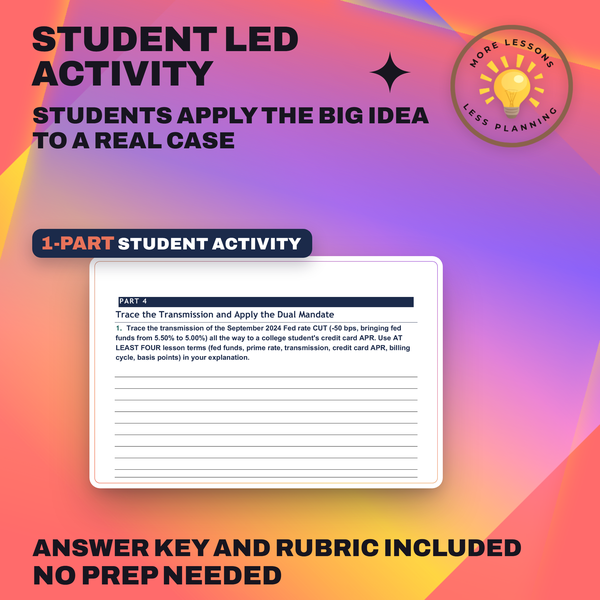
- Activity + answer key
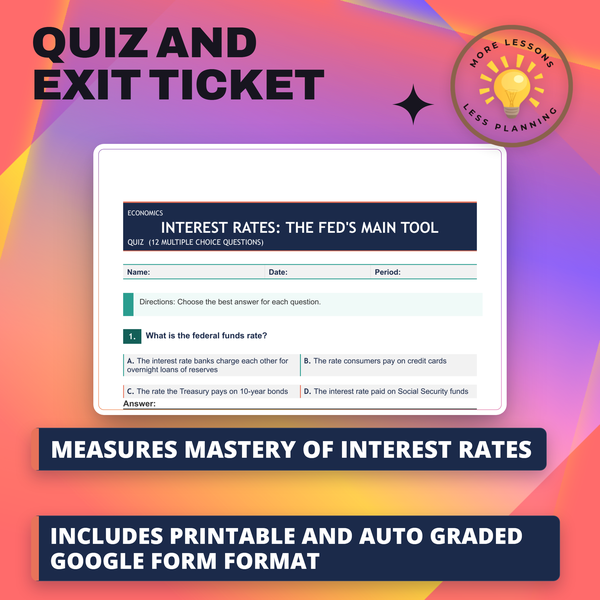
- Quiz + answer key
- Exit ticket + answer key
- Teacher guide
- Teacher presentation notes
What students do
- Trace how a single FOMC rate decision moves from the federal funds rate through the prime rate to a mortgage or credit card
- Brief a bank customer as regional-bank analyst Devin Park on what the latest rate decision means for their loan
- Predict whether a rate hike or a rate cut fits a recession scenario versus an inflation scenario
- Read an FOMC announcement and identify the target range and what changed since the last meeting
What it covers
- How the FOMC sets the federal funds rate through open market operations
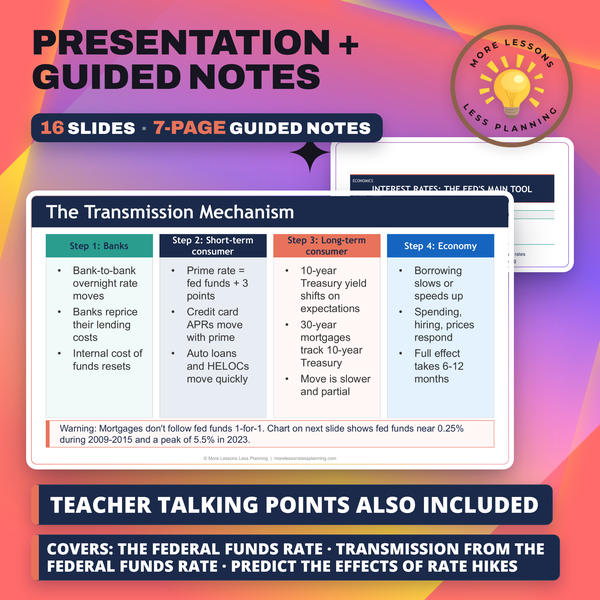
- The chain from the federal funds rate to the prime rate to mortgages, credit cards, and auto loans
- Why the March 2022 to July 2023 hiking cycle raised rates 5.25 points across eleven moves
- The lag between a rate decision and its effect on the wider economy
Learning targets
- Define the federal funds rate and explain how the FOMC sets it
- Trace transmission from the federal funds rate to mortgage and credit card rates
- Predict the effects of rate hikes vs rate cuts on inflation, jobs, and borrowing
Peek inside
The Definition
The federal funds rate is the interest rate banks charge each other for loans of reserves.
The FOMC sets it as a 0.25-point , not a single number (e.g., 5.25-5.50%).
The fed funds rate is the Fed's primary policy tool.
Why Banks Lend to Each Other
Banks must hold at the Fed.
1. Q1. The interest rate banks charge each other for overnight loans of the money they keep at the Fed - the single bank-to-bank rate the Fed targets eight times a year - is the .
Why this matters
A vote in Washington sets the rate on a car loan, a credit card, and eventually a mortgage, moving from the federal funds rate to the prime rate to whatever a bank charges. From March 2022 to July 2023 that chain moved eleven times as the Fed hiked rates 5.25 points, then held steady until it started cutting in September 2024.
What trips students up is the lag: a rate decision does not fully hit loan rates or the economy for months. I make them defend why a hike takes that long to bite, so they stop expecting policy to work like a light switch and start reading economic news with a longer clock in mind.
From one teacher to another
My students actually want to know why one interest-rate decision made in Washington shows up on their parents' credit card bill, and that's the question this toolkit answers. Devin Park's regional-bank scenario doesn't let them off with jargon; they have to translate an FOMC announcement into plain English for a customer, which is a harder skill than memorizing the transmission chain. The 2022-2024 case study gives them real numbers to argue with instead of a hypothetical.
Every file in this toolkit
-
Activity (Student)
Devin Park traces one FOMC vote all the way from the bank-to-bank overnight rate to a customer's prime-based mortgage or credit card bill. Two real charts on the 2022 to 2023 hike cycle back a recommendation memo for the next meeting.
-
Activity (Answer Key)
A 525 basis point move gets full worked math in the key, from the fed funds rate's climb off 0.25 percent in March 2022 to 5.50 percent in July 2023. A September 2024 cut is then followed step by step into a lower credit card APR.
-
Exit Ticket (Student)
The three items trace what a 50 basis point rate cut does to a typical credit card APR, why a 30-year mortgage can fall before the Fed actually moves, and what the Fed's dual mandate names. Whether the 2022 to 2023 hikes were too far or too fast is the judgment call.
-
Exit Ticket (Answer Key)
A 0.50 point APR drop within one or two billing cycles answers the rate-cut question, the 10-year Treasury pricing in expected moves explains the early mortgage shift, and maximum employment plus stable prices names the dual mandate. Credit needs a cited number and a verdict.
-
Guided Notes (Student)
A four-step transmission chain starts at the federal funds rate and ends wherever a bank sets its own charge, and students trace the March 2022 to July 2023 hike cycle peaking at 5.50 percent through it. They also pull the target range and any hint from an FOMC statement.
-
Guided Notes (Teacher Key)
Prime pegged at fed funds plus 3 points, credit card APR running prime plus 10 to 18 points, and the 5.25 point total rise across the 2022 to 2023 hike cycle come tallied with sources. CPI's move from 9.1 percent in June 2022 down to 3.2 percent by July 2023 rounds out the chart reading.
-
Quiz (Student)
Questions ask how many percentage points the prime rate sits above the federal funds benchmark, and which loan type reacts fastest once the FOMC votes to hike rates again.
-
Quiz (Answer Key)
The prime rate sits at the federal funds rate plus 3 points, and SOFR now stands as the benchmark that replaced LIBOR. The hike cycle peaks near 5.5 percent, and the FOMC meets eight times a year.
-
Slides
FOMC votes eight times a year on the federal funds rate, and the deck follows that single number into the prime rate, then credit card APRs, auto loans, and mortgages. The Fed's 2022 to 2024 moves supply the real numbers, 525 basis points of hikes, then a long hold, then 100 down.
-
Teacher Guide
An FOMC statement decoding drill sits in the extension set, timed opposite discussion prompts that pit the Fed Chair's single vote against all twelve committee members on the board.
-
Teacher Presentation Notes
Basis points get defined on the card that explains why 75 point moves were rare before 2022, and the script then walks the floor set by IORB against the ceiling set by the discount rate.
Download
Where should I send the next one?
Everything here is free and it stays that way. Leave your email and I'll send you the new lessons as they go up. You can unsubscribe from any one of them.
Related resources
Deflation: Why Falling Prices Are Bad
Hyperinflation: Weimar, Zimbabwe, Venezuela
Jerome Powell: The Most Powerful Person You've Never Heard Of
The 2022-2024 Inflation Crisis
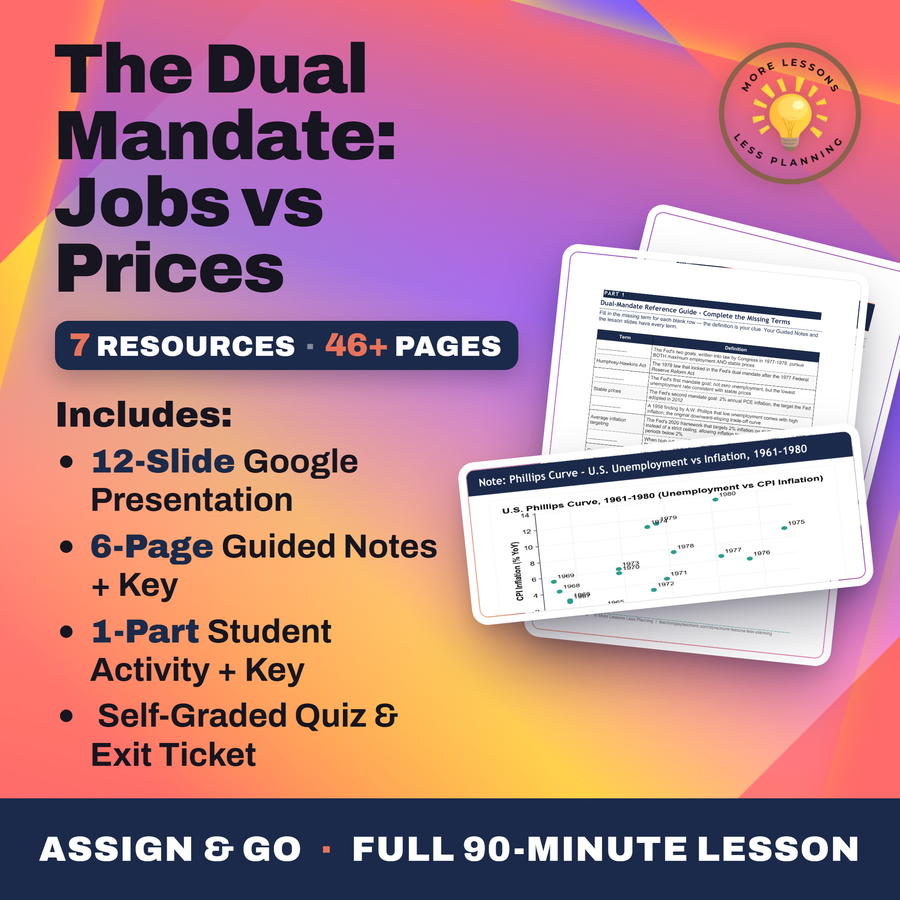
The Dual Mandate: Jobs vs Prices
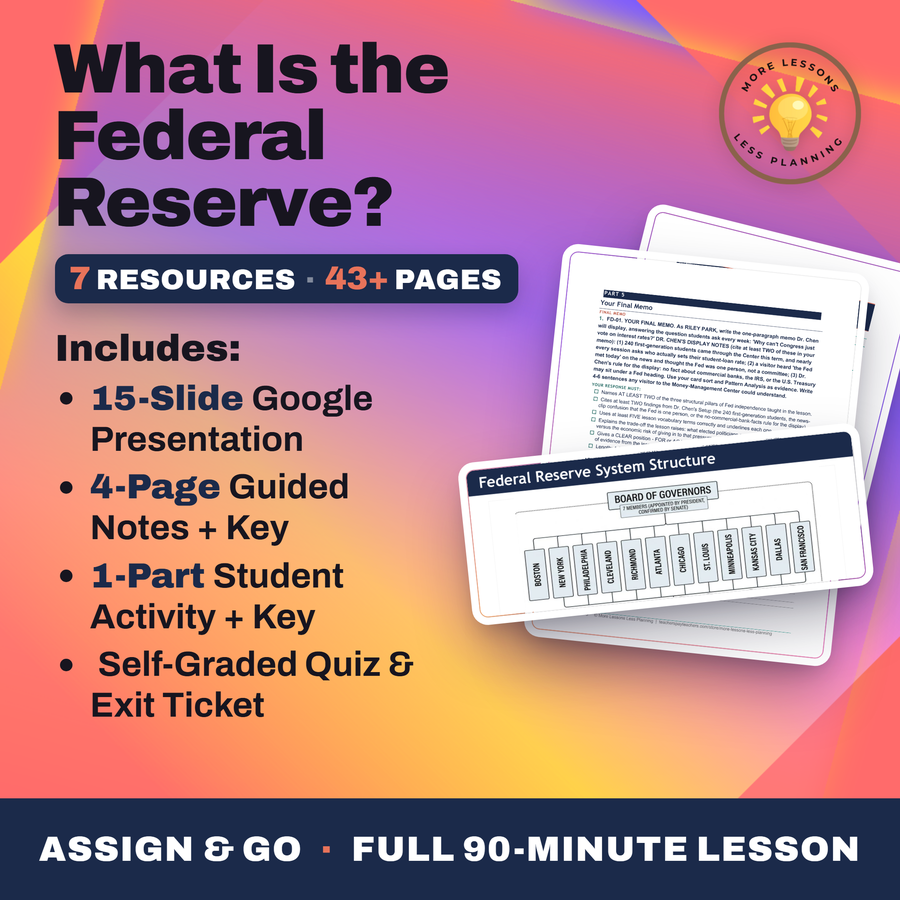
What Is the Federal Reserve?
Every lesson on this site is free to download and use. If one of them saved you a prep period, you can chip in a few bucks toward my three kids' daycare fund. That's genuinely where tips go.