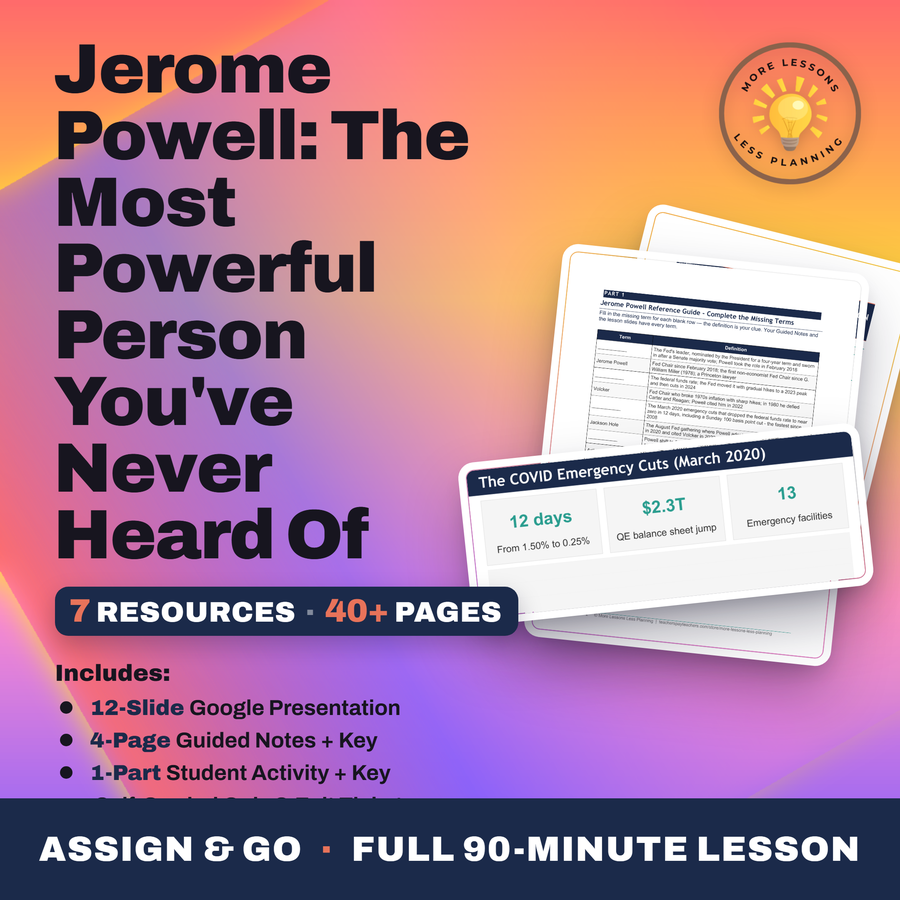
Jerome Powell: The Most Powerful Person You've Never Heard Of
Quality reviewed September 2026
Facts verified September 21, 2026
- Grades
- Grades 9-12
- Time
- About two 50-minute class periods
- Includes
- 11 ready-to-teach files
- Format
- Word (.docx) · PowerPoint (.pptx)
- Slide deck
- Guided notes
- Guided notes teacher key
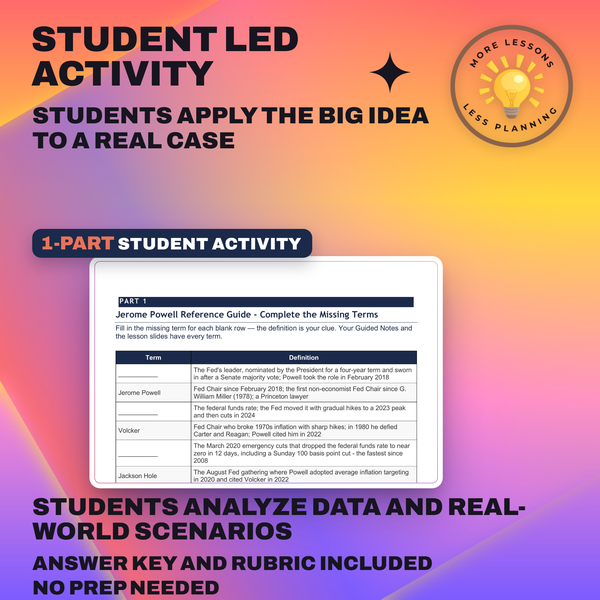
- Activity + answer key
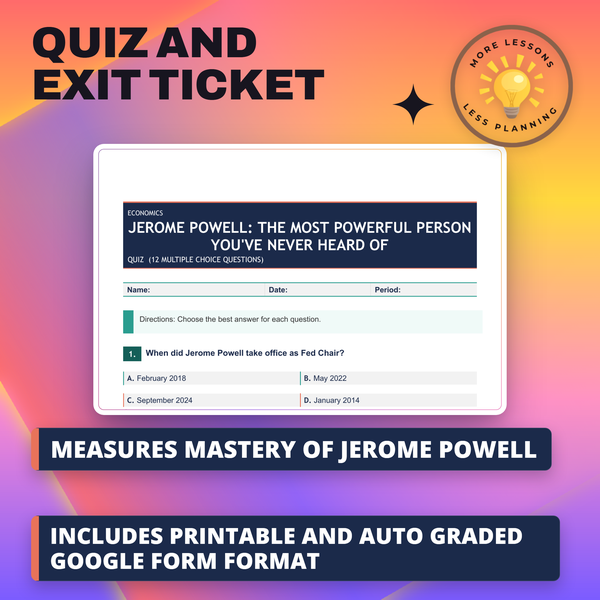
- Quiz + answer key
- Exit ticket + answer key
- Teacher guide
- Teacher presentation notes
What students do
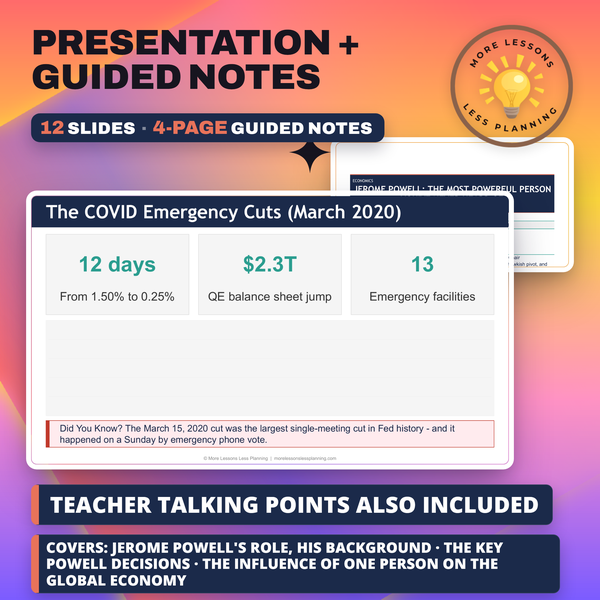
- Trace Powell's COVID emergency cuts, from 1.50% to 0.25% in just 12 days in March 2020
- Read a federal funds rate chart across Powell's tenure and a chart of the S&P 500 reacting to his decisions
- Explain the 2022 hawkish pivot, when Powell cited Volcker and hiked rates to a 5.50% peak
- Write a memo weighing whether one unelected official should hold this much economic influence
What it covers
- Powell's path to Fed Chair as the first non-economist to hold the role since 1978
- The March 2020 emergency cuts, including a Sunday phone-vote meeting that cut rates 100 basis points
- The August 2022 Jackson Hole speech, where Powell cited Volcker and committed the Fed to fighting inflation
- The four-step Senate confirmation process and the institutional case for Fed independence
Learning targets
- Identify Jerome Powell's role, his background, and how he became Fed Chair
- Trace the key Powell decisions: COVID emergency response, the 2022 hawkish pivot, and the 2024 cut cycle
- Evaluate the influence of one person on the global economy and the question of political pressure on the Fed
Peek inside
The Basics
Fed Chair, Feb 2018-2026
Born 1953, Washington DC; age 73 in 2026
Princeton 1975 (political science), Georgetown Law 1979
First non-economist Fed Chair since G. William Miller (1978)
The Basics
Jerome Powell became Fed Chair on February 5, .
Powell is the first non-economist Fed Chair since G. William (1978).
Powell holds an undergraduate degree from (1975, political science).
Powell holds a law degree from Law (1979).
The Career Arc
Why this matters
The person who cut interest rates from 1.50 percent to 0.25 percent in twelve days in March 2020, touching nearly every loan in the country, is someone most students have never heard of. Powell was also the first Fed Chair since 1978 to come from outside economics.
Watching Arthur Burns cave to Nixon in 1972 next to Powell holding firm under two different presidents gives students a real stake in central bank independence, not a textbook talking point. By the closing memo, most have picked a side and can defend it with an actual rate number.
From one teacher to another
I ask students to name the Fed Chair and almost nobody can, which is exactly the point, because the person running the meeting that moves interest rates for the entire country is somebody most of them have never heard of. They trace Powell's actual decisions using two real charts, the federal funds rate across his tenure and the S&P 500 reacting to it, and have to read specific values off both, like the rate hitting 0.25 percent just 12 days after COVID hit or the market low that followed his 2022 Jackson Hole speech, where he explicitly cited Paul Volcker before hiking rates to a 5.50 percent peak. What makes the lesson land is contrasting Powell's refusal to change course under pressure from two different presidents against Arthur Burns caving to Nixon in 1972, which gives students a real historical stake in the independence question instead of an abstract civics point. It ends with them writing a memo arguing whether one unelected official should really have this much influence over the economy, and I don't grade which side they take, only whether they can back it up with actual numbers off the charts.
Every file in this toolkit
-
Activity (Student)
Avery Chen's chart work has students read three federal funds rate values from Powell's early tenure, trace the zero-bound stretch after rates fell to 0.25 percent in early 2020, then pull S&P 500 levels around each pivot before an October 2026 retrospective memo.
-
Activity (Answer Key)
Rate figures in this key run 1.50 percent at the 2018 start down to 0.25 percent by March 2020 and climbing to a July 2023 peak of 5.50 percent, with sample verdicts citing Volcker or Arthur Burns as the historical parallel.
-
Exit Ticket (Student)
Questions ask when Powell took office and what makes him unusual, name his defining first-term decision, and identify which historical chair he cited during his August 2022 speech at Jackson Hole. Whether a single non-elected figure ought to wield this much sway is the judgment call.
-
Exit Ticket (Answer Key)
February 2018 and his background outside economics mark Powell's unusual start, the emergency rate cuts he ordered in March of 2020 stand as his defining decision, and Paul Volcker is the chair he invoked at Jackson Hole. Scoring covers his role, one decision, a verdict, and its defense.
-
Guided Notes (Student)
Notes trace one official's path from a 1979 Georgetown law degree through a Fed Board seat in 2012, then drop into the 12-day sprint of March 2020 that cut rates from 1.50% to 0.25%, ending on 2022's pivot to a 5.50% peak.
-
Guided Notes (Teacher Key)
Vote counts fill in the confirmation history, an 84 to 13 tally in 2018 and 80 to 19 in 2022, then contrast Arthur Burns caving to political pressure in 1972 against Volcker's refusal to bend in 1980, the case this lesson uses for independence.
-
Quiz (Student)
Chart reading pulls the federal funds rate the month Powell took office and again at the 2022 peak, while other items name who he cited at Jackson Hole and which earlier chair caved to presidential pressure.
-
Quiz (Answer Key)
Powell cuts rates 100 basis points on a Sunday in March 2020, the 2022-2023 cycle peaks at 5.50 percent, Paul Volcker gets cited as the figure invoked at Jackson Hole, and Arthur Burns stands as the cautionary predecessor.
-
Slides
A Sunday phone vote pushed the fed funds rate down to near zero in just 12 days during March 2020, and a later slide sets that beside Powell naming Volcker at his 2022 Jackson Hole address before the hiking cycle topped out at 5.50 percent in mid-2023.
-
Teacher Guide
A mock confirmation hearing puts three students in the chair while classmates play the Senate Banking Committee, grilling them on the 2021 transitory call and the size of the September 2024 cut. A companion profile stretches the same questions back through Volcker and Yellen.
-
Teacher Presentation Notes
An 8-minute Jackson Hole speech from August 2022 gets its own slide, tied to the emergency Sunday phone vote that cut rates in March 2020. Talking points also flag Twitter attacks from Trump in 2018 and 2019, then note the 2024 cut cycle opened with an unusual 50 basis point move.
Download
Where should I send the next one?
Everything here is free and it stays that way. Leave your email and I'll send you the new lessons as they go up. You can unsubscribe from any one of them.
Related resources
Deflation: Why Falling Prices Are Bad
Hyperinflation: Weimar, Zimbabwe, Venezuela
Interest Rates: The Fed's Main Tool
The 2022-2024 Inflation Crisis
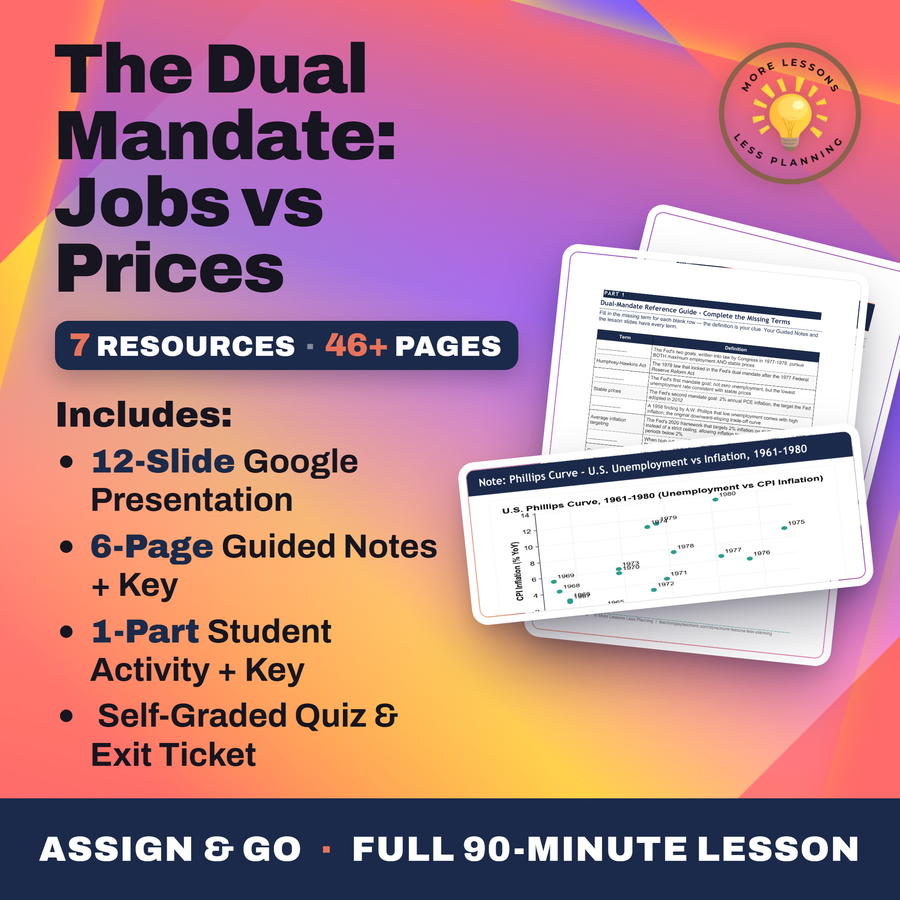
The Dual Mandate: Jobs vs Prices
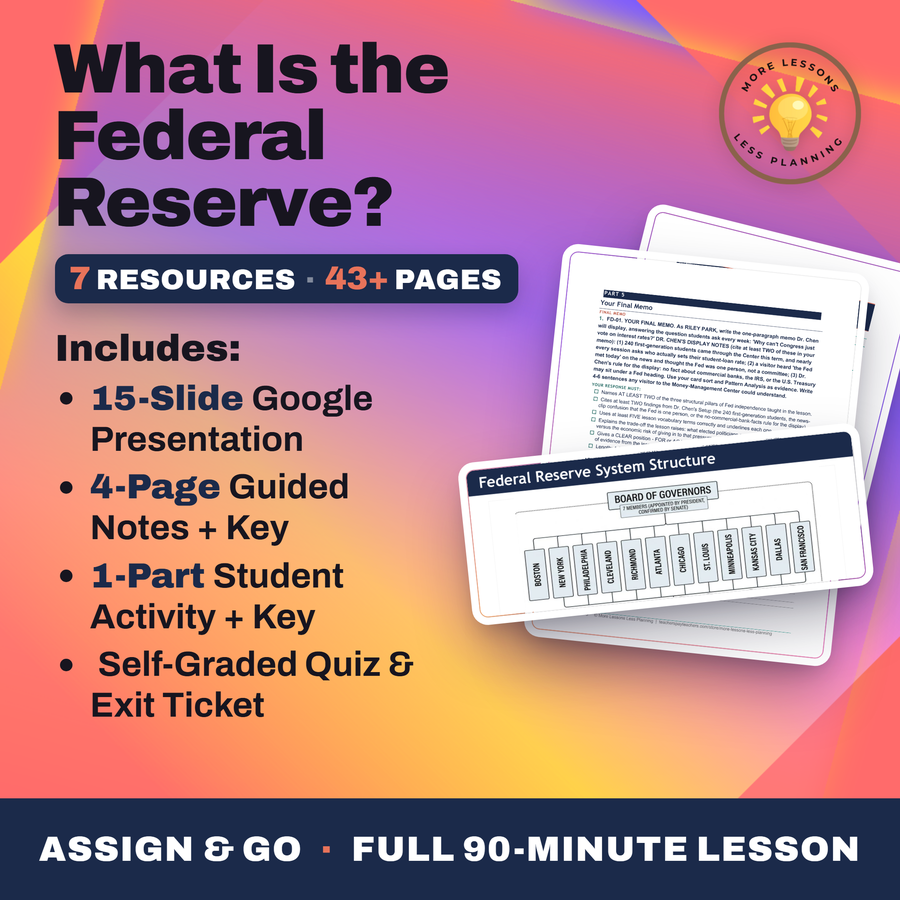
What Is the Federal Reserve?
Every lesson on this site is free to download and use. If one of them saved you a prep period, you can chip in a few bucks toward my three kids' daycare fund. That's genuinely where tips go.