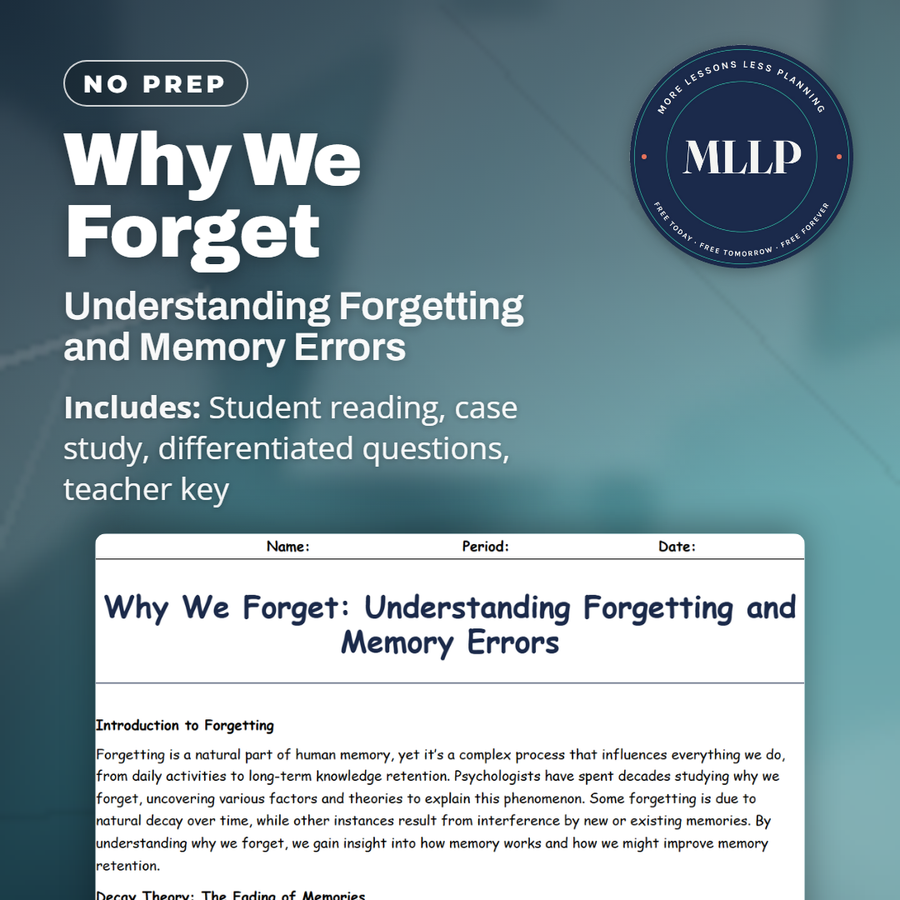
Why We Forget: Understanding Forgetting and Memory Errors
Quality reviewed September 2026
Facts verified September 10, 2026
- Subject
- Social Studies
- Grades
- Grades 9-12
- Length
- 6-page student worksheet
- Time
- About one 50-minute class period
- Great for
- Sub plans and independent work
- Includes
- Reading passage, comprehension questions + full answer key
- Format
- Print-and-go PDF
What students do
- Match terms like retroactive interference, proactive interference, and decay theory to their correct definitions
- Fill in the blank sentences on decay theory, proactive interference, and retrieval failure
- Answer multiple choice questions on decay theory, proactive interference, and retrieval failure
- Write short answers comparing proactive and retroactive interference, explaining adaptive forgetting, and listing strategies to prevent retrieval failure
What it covers
- Decay theory, interference theory, and retrieval failure as explanations for why we forget
- Proactive and retroactive interference, memory errors, and false memories
- Adaptive forgetting and a case study on retrieval failure during exam testing
Start reading this worksheet
Introduction to Forgetting
Forgetting is a natural part of human memory, yet it’s a complex process that influences everything we do, from daily activities to long-term knowledge retention. Psychologists have spent decades studying why we forget, uncovering various factors and theories to explain this phenomenon. Some forgetting is due to natural decay over time, while other instances result from interference by new or existing memories. By understanding why we forget, we gain insight into how memory works and how we might improve memory retention.
Decay Theory: The Fading of Memories
The Decay Theory suggests that memories weaken over time if they are not actively used or rehearsed. This theory implies that memories have a “use it or lose it” quality, where lack of recall leads to gradual fading. The concept of decay is especially applicable to short-term memory, where information can be quickly lost unless it is moved to long-term storage. In long-term memory, decay is thought to occur more slowly. Consider how a student may forget details from a history course taken years ago if the information isn’t revisited or used in real life. However, unlike physical decay, memory decay lacks clear scientific proof, and researchers debate its precise role in forgetting.
Interference Theory: When Memories Clash
According to Interference Theory, forgetting happens because different memories compete with or interfere with each other. This theory highlights two types of interference: Proactive Interference: Older memories make it harder to recall new information. For instance, if you learned Spanish before starting to learn French, your knowledge of Spanish might interfere with learning or remembering French vocabulary. Retroactive Interference: New memories hinder the recall of older information. Imagine learning a new set of rules for a card game—this could cause you to forget the rules of a game you learned previously. Interference tends to occur when information is similar, like learning multiple foreign languages. The more alike the memories are, the higher the chance they will interfere with each other.
Like what you read? The full reading, the case study, and every question set are in the free download below, along with the answer key.
Why this matters
Knowing material while studying and blanking on it during the test are not the same failure, and this reading gives three explanations for the gap: decay theory, interference, and retrieval failure. Most students have lived the testing-environment case study before they ever read it, the blank that hits mid-exam even though the material was there while they studied.
Proactive and retroactive interference are where students consistently mix up which direction the interference runs. Once they can tell the two apart, they are equipped to reason through strategies to prevent retrieval failure instead of just naming decay theory and interference as vocabulary terms.
From one teacher to another
I hand this out after the memory unit because it gives students a framework for why they blank on a test even when they knew the material while studying. The retrieval failure case study on testing environments is one students recognize immediately, and it sets up the short answer question on strategies to prevent retrieval failure during exams. The matching section keeps proactive and retroactive interference straight, which is where most students get tripped up, and the fill-in-the-blank sentences reinforce decay theory and retrieval cues before the case study questions.
What you get
Download
Where should I send the next one?
Everything here is free and it stays that way. Leave your email and I'll send you the new lessons as they go up. You can unsubscribe from any one of them.
Related resources
Classical Conditioning Explained: Pavlov and Beyond
False Memories: How Our Minds Create Misinformation
How We Remember: An Overview of Memory Processes
Operant Conditioning Basics: Reinforcement, Punishment, and Behavior
Sleep Disorders and Their Impact on Health: Insomnia to Narcolepsy
Stages of Sleep: NREM, REM, and Their Effects on Health
Every lesson on this site is free to download and use. If one of them saved you a prep period, you can chip in a few bucks toward my three kids' daycare fund. That's genuinely where tips go.