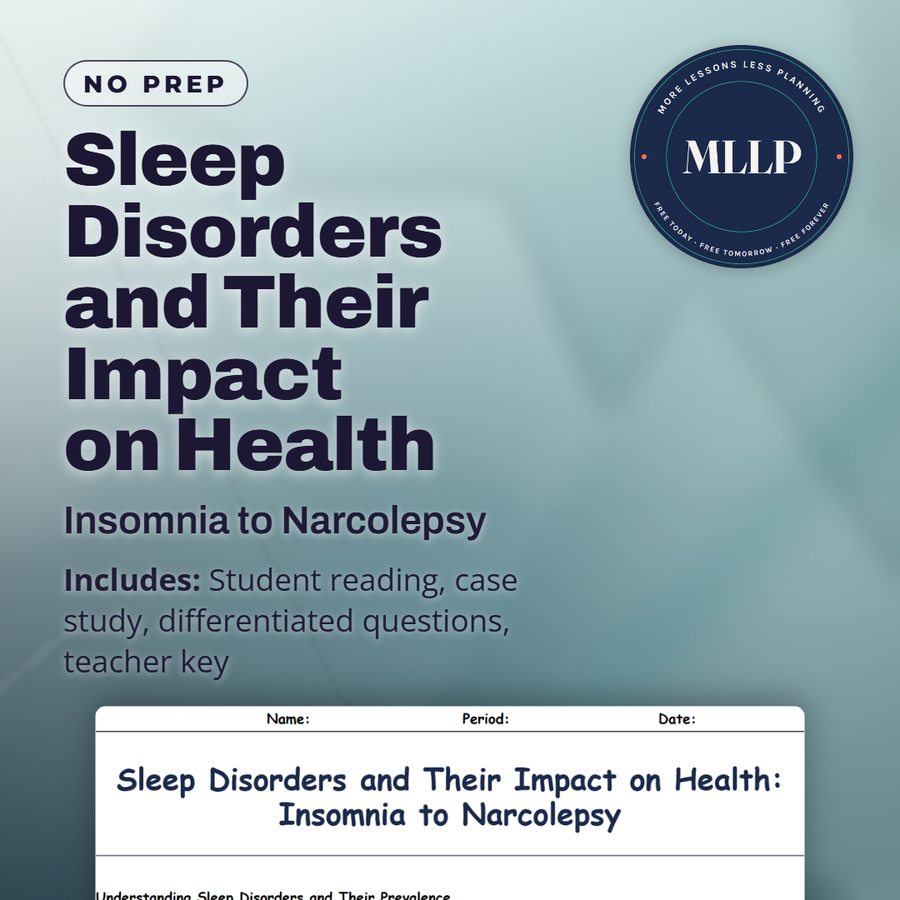
Sleep Disorders and Their Impact on Health: Insomnia to Narcolepsy
Quality reviewed September 2026
Facts verified September 10, 2026
- Subject
- Social Studies
- Grades
- Grades 9-12
- Length
- 7-page student worksheet
- Time
- About one 50-minute class period
- Great for
- Sub plans and independent work
- Includes
- Reading passage, comprehension questions + full answer key
- Format
- Print-and-go PDF
What students do
- Match terms like insomnia, sleep apnea, narcolepsy, and cataplexy to their correct definitions
- Fill in the blank sentences on narcolepsy, CPAP machines, and chronic health risks
- Answer multiple choice questions on the main symptom of insomnia, CPAP treatment, and narcolepsy in the workplace
- Write short answers on the physical effects of untreated sleep apnea, why CBT helps chronic insomnia, and the social challenges narcolepsy creates at work
What it covers
- The causes and symptoms of insomnia, sleep apnea, and narcolepsy
- Diagnosis and treatment approaches including CBT for insomnia, CPAP machines for sleep apnea, and medication for narcolepsy
- Two case studies, one on insomnia and academic performance in high schoolers and one on narcolepsy and workplace challenges
Start reading this worksheet
Understanding Sleep Disorders and Their Prevalence
Sleep disorders affect millions of people worldwide, impacting both their mental and physical health. Common sleep disorders, such as insomnia, sleep apnea, and narcolepsy, interfere with the body’s ability to obtain restful, restorative sleep. Without sufficient quality sleep, individuals may suffer from symptoms ranging from irritability and difficulty concentrating to more severe health issues like cardiovascular disease and mental health disorders. Understanding the causes, symptoms, and effects of these disorders provides essential insight into their overall impact on health and well-being.
Insomnia: Difficulty in Falling or Staying Asleep
Insomnia is one of the most prevalent sleep disorders and is characterized by difficulty falling asleep, staying asleep, or waking up too early. There are two main types of insomnia: acute insomnia, which is short-term and often triggered by stress, and chronic insomnia, which lasts for at least three nights a week over three months or more. People with insomnia often experience daytime fatigue, mood disturbances, and impaired concentration, which can affect school, work, and social relationships. Insomnia can arise from various factors, including lifestyle, stress, and health conditions. For instance, excessive caffeine intake, irregular sleep schedules, or mental health disorders such as anxiety and depression can contribute to insomnia. Chronic insomnia, if untreated, can increase the risk of developing heart disease, diabetes, and other chronic illnesses, highlighting the serious implications of this common disorder.
Sleep Apnea: Interrupted Breathing During Sleep
Sleep apnea is a serious sleep disorder in which breathing repeatedly stops and starts during sleep. The most common type, obstructive sleep apnea (OSA), occurs when the muscles in the throat relax too much, causing the airway to narrow or close. This blockage results in brief pauses in breathing that can last from a few seconds to a minute. Each time this happens, the brain briefly awakens the body to resume breathing, often without the person being fully aware of it. As a result, people with sleep apnea experience fragmented, non-restorative sleep, leading to daytime fatigue and other health risks. Untreated sleep apnea can lead to a host of health complications, including high blood pressure, stroke, and heart disease. Common symptoms of sleep apnea include loud snoring, gasping for air during sleep, and waking up with a dry mouth or headache. Treatment often involves lifestyle changes, the use of a Continuous Positive Airway Pressure (CPAP) machine, or surgical options in severe cases.
Like what you read? The full reading, the case study, and every question set are in the free download below, along with the answer key.
Why this matters
One case study centers on academic performance in high schoolers dealing with insomnia, close enough to most students' own sleep habits that they read it differently than the sleep apnea or narcolepsy material. Naming CBT as a treatment for chronic insomnia, instead of assuming medication is the only fix, is usually the detail that surprises them.
The second case study, on narcolepsy and workplace challenges, gets students thinking past their own routines into what a sleep disorder does to an adult's job. Keeping insomnia, sleep apnea, and narcolepsy straight instead of blurring them into one idea of being tired is the real work this reading asks of them.
From one teacher to another
I use this reading when we cover sleep disorders because it gives students two real case studies to dig into instead of just a list of symptoms. The insomnia and academic performance case study lands with my students since it ties directly to their own sleep habits, and the narcolepsy workplace case study opens up a good discussion on how a medical condition can affect someone's job. The matching section keeps insomnia, sleep apnea, and narcolepsy straight, and the short answer questions make students connect the health risks back to the specific disorder that causes them.
What you get
Download
Where should I send the next one?
Everything here is free and it stays that way. Leave your email and I'll send you the new lessons as they go up. You can unsubscribe from any one of them.
Related resources
Classical Conditioning Explained: Pavlov and Beyond

False Memories: How Our Minds Create Misinformation
How We Remember: An Overview of Memory Processes
Operant Conditioning Basics: Reinforcement, Punishment, and Behavior
Stages of Sleep: NREM, REM, and Their Effects on Health
Types of Memory: Sensory, Short-Term, Long-Term, and Working Memory
Every lesson on this site is free to download and use. If one of them saved you a prep period, you can chip in a few bucks toward my three kids' daycare fund. That's genuinely where tips go.