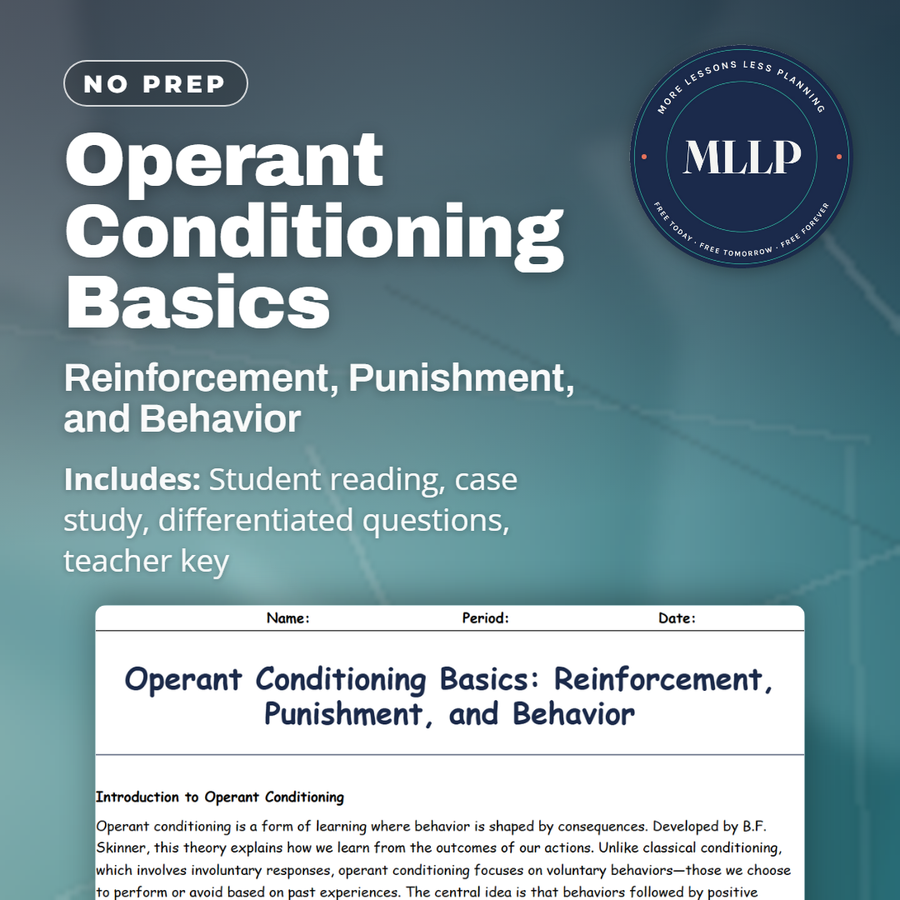
Operant Conditioning Basics: Reinforcement, Punishment, and Behavior
Quality reviewed September 2026
Facts verified September 10, 2026
- Subject
- Social Studies
- Grades
- Grades 9-12
- Length
- 6-page student worksheet
- Time
- About one 50-minute class period
- Great for
- Sub plans and independent work
- Includes
- Reading passage, comprehension questions + full answer key
- Format
- Print-and-go PDF
What students do
- Match terms like negative reinforcement, positive punishment, and variable-ratio schedule to their correct definitions
- Fill in the blank sentences on reinforcement, positive punishment, and fixed-interval schedules
- Answer multiple choice questions on negative reinforcement, fixed-interval schedules, and positive punishment
- Write short answers comparing positive and negative punishment, and explaining how negative reinforcement differs from punishment
What it covers
- Skinner's theory of operant conditioning and how consequences shape voluntary behavior
- Positive and negative reinforcement, positive and negative punishment, and the difference between them
- Schedules of reinforcement including fixed-ratio, variable-ratio, fixed-interval, and variable-interval, plus a classroom attendance case study
Start reading this worksheet
Introduction to Operant Conditioning
Operant conditioning is a form of learning where behavior is shaped by consequences. Developed by B.F. Skinner, this theory explains how we learn from the outcomes of our actions. Unlike classical conditioning, which involves involuntary responses, operant conditioning focuses on voluntary behaviors—those we choose to perform or avoid based on past experiences. The central idea is that behaviors followed by positive outcomes are likely to be repeated, while those followed by negative outcomes tend to diminish.
Reinforcement: Encouraging Desired Behavior
Reinforcement is a crucial component of operant conditioning. It refers to any outcome or consequence that strengthens a behavior, making it more likely to occur again. Reinforcements can be either positive or negative, but in both cases, the aim is to increase the likelihood of a behavior. Positive Reinforcement: This occurs when a behavior is followed by a pleasant stimulus, such as praise, rewards, or privileges. For example, if a student studies hard and receives an A on a test, the good grade serves as positive reinforcement, encouraging the student to study again in the future. Negative Reinforcement: Negative reinforcement involves the removal of an unpleasant stimulus following a behavior, which in turn increases that behavior. Imagine a situation where a student is allowed to skip a homework assignment as a reward for completing extra credit work. The removal of the homework task acts as negative reinforcement, motivating the student to engage in more extra credit work. Both forms of reinforcement are effective in promoting desired behaviors, but they differ in how they achieve that effect.
Punishment: Discouraging Unwanted Behavior
While reinforcement aims to increase behavior, punishment is designed to reduce or eliminate it. Punishment can also be positive or negative, but unlike reinforcement, punishment decreases the likelihood of a behavior reoccurring. Positive Punishment: This type of punishment involves presenting an unpleasant stimulus after a behavior. For example, if a student talks out of turn in class and is scolded by the teacher, the scolding serves as positive punishment, discouraging the student from interrupting again. Negative Punishment: Negative punishment, on the other hand, involves taking away a pleasant stimulus to reduce behavior. For example, if a teenager loses phone privileges for breaking curfew, the removal of the phone acts as negative punishment, reducing the likelihood of further curfew violations. The distinction between reinforcement and punishment is essential in understanding how behavior can be modified. While reinforcement is generally more effective in encouraging behavior change, punishment is sometimes necessary to curb unwanted actions.
Like what you read? The full reading, the case study, and every question set are in the free download below, along with the answer key.
Why this matters
Losing phone privileges for breaking curfew and getting scolded for talking out of turn are both punishment, but they work through opposite mechanisms, one negative and one positive. The reading uses examples like these before asking students to sort out the difference themselves.
The contrast with classical conditioning is what makes this reading worth the class time, involuntary responses giving way to consequences shaping voluntary behavior. The classroom attendance case study is where the confusion usually shows up, since students have to identify positive and negative reinforcement operating in the same scenario instead of picking one clean example.
From one teacher to another
I pull this out right after classical conditioning so students can see the contrast between involuntary and voluntary learning. The passage lays out reinforcement and punishment with classroom examples like a scolding for talking out of turn or losing phone privileges for breaking curfew, which students connect with fast. The case study on class attendance is useful because it forces them to identify positive and negative reinforcement in the same scenario. By the short answer questions on schedules of reinforcement, they've already seen fixed-ratio and variable-ratio examples in the reading.
What you get
Download
Where should I send the next one?
Everything here is free and it stays that way. Leave your email and I'll send you the new lessons as they go up. You can unsubscribe from any one of them.
Related resources
Classical Conditioning Explained: Pavlov and Beyond
False Memories: How Our Minds Create Misinformation
How We Remember: An Overview of Memory Processes
Sleep Disorders and Their Impact on Health: Insomnia to Narcolepsy
Stages of Sleep: NREM, REM, and Their Effects on Health
Types of Memory: Sensory, Short-Term, Long-Term, and Working Memory
Every lesson on this site is free to download and use. If one of them saved you a prep period, you can chip in a few bucks toward my three kids' daycare fund. That's genuinely where tips go.