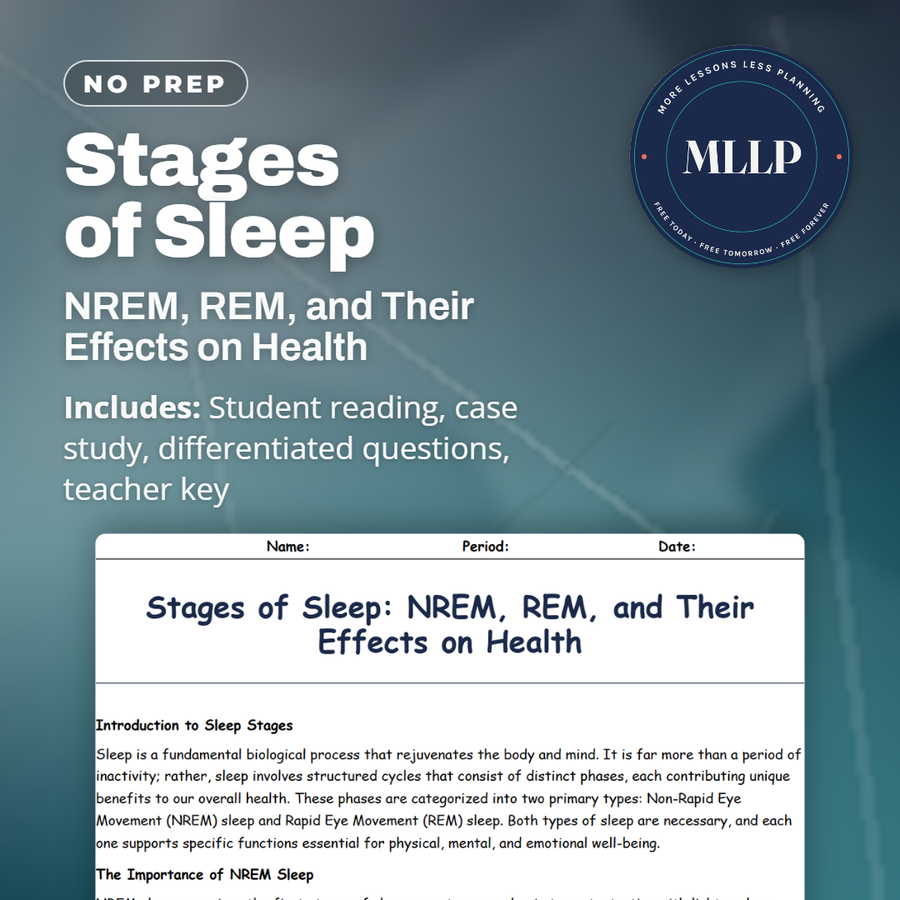
Stages of Sleep: NREM, REM, and Their Effects on Health
Quality reviewed September 2026
Facts verified September 10, 2026
- Subject
- Social Studies
- Grades
- Grades 9-12
- Length
- 6-page student worksheet
- Time
- About one 50-minute class period
- Great for
- Sub plans and independent work
- Includes
- Reading passage, comprehension questions + full answer key
- Format
- Print-and-go PDF
What students do
- Match terms like NREM Stage 1, Stage 3, and REM sleep to their correct definitions
- Fill in the blank sentences on sleep spindles, growth hormone in Stage 3, and emotional regulation after REM loss
- Answer multiple choice questions on time spent in Stage 2 sleep, the main benefit of REM sleep, and how sleep cycles change overnight
- Write short answers on why Stage 3 sleep matters, how sleep cycles meet physical and cognitive needs, and how sleep hygiene improves sleep stages
What it covers
- The three NREM stages, from light sleep to deep slow-wave sleep, and what happens in the body during each
- REM sleep and its role in memory consolidation, emotional regulation, and dreaming
- A case study on REM sleep deprivation in college students and the health effects of chronic sleep deprivation
Start reading this worksheet
Introduction to Sleep Stages
Sleep is a fundamental biological process that rejuvenates the body and mind. It is far more than a period of inactivity; rather, sleep involves structured cycles that consist of distinct phases, each contributing unique benefits to our overall health. These phases are categorized into two primary types: Non-Rapid Eye Movement (NREM) sleep and Rapid Eye Movement (REM) sleep. Both types of sleep are necessary, and each one supports specific functions essential for physical, mental, and emotional well-being.
The Importance of NREM Sleep
NREM sleep comprises the first stages of sleep we enter as we begin to rest, starting with lighter sleep stages and moving into deeper, restorative phases. Within NREM, there are three stages, each characterized by particular patterns of brain activity and physiological changes. Stage 1 (Light Sleep): As we transition from wakefulness to sleep, we enter a light sleep stage. Here, brain waves slow, and the body relaxes. This phase is brief but essential, as it allows the body to start unwinding and prepares it for deeper stages. Stage 2 (Intermediate Sleep): This stage constitutes the majority of our sleep time, comprising roughly 50% of the entire sleep cycle. In this phase, our heart rate slows down, our body temperature drops, and brain activity becomes rhythmic, with bursts called “sleep spindles” occurring. These spindles play a role in processing memories. Stage 3 (Deep Sleep or Slow-Wave Sleep): The deepest form of NREM sleep, Stage 3, is essential for bodily recovery and immune health. During this phase, the brain produces slow delta waves, and the body repairs muscles and tissues. Growth hormone is also released, which supports physical growth and regeneration. This stage is vital for physical recovery, which is why those deprived of deep sleep often feel physically exhausted.
REM Sleep: The Dream Stage
Approximately 90 minutes after we initially fall asleep, we enter REM sleep, during which most dreaming occurs. REM sleep is distinctive due to rapid eye movement and increased brain activity, which resembles wakefulness, though the body is temporarily paralyzed to prevent acting out dreams. REM sleep is essential for cognitive and emotional health, contributing to memory consolidation, creativity, and emotional regulation. REM cycles lengthen as the night progresses, allowing for enhanced memory processing in the later sleep cycles. Without sufficient REM sleep, people are more likely to experience mood swings, poor memory retention, and difficulty with learning new information.
Like what you read? The full reading, the case study, and every question set are in the free download below, along with the answer key.
Why this matters
Wake someone the instant they enter REM sleep, over and over, and the effects are hard to miss: poor memory recall and irritability. Those are the effects the college students in this reading's case study experienced, a clear way to show what REM sleep is doing while students assume all sleep looks the same.
Most students think sleep is just being unconscious, not a series of shifting stages with growth hormone release in Stage 3 and dreaming concentrated in REM. Once they see sleep spindles and slow-wave sleep named and separated, generic sleep hygiene advice starts pointing at a specific stage it is meant to protect.
From one teacher to another
I use this reading right after we introduce sleep, because it breaks down NREM Stage 1 through Stage 3 and REM sleep in a way students can actually follow instead of just calling it all "deep sleep." The REM deprivation case study gets a reaction, since it shows real effects like poor memory recall and irritability in college students who were woken every time they entered REM. The matching and fill-in-the-blank sections reinforce terms like sleep spindles and slow-wave sleep before the short answer questions connect sleep stages to health outcomes.
What you get
Download
Where should I send the next one?
Everything here is free and it stays that way. Leave your email and I'll send you the new lessons as they go up. You can unsubscribe from any one of them.
Related resources
Classical Conditioning Explained: Pavlov and Beyond

False Memories: How Our Minds Create Misinformation
How We Remember: An Overview of Memory Processes
Operant Conditioning Basics: Reinforcement, Punishment, and Behavior
Sleep Disorders and Their Impact on Health: Insomnia to Narcolepsy
Types of Memory: Sensory, Short-Term, Long-Term, and Working Memory
Every lesson on this site is free to download and use. If one of them saved you a prep period, you can chip in a few bucks toward my three kids' daycare fund. That's genuinely where tips go.