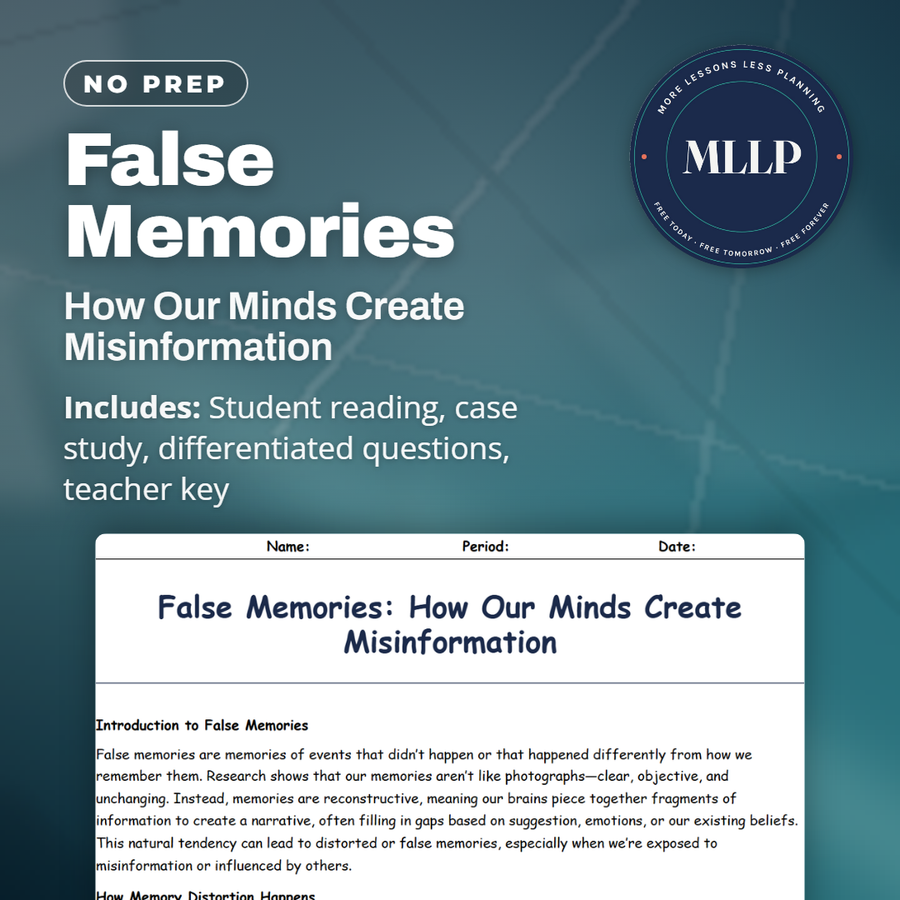
False Memories: How Our Minds Create Misinformation
Quality reviewed September 2026
Facts verified September 10, 2026
- Subject
- Social Studies
- Grades
- Grades 9-12
- Length
- 6-page student worksheet
- Time
- About one 50-minute class period
- Great for
- Sub plans and independent work
- Includes
- Reading passage, comprehension questions + full answer key
- Format
- Print-and-go PDF
What students do
- Match terms like misinformation effect, suggestibility, and false memories to their definitions
- Fill in the blank sentences on the misinformation effect and the Loftus and Palmer "smashed" versus "hit" wording
- Answer multiple choice questions on the misinformation effect, the Loftus and Palmer study, and factors that increase false memories
- Write short answers on authority figures, high-stress emotions, and how the Loftus and Palmer study shows memory can be shaped by wording
What it covers
- How memory distortion happens through suggestion, leading questions, and the misinformation effect
- Factors that make false memories more likely, including age, emotion, repetition, and authority figures
- The Loftus and Palmer car accident case study and the real-world stakes of false memories in eyewitness testimony and therapy
Start reading this worksheet
Introduction to False Memories
False memories are memories of events that didn’t happen or that happened differently from how we remember them. Research shows that our memories aren’t like photographs—clear, objective, and unchanging. Instead, memories are reconstructive, meaning our brains piece together fragments of information to create a narrative, often filling in gaps based on suggestion, emotions, or our existing beliefs. This natural tendency can lead to distorted or false memories, especially when we’re exposed to misinformation or influenced by others.
How Memory Distortion Happens
Memory distortion occurs when our recall of an event is influenced by factors like suggestion, external information, or even our own expectations. For instance, if someone suggests that you were wearing a blue shirt on your last birthday, you might start to believe this detail, even if you were actually wearing a red one. This effect is known as suggestibility, where our memory can be shaped by external cues. Additionally, the way we frame questions about past events can influence memory. For example, if asked, “How fast was the car going when it smashed into the other vehicle?” people tend to report higher speeds than if asked, “How fast was the car going when it bumped the other vehicle?” These small differences in wording can impact our memories and change how we remember events.
The Misinformation Effect
The Misinformation Effect is a psychological phenomenon where exposure to incorrect information after an event can alter our memory of that event. This effect is powerful enough that even well-documented events in a person’s life can be distorted by misinformation. The misinformation effect can happen through various channels, such as conversations, media, or even suggestive questioning. For instance, in cases of eyewitness testimony, people might be exposed to new information that is inaccurate but still affects their memory. If an eyewitness to a robbery hears a report suggesting the thief was wearing a red hat, they may start to believe they saw a red hat, even if that detail is incorrect.
Like what you read? The full reading, the case study, and every question set are in the free download below, along with the answer key.
Why this matters
Two people can watch the same car accident and report two different speeds, not because one is lying but because a single word changed what they remembered. This is the core of the Loftus and Palmer study, and the reading has students sit with "smashed" versus "hit" long enough to see how much one word can bend a memory.
Eyewitness testimony and therapy both depend on memory being reliable, and authority figures and high stress both make it less so. Most students insist their own memory is the exception until they have to explain in writing why the misinformation effect fools nearly everyone who is certain they would notice.
From one teacher to another
I use this one when we get into memory reliability, because students always assume their memories work like a video recording. The passage on the misinformation effect and the Loftus and Palmer car accident study gives them a concrete example to point back to, and the case study questions make them explain why "smashed" produced higher speed estimates than "hit." The matching and fill-in-the-blank sections lock in vocabulary like suggestibility and false memories before students hit the short answer questions on authority figures and stress.
What you get
Download
Where should I send the next one?
Everything here is free and it stays that way. Leave your email and I'll send you the new lessons as they go up. You can unsubscribe from any one of them.
Related resources
Classical Conditioning Explained: Pavlov and Beyond
How We Remember: An Overview of Memory Processes
Operant Conditioning Basics: Reinforcement, Punishment, and Behavior
Sleep Disorders and Their Impact on Health: Insomnia to Narcolepsy
Stages of Sleep: NREM, REM, and Their Effects on Health
Types of Memory: Sensory, Short-Term, Long-Term, and Working Memory
Every lesson on this site is free to download and use. If one of them saved you a prep period, you can chip in a few bucks toward my three kids' daycare fund. That's genuinely where tips go.