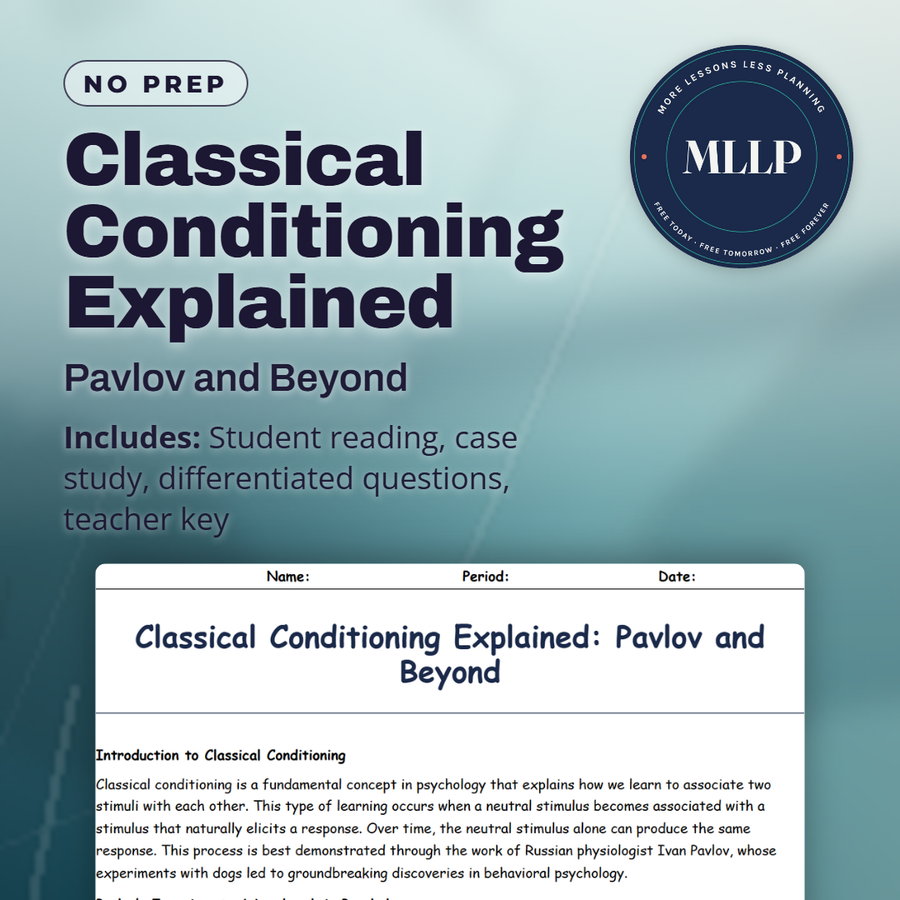
Classical Conditioning Explained: Pavlov and Beyond
Quality reviewed September 2026
Facts verified September 10, 2026
- Subject
- Social Studies
- Grades
- Grades 9-12
- Length
- 7-page student worksheet
- Time
- About one 50-minute class period
- Great for
- Sub plans and independent work
- Includes
- Reading passage, comprehension questions + full answer key
- Format
- Print-and-go PDF
What students do
- Match key terms like unconditioned stimulus, conditioned response, and extinction to their correct definitions
- Fill in the blank sentences on the bell as conditioned stimulus and on generalization
- Answer multiple choice questions on spontaneous recovery, generalization, and the conditioned stimulus in Pavlov's experiment
- Write short answers explaining how generalization differs from discrimination and how extinction leads to spontaneous recovery
What it covers
- Pavlov's original experiment pairing a bell with food to produce salivation in dogs
- The four core terms of classical conditioning plus generalization, discrimination, extinction, and spontaneous recovery
- Real world applications in phobia treatment and advertising, plus a case study on Pavlov's dogs
Start reading this worksheet
Introduction to Classical Conditioning
Classical conditioning is a fundamental concept in psychology that explains how we learn to associate two stimuli with each other. This type of learning occurs when a neutral stimulus becomes associated with a stimulus that naturally elicits a response. Over time, the neutral stimulus alone can produce the same response. This process is best demonstrated through the work of Russian physiologist Ivan Pavlov, whose experiments with dogs led to groundbreaking discoveries in behavioral psychology.
Pavlov’s Experiment: A Landmark in Psychology
Ivan Pavlov’s research began as a study of the digestive system, but he soon observed an interesting phenomenon. Pavlov noticed that the dogs in his lab would start to salivate not only when food was presented, but also when they heard the footsteps of the assistant who brought the food. This led Pavlov to investigate further, developing what we now call classical conditioning. In his famous experiment, Pavlov presented dogs with food (an unconditioned stimulus, or US) that naturally caused them to salivate (an unconditioned response, or UR). He then paired this food presentation with a neutral stimulus, such as the sound of a bell. After several pairings of the bell with the food, the dogs began to salivate in response to the bell alone. The bell had become a conditioned stimulus (CS), and the salivation in response to it was a conditioned response (CR). Pavlov’s work demonstrated that behaviors could be learned through association.
Key Principles of Classical Conditioning
Stimulus-Response Relationships In classical conditioning, the association formed between a stimulus and a response is central. A stimulus can be anything that triggers a response in the body or mind, while a response is the reaction to that stimulus. Pavlov’s experiment highlighted two types of stimuli and responses: the unconditioned stimulus (US) and unconditioned response (UR), which are naturally occurring, and the conditioned stimulus (CS) and conditioned response (CR), which are learned. For example, the food in Pavlov’s experiment was an unconditioned stimulus that naturally caused salivation (an unconditioned response). The bell, however, became a conditioned stimulus, causing a conditioned response (salivation) only after repeated pairings with the food. This relationship between stimulus and response forms the basis of classical conditioning.
Like what you read? The full reading, the case study, and every question set are in the free download below, along with the answer key.
Why this matters
Pavlov's bell did nothing to a dog's saliva glands until it was paired with food often enough that the dog's body stopped waiting for proof. That pairing is the idea behind classical conditioning, and the reading walks through it before asking students to separate generalization from discrimination, where most confusion lives.
Generalization and discrimination blur together every year, so I spend real time on the Pavlov's dogs case study and how a bell turned into a trigger for salivation in the first place. Students who can explain that shift clearly are usually the same ones who can predict when spontaneous recovery will happen and when it won't.
From one teacher to another
I use this reading when I introduce classical conditioning and want students to work with Pavlov's dogs instead of just hearing about them. The passage walks through the bell and food experiment step by step, so by the matching section on unconditioned stimulus versus conditioned response they've already seen the vocabulary in context. My students like the case study best because it makes them explain how a bell turned into a trigger for salivation. The short answer questions push them into comparing generalization and discrimination, which is usually where the confusion shows up.
What you get
Download
Where should I send the next one?
Everything here is free and it stays that way. Leave your email and I'll send you the new lessons as they go up. You can unsubscribe from any one of them.
Related resources
False Memories: How Our Minds Create Misinformation
How We Remember: An Overview of Memory Processes
Operant Conditioning Basics: Reinforcement, Punishment, and Behavior
Sleep Disorders and Their Impact on Health: Insomnia to Narcolepsy
Stages of Sleep: NREM, REM, and Their Effects on Health
Types of Memory: Sensory, Short-Term, Long-Term, and Working Memory
Every lesson on this site is free to download and use. If one of them saved you a prep period, you can chip in a few bucks toward my three kids' daycare fund. That's genuinely where tips go.