
Why Shein & Temu Are So Cheap
Quality reviewed September 2026
- Grades
- Grades 9-12
- Time
- About two 50-minute class periods
- Includes
- 10 ready-to-teach files
- Format
- Word (.docx) · PowerPoint (.pptx)
- Slide deck
- Guided notes
- Guided notes teacher key
- Activity + answer key
- Quiz + answer key
- Exit ticket + answer key
- Teacher guide
What students do
- Explain the five-step ultra-fast-fashion production model that lets a platform add thousands of new items a day
- Identify the $800 de minimis loophole and how it lets platforms skip tariffs U.S. retailers still have to pay
- Work real tariff math comparing what a platform pays on a dress to what a U.S. retailer pays on the same item
- Weigh the consumer, labor, and environmental trade-offs and draft a trade policy position paper
What it covers
- The five-step production model, from small test runs to algorithm-driven design to direct-from-factory shipping with almost no U.S. warehouse
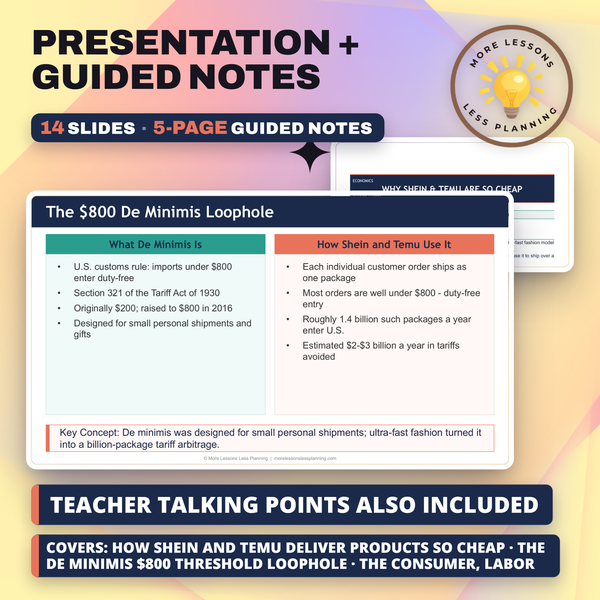
- The $800 de minimis threshold from the 1930 Tariff Act, and how over a billion packages a year enter the U.S. duty-free through it
- Real tariff math on what a Chinese-made dress costs in duties for a platform shipping direct versus a U.S. retailer selling the identical item
- Documented labor and environmental concerns, from reported factory work weeks to how much of ocean plastic pollution traces back to synthetic textiles
Learning targets
- Explain how Shein and Temu deliver products so cheap, including the ultra-fast fashion model and direct-from-factory shipping
- Identify the de minimis $800 threshold loophole and how Shein and Temu use it to ship over a billion duty-free packages a year
- Evaluate the consumer, labor, and environmental trade-offs of ultra-fast fashion and the policy debate over closing the loophole
Peek inside
Shein revenue 2024
About $45 billion globally; the world's largest online fast-fashion retailer (founded 2008, China)
Temu U.S. launch
September 2022; parent company is PDD Holdings (also owns Pinduoduo); 2024 U.S. revenue about $30 billion
U.S. user base
Scale and User Base
Shein revenue 2024 was about $ billion globally - the world's largest online fast-fashion retailer.
Temu launched in the U.S. in September ; parent company is PDD Holdings.
About million U.S. monthly active users between Shein and Temu combined.
Roughly billion individual packages a year ship into the U.S. between Shein, Temu, and similar platforms.
About percent of U.S. teens have ordered from Shein or Temu in the past year.
1. A U.S. customs rule that lets imports under $800 enter the country duty-free with minimal paperwork is called .
Why this matters
Zero dollars is what a Shein or Temu package under $800 owes in duty crossing the border, a loophole from the 1930 Tariff Act that lets over a billion packages a year in untaxed. Before the policy question, my students learn the five-step production model, tiny test runs, algorithm-driven design, factory-direct shipping, that makes a price that low possible.
The tariff math convinces them something is off: what a store like Macy's pays in duties on a dress next to what the identical dress costs a platform shipping under $800 shows the gap in real dollars. Weighing that against documented labor conditions and ocean plastic pollution turns the paper into an argument.
From one teacher to another
Students step into a policy analyst's seat working with Ambassador Devon Khalil at the U.S. Trade Representative's office, drafting a position paper on whether the U.S. should close the $800 de minimis loophole that lets platforms like Shein and Temu ship over a billion packages a year into the country without paying duty on any of it. Before they touch the policy debate, they have to understand the production model that makes the price possible in the first place, tiny test runs, algorithm-driven design pulling from social media, and shipping straight from a factory floor instead of sitting in a U.S. warehouse. The tariff math is where the loophole actually becomes visible, since I have them calculate what a store like Macy's pays in duties on a dress next to what the exact same dress costs a platform shipping under $800 at a time. It closes on the trade-offs nobody puts on a price tag, documented factory conditions and how much of ocean plastic pollution traces back to synthetic textiles like the ones in fast fashion.
Every file in this toolkit
-
Activity (Student)
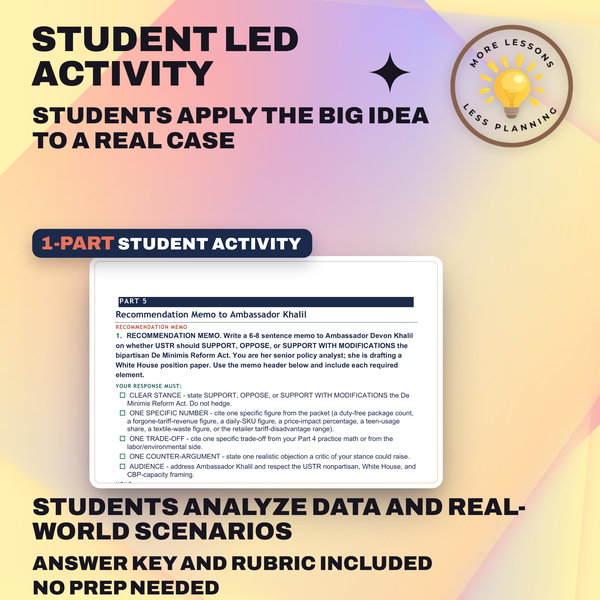
Ambassador Devon Khalil needs a position paper on the de minimis loophole, so you trace the ultra-fast fashion model, run tariff math comparing what Shein and Macy's each pay on an identical dress, weigh labor and environmental costs, then recommend a stance on the reform bill.
-
Activity (Answer Key)
The Guangzhou dress example gets solved in full, Macy's $0.94 in tariffs against Shein's zero, scaled to a $940 million gap on a billion units. Labor and environmental figures back a full sample recommendation memo to Ambassador Khalil.
-
Exit Ticket (Student)
Items define what de minimis means in U.S. customs, ask why Shein and Temu owe close to zero tariffs while Macy's pays 16 to 25 percent on the same goods, and name one major documented cost of ultra-fast fashion. Students take a stance on the reform bill with one lesson number.
-
Exit Ticket (Answer Key)
Imports under $800 entering without duty is what de minimis means, shipping direct-to-consumer under that threshold is why Shein and Temu skip the tariff Macy's pays, and microfiber pollution with labor concerns names the major cost. A stance, one number, and both trade-offs make up the answer.
-
Guided Notes (Student)
A $4 wholesale dress gets run through the tariff math twice, about $0.94 in duty at Macy's 23.5 percent combined rate against zero for a platform shipping under the $800 threshold. Students trace the five-step production model before arguing a position on closing the loophole.
-
Guided Notes (Teacher Key)
Macy's 23.5 percent combined rate producing $0.94 in duty on a $4 dress against zero under a de minimis shipment, and the roughly $940 million in yearly savings that gap creates at scale, each come answered. The five-step production model and 1930 Tariff Act origin round out the page.
-
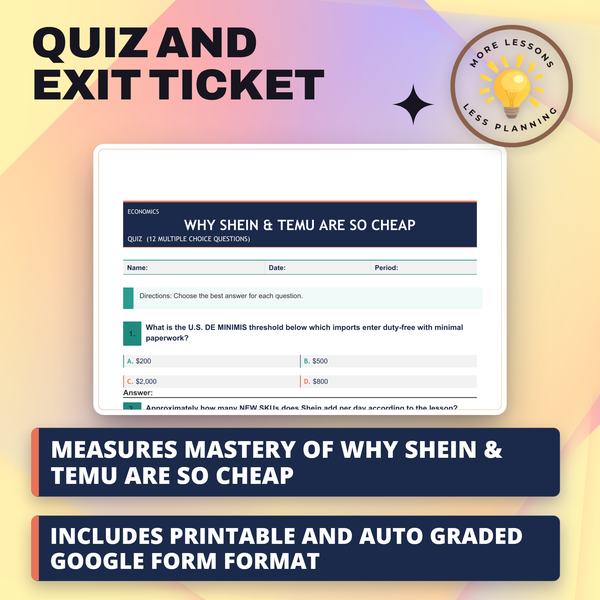
Quiz (Student)
A tariff-math item sets a $4 wholesale dress against the duty rates a commercial importer like Macy's must pay, then asks how many packages cross the border each year under the $800 exemption.
-
Quiz (Answer Key)
The de minimis threshold sits at $800, Macy's duty on that $4 dress runs near 94 cents against Shein's near zero, and synthetic textiles get named as the top ocean microplastic source.
-
Slides
6,000 new SKUs a day gets its own chart before one dress runs through two tariff stacks, about $0.94 in duty for Macy's against zero under the shipment limit set by the de minimis rule at $800, then the gap totals near $2 to $3 billion lost a year.
-
Teacher Guide
One actual household order gets tracked from checkout to doorstep in an extension that has students price what the same items would have cost a retailer paying full duty. A three-way simulation splits the class into retailers, advocates, and labor groups ahead of a position paper.
Download
Where should I send the next one?
Everything here is free and it stays that way. Leave your email and I'll send you the new lessons as they go up. You can unsubscribe from any one of them.
Related resources
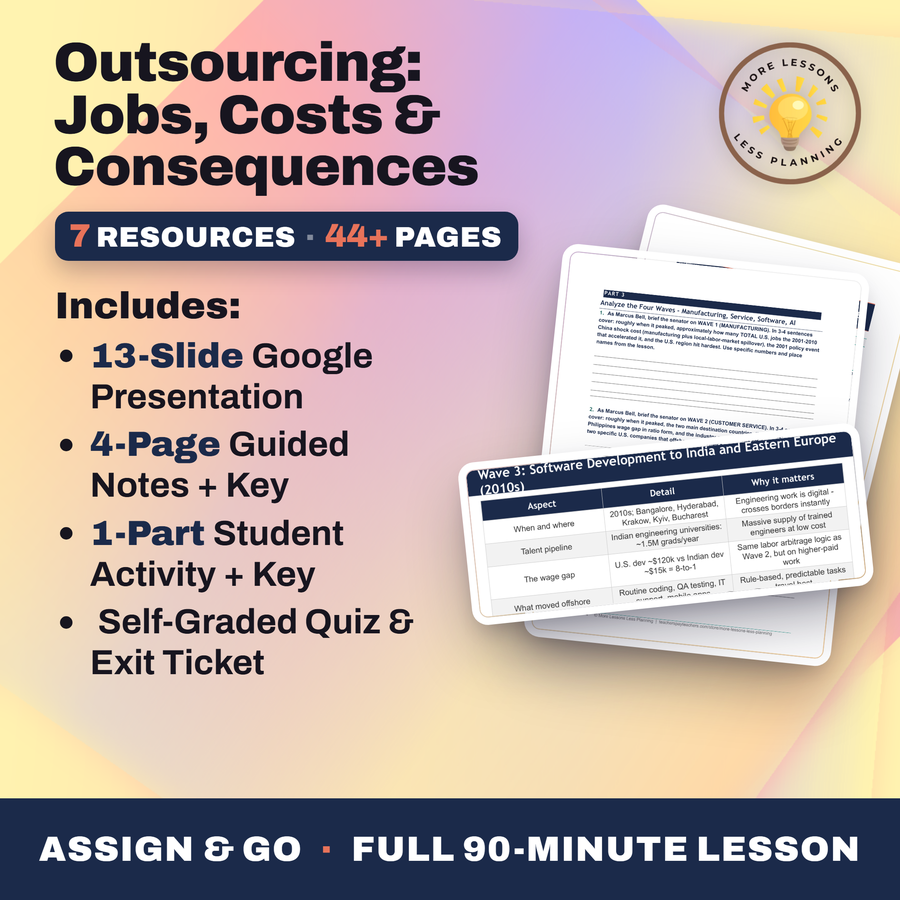
Outsourcing: Jobs, Costs & Consequences
Tariffs: Who Really Pays?
The Trump Tariffs: A Case Study
Amazon Warehouses: Working Conditions Investigation
Anti-Trust Laws and Regulation: Promoting Fair Competition
Barriers to Entry: What Keeps Competitors Out
Every lesson on this site is free to download and use. If one of them saved you a prep period, you can chip in a few bucks toward my three kids' daycare fund. That's genuinely where tips go.