Amazon Warehouses: Working Conditions Investigation
Quality reviewed September 2026
- Grades
- Grades 9-12
- Time
- About two 50-minute class periods
- Includes
- 11 ready-to-teach files
- Format
- Word (.docx) · PowerPoint (.pptx)
- Slide deck
- Guided notes
- Guided notes teacher key
- Activity + answer key
- Quiz + answer key
- Exit ticket + answer key
- Teacher guide
- Teacher presentation notes
What students do
- Describe warehouse productivity quotas known as "the Rate" and how Time Off Task tracking works inside JFK8, LDJ5, and ALB1
- Trace how Chris Smalls organized JFK8 into the first successful Amazon union vote in company history on April 1, 2022
- Weigh Amazon's and the union's competing readings of the same OSHA injury data before taking a side
- Draft a labor-conditions brief for a state hearing on warehouse productivity quotas
What it covers
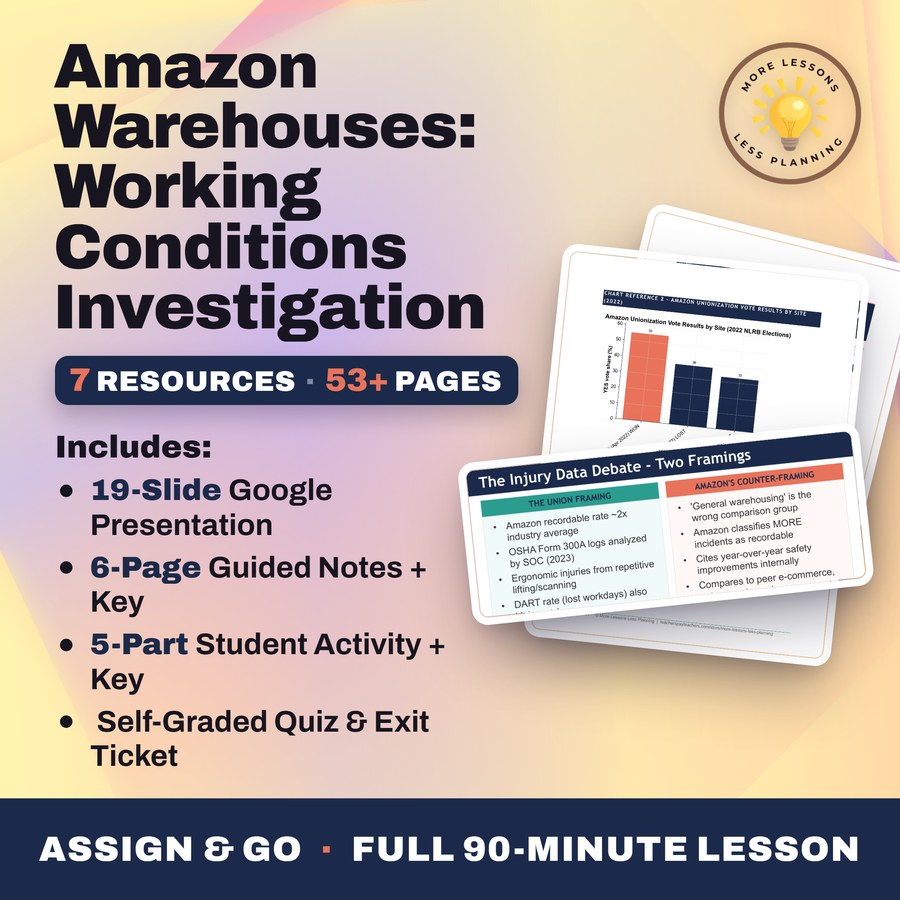
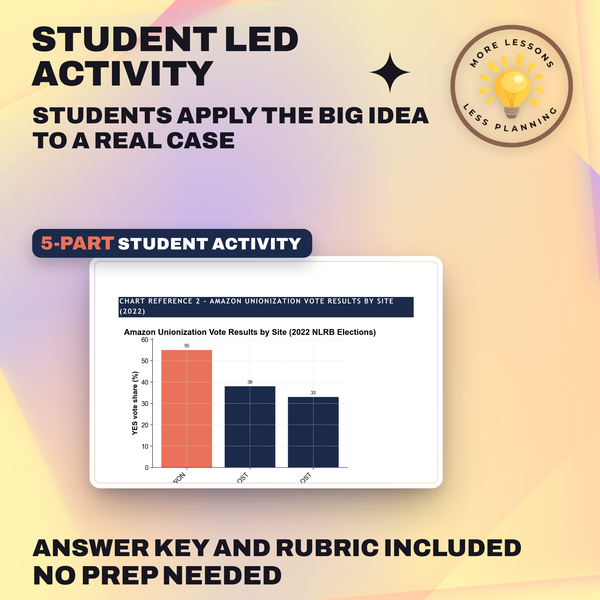
- JFK8's union vote results next to the union elections at LDJ5 and ALB1 that followed a few months later
- The Rate and Time Off Task, and how Amazon's system can flag a worker for a bathroom break without a manager ever stepping in
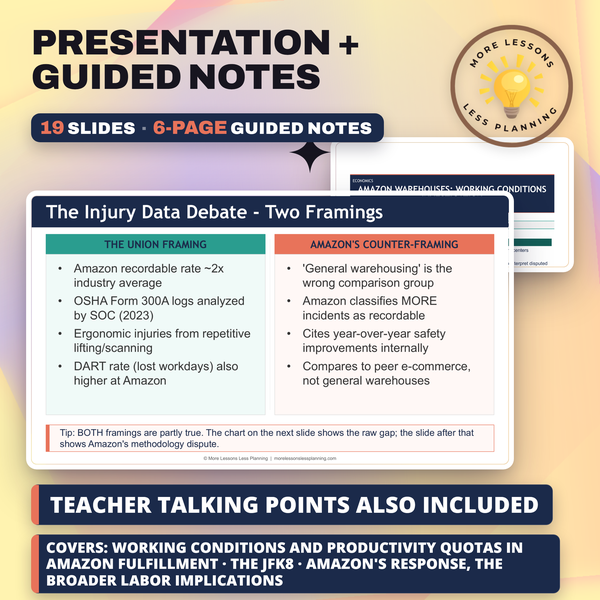
- Two framings of the same OSHA Form 300A data, the union's comparison group against Amazon's own
- Chris Smalls's path from a fired JFK8 worker to founder of the independent Amazon Labor Union
Learning targets
- Describe working conditions and productivity quotas in Amazon fulfillment centers
- Trace the JFK8 (Staten Island) unionization win of April 1, 2022
- Evaluate Amazon's response, the broader labor implications, and how to interpret disputed injury data
Peek inside
1. A JFK8 picker must scan about 300 items every hour, and Amazon's system can auto-terminate a worker who falls short. This productivity quota, measured in units per hour, is called .
Why this matters
Ask a student who decides whether an Amazon warehouse worker gets flagged for a bathroom break, and most guess a manager. Inside JFK8, LDJ5, and ALB1 that decision runs through an automated system called the Rate, tracking Time Off Task, with no manager involved at all.
Amazon and the union are not even arguing about different injury numbers, which surprises most students walking in. Both sides read the exact same OSHA Form 300A data and reach opposite conclusions, and I spend real class time making them name what's actually disputed, the comparison group each side chooses, instead of just picking a side.
From one teacher to another
I built this one around Jordan Reyes, an OSHA compliance specialist drafting an internal brief on Amazon's warehouse injury data for a state hearing on productivity quotas, and students do the same digging Jordan would actually do. They start inside the numbers themselves, the Rate, Time Off Task, and what it actually took for Chris Smalls to organize JFK8 into a union win, before they're allowed anywhere near an opinion. The injury-rate section is the part I'm strictest about, because Amazon and the union are reading the exact same OSHA data and landing on opposite conclusions, so students have to sit with both framings and name what's actually being disputed instead of picking a side by instinct. I added LDJ5 and ALB1's votes on purpose too, since both lost a few months after JFK8 won, and that gap is what keeps a single victory from reading like a trend.
Every file in this toolkit
-
Activity (Student)
Jordan Reyes needs a labor-conditions memo ready for a New York hearing, so you sort five terms into a reference guide, read the injury-rate bars for Amazon against the rest of warehousing, then weigh JFK8's win against the losses at LDJ5 and ALB1 before rating six stakeholders.
-
Activity (Answer Key)
Worked answers show why Time Off Task and the Rate earn their reference-guide slots, both injury-rate bars broken into exact percentages, and all three 2022 union vote totals lined up against each other. Six stakeholder verdicts anchor a full synthesis memo closing the case.
-
Exit Ticket (Student)
Three questions cover the JFK8 vote outcome on April 1, 2022, Amazon's pushback on the OSHA injury comparison, and why that vote counts as an outlier. The quick write asks students to name another industry running under a productivity quota and match it to a 2022 protection.
-
Exit Ticket (Answer Key)
Correct answers land on the 55 percent JFK8 outcome, the comparison-group flaw behind Amazon's OSHA pushback, and the two later votes that make JFK8 an outlier. Scoring on the quick write covers a named industry, a cited protection, and the fit between them.
-
Guided Notes (Student)
Chart 1 sets Amazon's 2022 injury rate at 6.6 per 100 workers against 3.2 for other warehousing, and students log both figures before reading Amazon's argument about picking the wrong comparison group. A second chart then has them record JFK8, LDJ5, and ALB1 vote shares side by side.
-
Guided Notes (Teacher Key)
JFK8's final tally of 2,654 YES against 2,131 NO sits filled in next to Amazon's 25 plus NLRB objections and the $14.2 million it spent on union avoidance consultants company wide. Definitions for Time Off Task, DART rate, and collective bargaining are ready for a teacher fielding questions cold.
-
Quiz (Student)
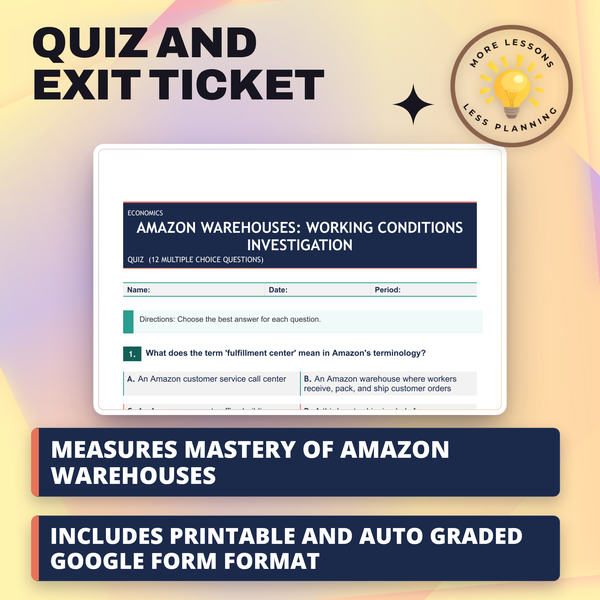
Twelve questions ask what a fulfillment center is, what TOT tracking stands for, how Amazon argues against comparing its injury rate to general warehousing, and what happened at LDJ5 and ALB1.
-
Quiz (Answer Key)
Amazon's union-avoidance consultants cost $14.2 million during the campaign, JFK8 workers still won their 2022 union vote, and the company went on to file more than 25 formal objections with the NLRB afterward.
-
Slides
JFK8 unionized 55 percent to 45 percent while LDJ5 and ALB1 both voted no months later, and the Rate slide shows how an algorithm can flag a bathroom break without any manager stepping in.
-
Teacher Guide
Five discussion prompts push past picking a side, one asking whether NY State should regulate warehouse quotas before an audit settles the OSHA methodology dispute. One extension has students design the ALU's contract demand sheet.
-
Teacher Presentation Notes
Two card sides read the identical OSHA Form 300A numbers and land in opposite places, flagged as both partly true, right before the vote math and Amazon's methodology objection split onto separate slides.
Download
Where should I send the next one?
Everything here is free and it stays that way. Leave your email and I'll send you the new lessons as they go up. You can unsubscribe from any one of them.
Related resources
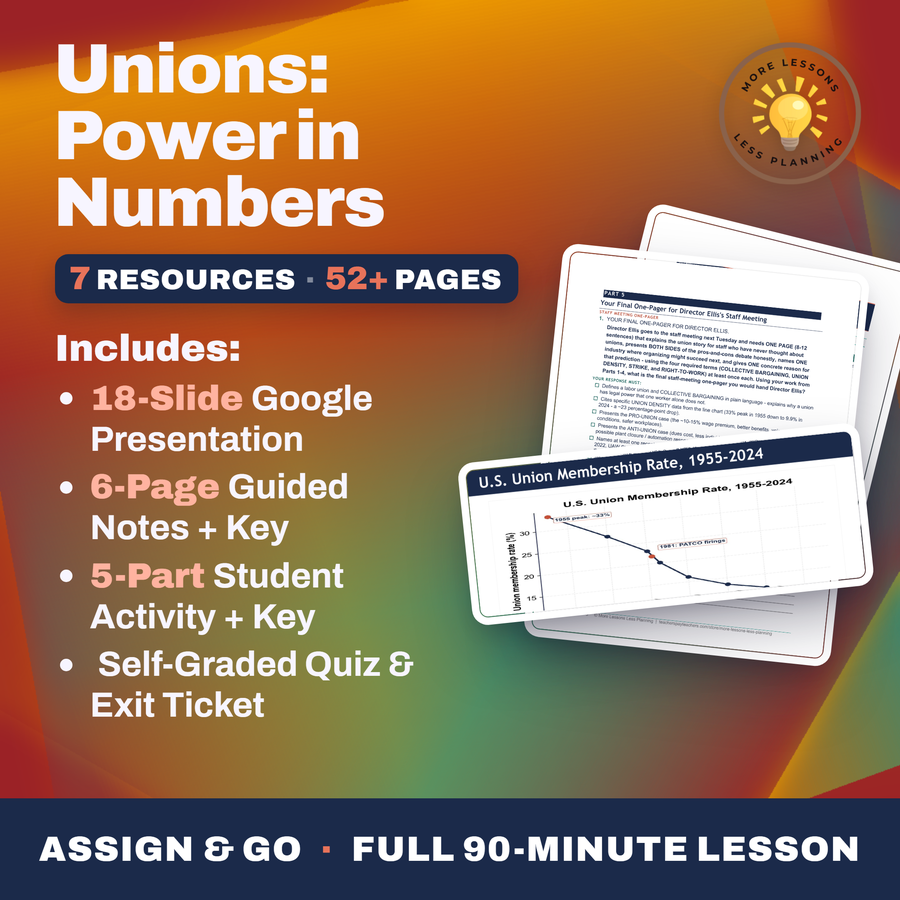
Unions: Power in Numbers
Anti-Trust Laws and Regulation: Promoting Fair Competition
Barriers to Entry: What Keeps Competitors Out
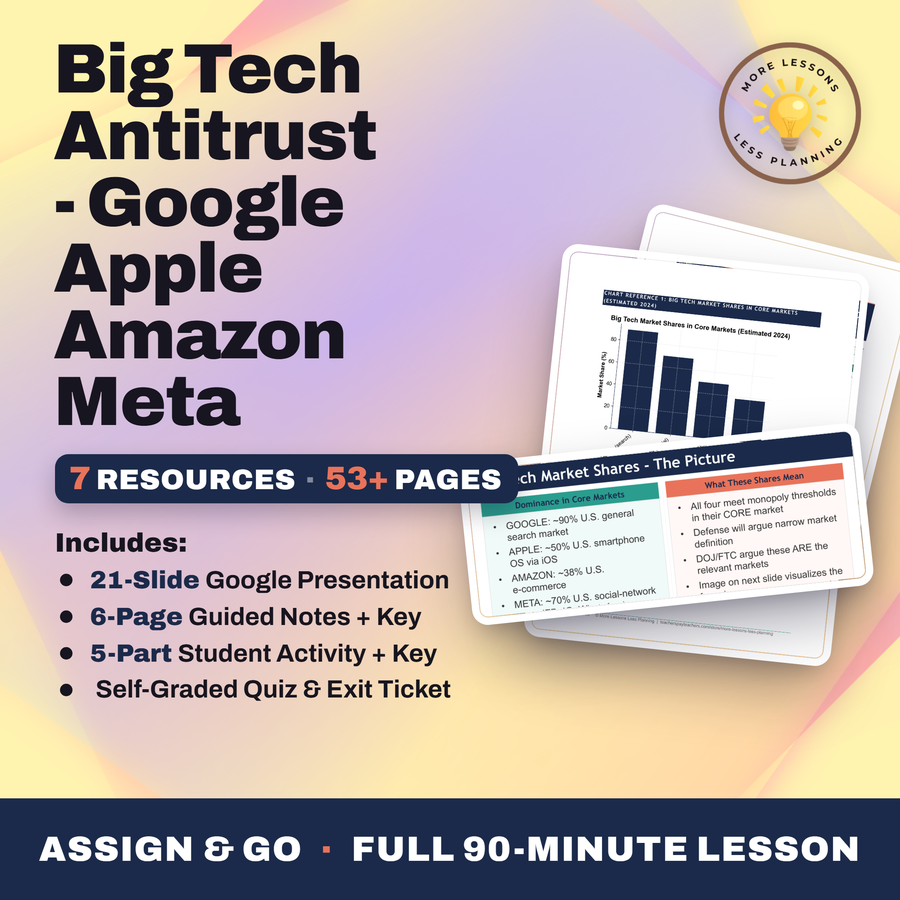
Big Tech Antitrust - Google Apple Amazon Meta
Budget Deficits & Surpluses: Understanding Fiscal Balances
Business Cycles Demystified: Boom, Bust, and Recovery
Every lesson on this site is free to download and use. If one of them saved you a prep period, you can chip in a few bucks toward my three kids' daycare fund. That's genuinely where tips go.