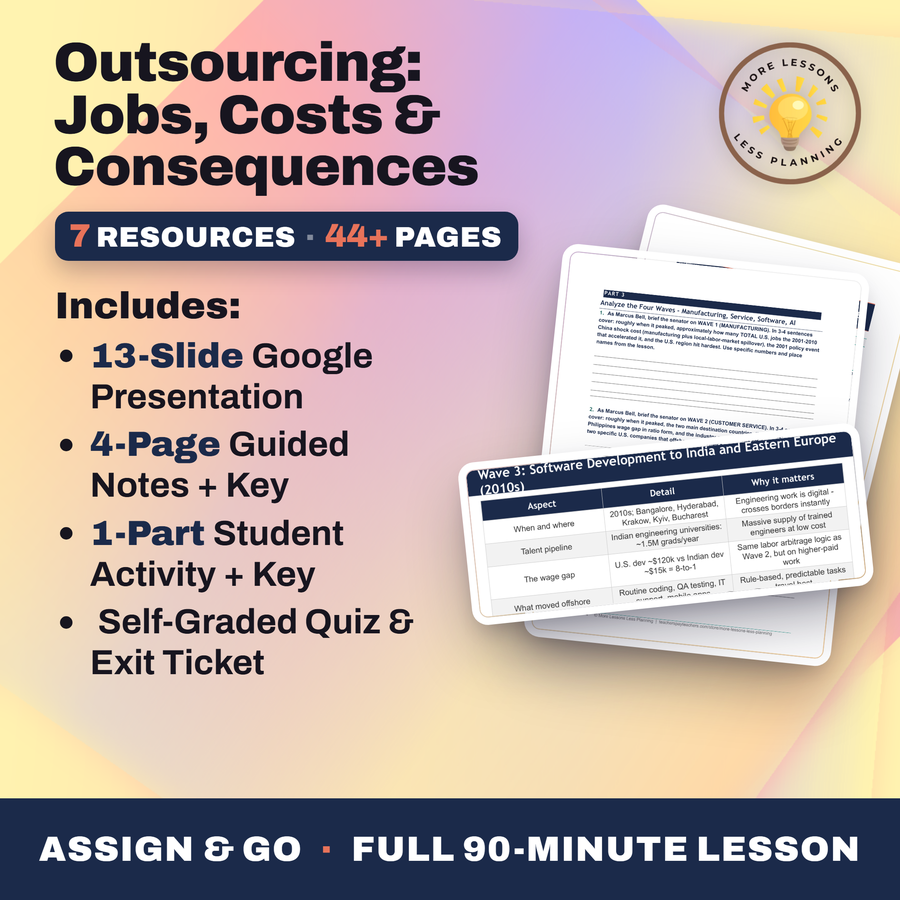
Outsourcing: Jobs, Costs & Consequences
Quality reviewed September 2026
- Grades
- Grades 9-12
- Time
- About two 50-minute class periods
- Includes
- 11 ready-to-teach files
- Format
- Word (.docx) · PowerPoint (.pptx)
- Slide deck
- Guided notes
- Guided notes teacher key
- Activity + answer key
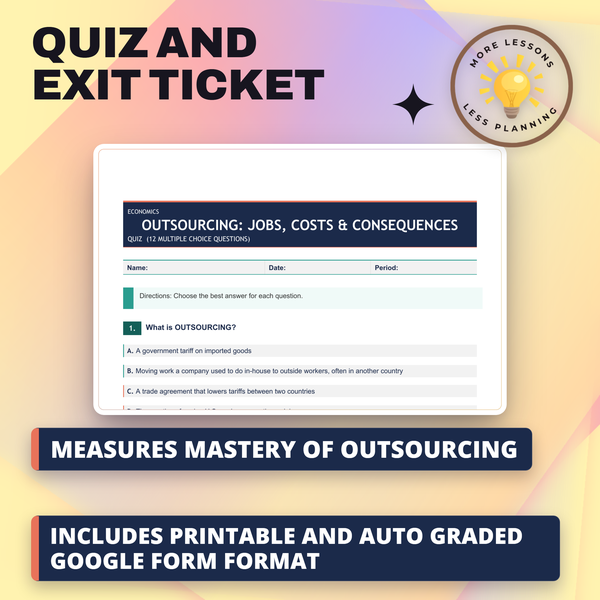
- Quiz + answer key
- Exit ticket + answer key
- Teacher guide
- Teacher presentation notes
What students do
- Trace four waves of outsourcing from manufacturing offshoring to Wave 4 AI-driven knowledge work
- Calculate the wage gaps that drove each wave, including the 7-to-1 gap behind call center offshoring
- Read a timeline chart and a bar chart to find which wave peaked when and which displaced the most jobs
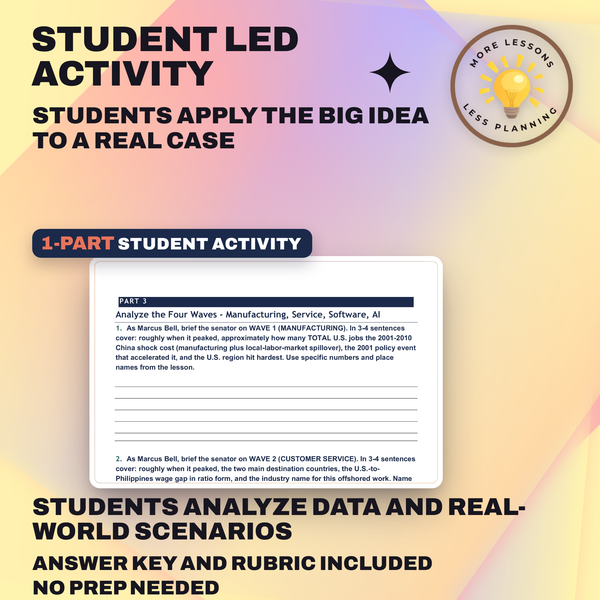
- Write a policy memo as a Department of Labor analyst recommending how to help workers displaced by AI
What it covers
- The 2001-2010 China shock and its roughly 2.4 million total U.S. jobs lost, per Autor/Dorn/Hanson research
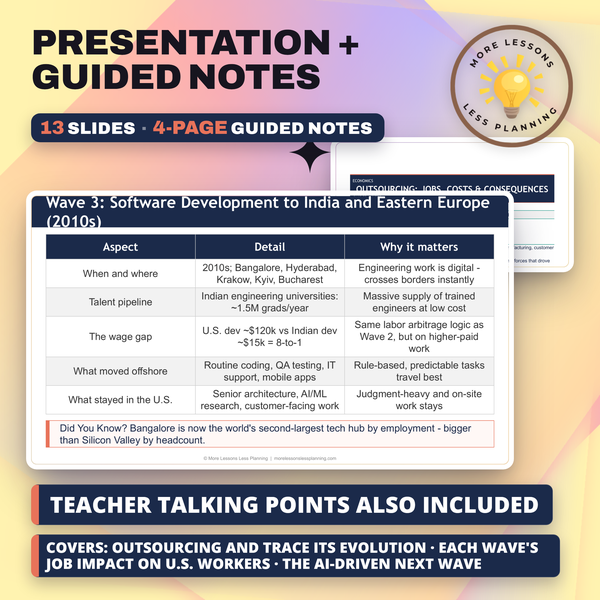
- Call center offshoring to India and the Philippines, and software offshoring to Bangalore and Eastern Europe
- Why Wave 4, starting with ChatGPT's 2022 launch, needs no foreign country to displace a job
- The routine-versus-non-routine divide that predicts which jobs are safe from AI and which aren't
Learning targets
- Define OUTSOURCING and trace its evolution through four waves - manufacturing, customer service, software, and AI-driven knowledge work
- Identify each wave's job impact on U.S. workers and explain the economic forces that drove jobs offshore
- Evaluate the AI-driven next wave of outsourcing and weigh consumer benefits against worker displacement
Peek inside
Definition and Why Companies Do It
OUTSOURCING is moving work a company used to do to outside workers.
OFFSHORING is outsourcing to another .
Bringing the work back home is called onshoring or .
The economic driver of outsourcing is LABOR .
Consumers get LOWER on goods and services when work is outsourced.
1. When a company moves work it used to do in-house out to outside workers or contractors - often in another country - that practice is called .
Why this matters
My students think outsourcing means one thing, factories moving to China, and that is only the first of four waves this lesson traces. A 7-to-1 wage gap explains call centers moving to Manila, the same demand later pulled software jobs to Bangalore, and a fourth wave, AI, needs no country at all to displace a job.
That last wave unsettles a room fastest, because there is no factory town to point at and nowhere for the job to come back from. Reading real charts on which wave displaced the most jobs, then writing a policy memo, pushes students to recommend something more specific than help workers.
From one teacher to another
This lesson exists because my students think "outsourcing" just means factories moved to China, and that's only wave one of four. We trace manufacturing offshoring through to call centers in Manila, software jobs in Bangalore, and now AI eliminating knowledge work entirely, which is the wave that scares them most because there's no country for the job to come back from. Every wave gets an actual wage-gap number attached to it, not just a vague "cheaper labor" explanation, and by the end students are reading real charts to figure out which wave hit hardest before writing a policy memo as a Department of Labor analyst who has to recommend something more specific than "help workers."
Every file in this toolkit
-
Activity (Student)
Marcus Bell is briefing a senator on four decades of job losses, so you cover each outsourcing wave from Rust Belt factories to Bangalore software work to AI, pull numbers off a peak-year chart and a total-jobs bar chart, then rebut his aide's claim that AI just repeats Wave 1.
-
Activity (Answer Key)
Each of the four outsourcing waves gets its peak year, wage-gap ratio, and displaced-jobs figure spelled out, from the 2.4 million China shock jobs to the Goldman Sachs AI projection. A rebuttal to the senator's aide leads into a full sample policy memo.
-
Exit Ticket (Student)
Questions cite the total U.S. jobs lost to the China shock between 2001 and 2010, identify what separates Wave 4 AI outsourcing from the first three waves, and pick the job least likely to be automated. Students point to who benefits, who loses, and why companies do it anyway.
-
Exit Ticket (Answer Key)
About 2.4 million jobs is the China-shock total, needing no foreign country at all describes the Wave 4 difference, and a plumber's home repair is the safest job on the list. Scoring wants a winner, a loser, a specific number, and a reason companies outsource.
-
Guided Notes (Student)
A 7-to-1 wage gap between U.S. and Filipino call-center pay opens the wave-by-wave math, and students carry it through Bangalore's 8-to-1 software gap before reaching Wave 4, where AI eliminates the work with no country involved. Four waves get compared for total jobs displaced.
-
Guided Notes (Teacher Key)
The $35,000 versus $5,000 call-center gap, the $120k versus $15k software gap, and the roughly 2.4 million jobs the 2001 to 2010 China shock cost all come tallied with sources. Labor arbitrage, offshoring, and routine versus non-routine tasks are ready to cite.
-
Quiz (Student)
A wage-gap item compares a $35,000 U.S. call-center salary to a $5,000 Filipino one, and a bar-chart question asks which of the four outsourcing waves hit the largest total number of jobs.
-
Quiz (Answer Key)
That wage gap comes out to 7-to-1, manufacturing gets named as the wave with the largest total job losses, and Goldman Sachs estimates how much of the workforce AI could displace by 2030.
-
Slides
A first-wave chart puts a number on the 2001 China shock, close to 2.4 million jobs gone in the decade that followed, before a bar chart lines up call centers, Bangalore software work, and Wave 4 AI jobs that Goldman Sachs pegs at 300 million exposed worldwide.
-
Teacher Guide
Extension work has students trace one outsourced item from their day, a phone, a chat window, an app, back to the wave that made it possible or cheap. A differentiation note pairs each wage-gap slide with the same ratio written both as dollars and as 7-to-1, for English language learners.
-
Teacher Presentation Notes
Manufacturing employment sliding from 17 million in 2000 to about 12 million by 2010 anchors one card, timed right before the script turns to the fourth wave dated to ChatGPT's November 2022 launch.
Download
Where should I send the next one?
Everything here is free and it stays that way. Leave your email and I'll send you the new lessons as they go up. You can unsubscribe from any one of them.
Related resources
Tariffs: Who Really Pays?
The Trump Tariffs: A Case Study

Why Shein & Temu Are So Cheap
Amazon Warehouses: Working Conditions Investigation

Anti-Trust Laws and Regulation: Promoting Fair Competition
Barriers to Entry: What Keeps Competitors Out
Every lesson on this site is free to download and use. If one of them saved you a prep period, you can chip in a few bucks toward my three kids' daycare fund. That's genuinely where tips go.