Tariffs: Who Really Pays?
Quality reviewed September 2026
- Grades
- Grades 9-12
- Time
- About two 50-minute class periods
- Includes
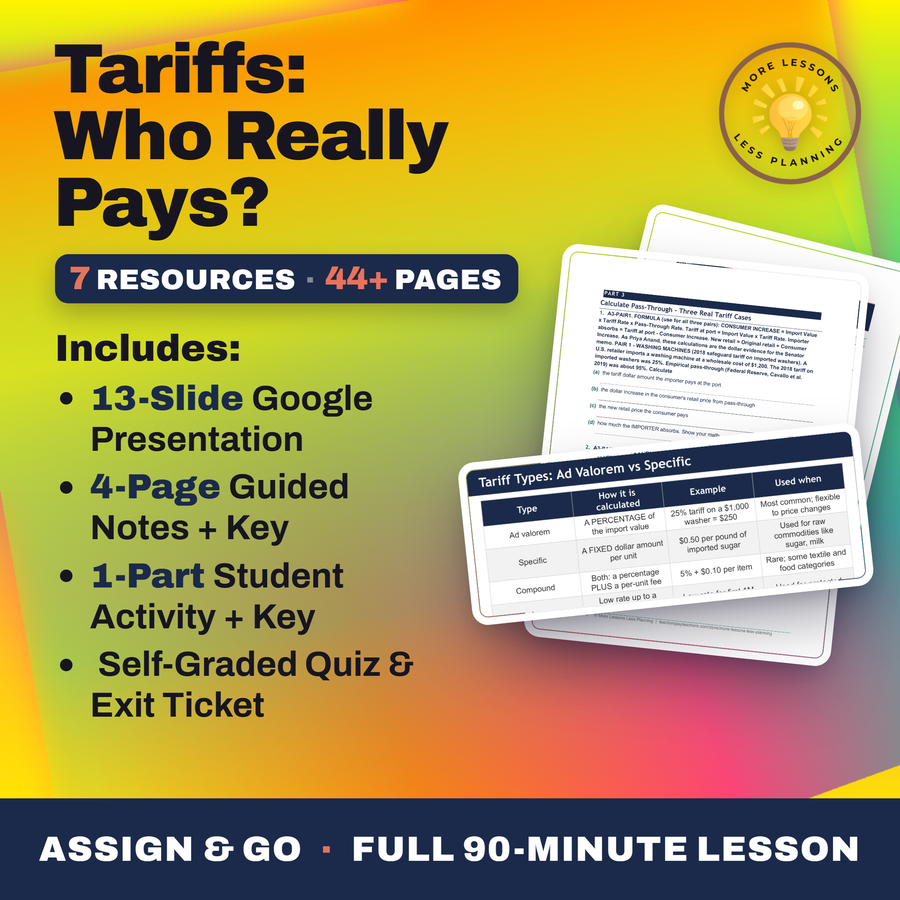
- 10 ready-to-teach files
- Format
- Word (.docx) · PowerPoint (.pptx)
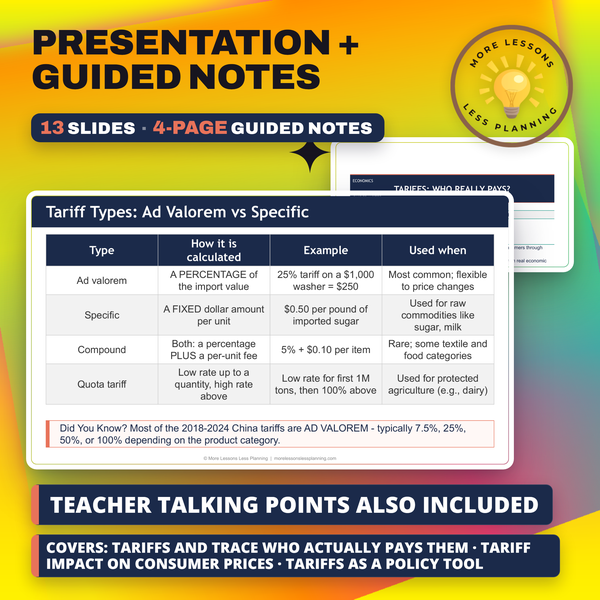
- Slide deck
- Guided notes
- Guided notes teacher key
- Activity + answer key
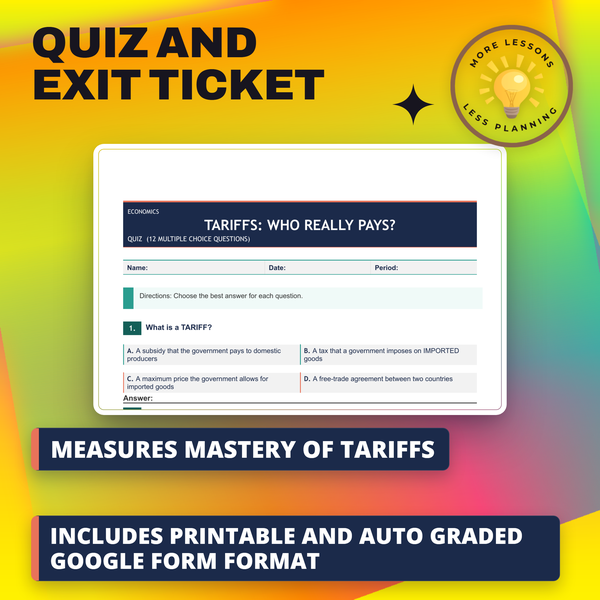
- Quiz + answer key
- Exit ticket + answer key
- Teacher guide
What students do
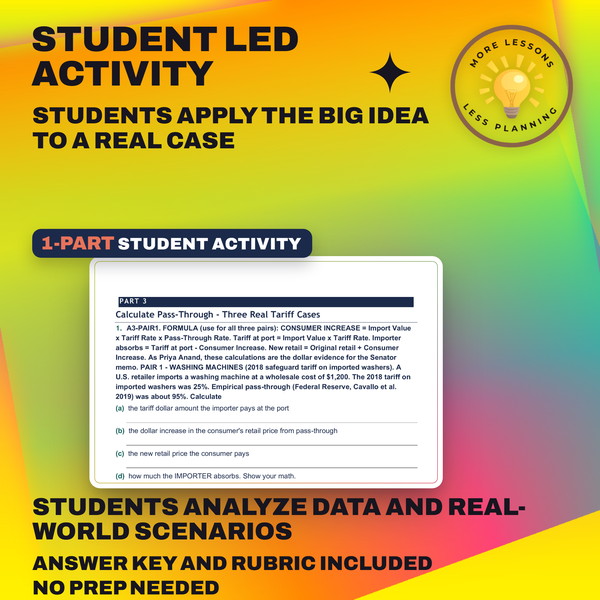
- Calculate the pass-through cost of a 25% tariff on a $1,200 washing machine, splitting what the importer eats from what the shopper pays
- Compare pass-through rates across three real 2018-2024 tariffs, on washing machines, televisions, and solar panels
- Read a supply-and-demand chart to see how a tariff shifts supply left, raising price and lowering quantity traded
- Write a CBO memo naming the legal payer, the economic payer, and what the foreign exporter actually pays
What it covers
- Federal Reserve, NBER, and Peterson Institute research finding 95-100% of 2018-2019 tariffs reached American consumers
- The dollar chain on a $1,200 washing machine, from the importer's tariff bill at the port to the shopper's price increase
- Comparing pass-through rates across three real 2018-2024 tariffs, on washing machines, televisions, and solar panels
- U.S. tariff revenue roughly doubling from $33 billion in 2017 to $71 billion in 2019
Learning targets
- Define tariffs and trace who actually pays them - importers first, then consumers through higher prices
- Calculate tariff impact on consumer prices using the pass-through rate from real economic studies
- Evaluate tariffs as a policy tool by weighing protection and revenue benefits against consumer cost
Peek inside
Definition and Where the Tax Lands
A tariff is a a government puts on imported goods.
Tariffs are collected at the when goods arrive.
The tariff is paid by the to U.S. Customs (CBP).
The foreign country does pay the tariff.
After the importer pays the tariff, the cost reaches the consumer through a higher price.
1. A tax a government places on imported goods, collected at the border when the goods enter the country, is a .
Why this matters
China pays the tariffs is the myth most students walk in with, but the Federal Reserve, the NBER, and the Peterson Institute all found 95-100% of the tariff landed on American consumers. Working the dollar chain on a $1,200 washing machine, a $300 tariff bill, students calculate how that splits between importer and shopper.
The same math run again on real 2019 television tariffs and the 2024 solar tariff produces a similar split every time, which is what actually changes a student's answer. By the time they read U.S. tariff revenue doubling from $33 billion in 2017 to $71 billion in 2019, they can name who legally pays and who actually does.
From one teacher to another
"China pays the tariffs" is the line most of my students walk in believing, so I open by handing them the same data three independent groups landed on, the Federal Reserve, the NBER, and the Peterson Institute, all finding 95-100% of the 2018-2019 tariffs reached American consumers. We trace the actual dollar chain on a $1,200 washing machine: a 25% tariff means the importer pays $300 at the port, and students work out for themselves, at 95% pass-through, how that $300 splits between what the shopper pays and what the importer eats. They repeat the math on real 2019 television tariffs and the 2024 solar panel tariff, before reading a chart showing U.S. tariff revenue roughly doubling from $33 billion in 2017 to $71 billion in 2019, and close by writing a CBO-style memo that has to name who legally writes the check versus who actually pays.
Every file in this toolkit
-
Activity (Student)
Priya Anand's tariff math has students turn a 25 percent rate into a $300 bill on one appliance, split between shopper and importer, then repeat the split on a $600 television and a $4,000 solar array before a policy memo to a U.S. Senator.
-
Activity (Answer Key)
Pass-through math in this key runs $300 down to a $285 consumer hit on the washer, $45 down to $40.50 on the television, and the full $2,000 landing on the solar buyer, while federal tariff revenue roughly doubles, about $33 billion in 2017 climbing toward $71 billion two years later.
-
Exit Ticket (Student)
Items identify who legally pays a tariff on Chinese-made washing machines, work out the price jump on a $4,000 solar array under a 50 percent tariff, and name who absorbed most of the 2018-2019 tariffs. Who writes the check, who bears the cost, and what the exporter pays all need naming.
-
Exit Ticket (Answer Key)
The U.S. importer writes the check at customs, $2,000 is the solar-array price jump, and U.S. buyers absorbing 95 to 100 percent answers the 2018-2019 question. Scoring wants the check-writer, the cost-bearer, one lesson number, and the exporter's near-zero share.
-
Guided Notes (Student)
The dollar chain gets worked on a $1,000 washing machine, a 25 percent tariff that costs the importer $250 at the port, then at 95 percent pass-through students calculate how much lands on the shopper's receipt instead of the importer's ledger.
-
Guided Notes (Teacher Key)
Findings from the Peterson Institute, the Federal Reserve, and the NBER get cited together for the 95 to 100 percent pass-through, then the exact math closes it out, a $237.50 consumer increase and a $12.50 importer loss on the same $250 tariff bill.
-
Quiz (Student)
A $2,000 imported product runs the pass-through math item by item, while other questions ask which party is legally on the hook for a tariff at the border and what Section 232 authorizes.
-
Quiz (Answer Key)
The math on a $2,000 product works out to a $475 price increase, the U.S. importer stands as who legally pays at the border, and Federal Reserve and NBER studies put the pass-through at 95 to 100 percent.
-
Slides
A $1,000 import shows the whole chain, a 25 percent tariff means $250 paid at the port, then the deck runs the pass through math to land $237.50 on the shopper at a 95 percent rate. Three independent studies book that same near total pass through, next to $80 billion in tariff revenue.
-
Teacher Guide
A $1,000 washing machine's tariff math structures the guided practice, and Teaching Tips flag the common error of treating pass-through as if it always equals 100 percent.
Download
Where should I send the next one?
Everything here is free and it stays that way. Leave your email and I'll send you the new lessons as they go up. You can unsubscribe from any one of them.
Related resources
Outsourcing: Jobs, Costs & Consequences
The Trump Tariffs: A Case Study
Why Shein & Temu Are So Cheap
Amazon Warehouses: Working Conditions Investigation
Anti-Trust Laws and Regulation: Promoting Fair Competition
Barriers to Entry: What Keeps Competitors Out
Every lesson on this site is free to download and use. If one of them saved you a prep period, you can chip in a few bucks toward my three kids' daycare fund. That's genuinely where tips go.