Why Gen Z Can't Buy a House
Quality reviewed September 2026
- Grades
- Grades 9-12
- Time
- About two 50-minute class periods
- Includes
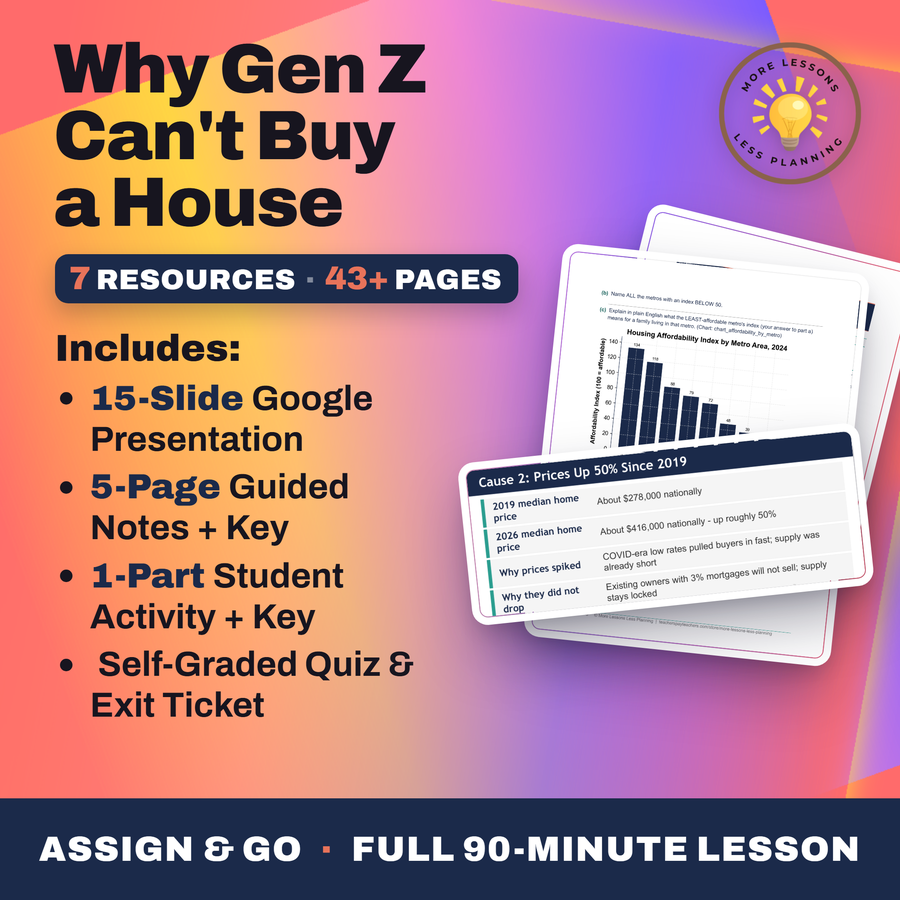
- 10 ready-to-teach files
- Format
- Word (.docx) · PowerPoint (.pptx)
- Slide deck
- Guided notes
- Guided notes teacher key
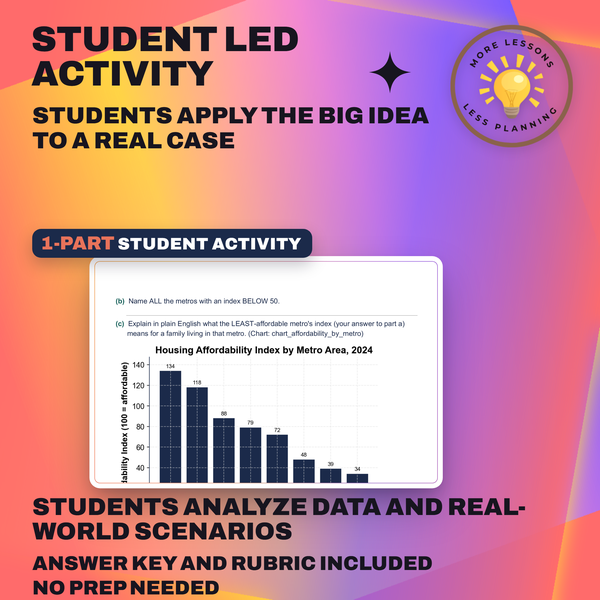
- Activity + answer key
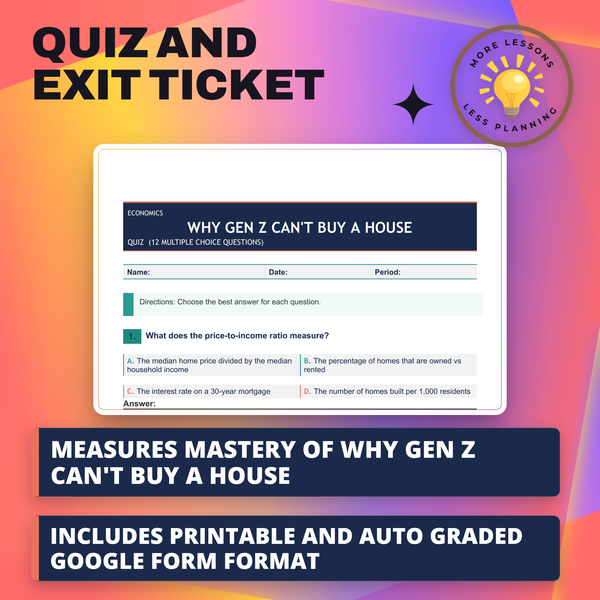
- Quiz + answer key
- Exit ticket + answer key
- Teacher guide
What students do
- Calculate the monthly mortgage payment on a starter home at a 7% rate versus the 2021 rate of about 3%
- Compare the median age of first-time homebuyers across generations using the lesson's age chart
- Rank the four policy options, upzoning, builder incentives, down-payment assistance, and rate cuts, from most to least effective before defending a top pick to a partner
- Argue for one policy solution, upzoning, builder incentives, down-payment assistance, or rate cuts, using the lesson's data
What it covers
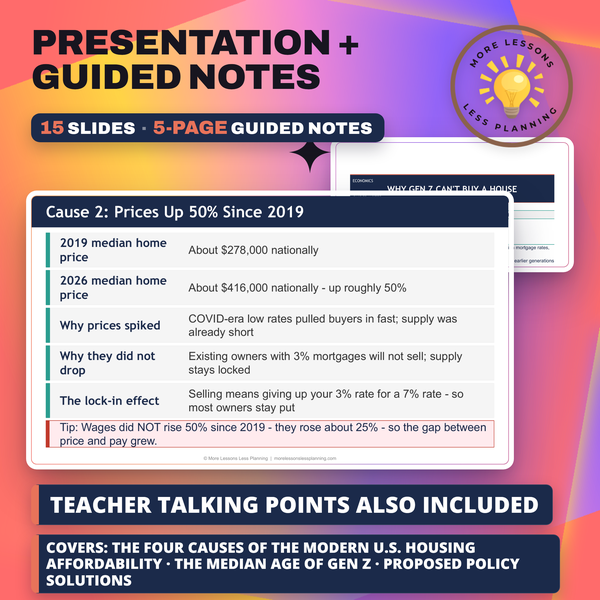
- The four causes of the housing affordability crisis, mortgage rates near 7%, prices up 50% since 2019, a 4-million-unit supply shortage, and single-family zoning
- Why the U.S. price-to-income ratio climbed from about 3 in 1985 to over 7 today
- How single-family zoning covers roughly 75% of U.S. residential land and blocks new supply
- What's pushed the median age of a first-time homebuyer later with each generation
Learning targets
- Identify the four causes of the modern U.S. housing affordability crisis: high mortgage rates, high prices, the supply shortage, and zoning rules that block building
- Compare the median age of Gen Z and millennial first-time homebuyers to earlier generations and explain what shifted
- Evaluate proposed policy solutions (zoning reform, builder incentives, down-payment assistance, rate cuts) using lesson data
Peek inside
Three Numbers That Show the Scale of the Problem
In 1985, the U.S. price-to-income ratio was about (homes cost about 3 times income).
In 2026, the ratio is about (homes cost about 7 times income).
In 2021, mortgage rates were near % and were considered normal.
By 2024, mortgage rates hit about %.
Boomers bought their first home at age .
Why this matters
Plenty of students have heard a parent say they will never afford a house here. This lesson attaches a real mortgage payment to that complaint: the same starter home costs far more monthly at today's 7% rate than at 2021's roughly 3%, against a price-to-income ratio up from about 3 in 1985 to over 7 now.
What breaks the economy-is-just-bad shrug is zoning, since most students never guess that single-family zoning locks up roughly 75% of U.S. residential land before a rate or price even enters the picture. I have them rank the fixes and defend one to a partner, which turns a complaint into a position they can argue for.
From one teacher to another
The data in this lesson finally explains something my students already feel, since more than a few of them have heard their parents say they'll never afford a house here. Walking through mortgage rates, prices, the supply shortage, and zoning as four separate, addable causes stops the conversation from collapsing into "the economy is just bad" and gets them naming an actual policy lever. The exit ticket has them pick one fix and defend the choice with a specific rate, price, or policy detail pulled straight from the deck.
Every file in this toolkit
-
Activity (Student)
Mortgage math has students compute a $300,000 loan at 3 percent against 7 percent, read median first-home ages climbing from 29 for Boomers to 37 for Gen Z, then rank upzoning, builder incentives, down-payment aid, and rate cuts for a legislator.
-
Activity (Answer Key)
Payment figures in this key show a $300,000 loan costing $731 more a month at 7 percent than at 3 percent, a price-to-income ratio at 7.4 versus 1985's 3.2, and a policy memo scored for citing two lesson figures plus a stated trade-off.
-
Exit Ticket (Student)
Three questions define what an ADU actually is, name what most economists call the single biggest fix for the affordability crisis, and estimate how many years later Gen Z buys a first home compared to Baby Boomers. The response gives one policy fix and defends it with a lesson number.
-
Exit Ticket (Answer Key)
ADU means a small additional home on the same lot, building more housing through upzoning is the biggest fix economists name, and about eight years later marks the Gen Z timeline gap against Baby Boomers. No rubric rides along here, just a teacher's read of the reasoning.
-
Guided Notes (Student)
A $300K mortgage payment gets calculated at today's 7 percent rate against 2021's roughly 3 percent rate, then an age chart shows earlier generations buying their first home at 29 against a current buyer now waiting until 37.
-
Guided Notes (Teacher Key)
The exact payment math gets run, $1,265 a month on that loan at 3 percent against $1,996 a month at 7 percent, then the notes price a 2026 median home at $416,000, showing a buyer needs household income near $129,300 against an actual median near $80,000.
-
Quiz (Student)
Mortgage rates near 7 percent in 2024 get set against homeowners locked into 3 percent loans, while other items define NIMBY and upzoning and ask why supply stays off the market.
-
Quiz (Answer Key)
That price-to-income ratio sits at about 3.2 back in 1985, the lock-in effect keeps 3 percent mortgage holders from selling, and upzoning stands as allowing more units on the same land.
-
Slides
A price-to-income ratio climbing from 3.2 in 1985 to 7.1 today pairs with a slide on single-family zoning locking up about 75 percent of U.S. residential land, then a generational chart moves the first-time buyer age from 29 for Boomers to 37 for Gen Z.
-
Teacher Guide
A rate-scenario handout runs the same $400,000 loan through five mortgage rates, from 3 percent up to the 1980s peak of 12 percent, and has students rank each by total interest paid over 30 years. A zoning walkthrough using real city maps asks where they would prioritize new building.
Download
Where should I send the next one?
Everything here is free and it stays that way. Leave your email and I'll send you the new lessons as they go up. You can unsubscribe from any one of them.
Related resources
Pandemic Economics: COVID's Lasting Impact
The Billionaire Tax Debate
Universal Basic Income: Free Money for Everyone?
Wealth Inequality: The Top 1% Explained
Amazon Warehouses: Working Conditions Investigation

Anti-Trust Laws and Regulation: Promoting Fair Competition
Every lesson on this site is free to download and use. If one of them saved you a prep period, you can chip in a few bucks toward my three kids' daycare fund. That's genuinely where tips go.