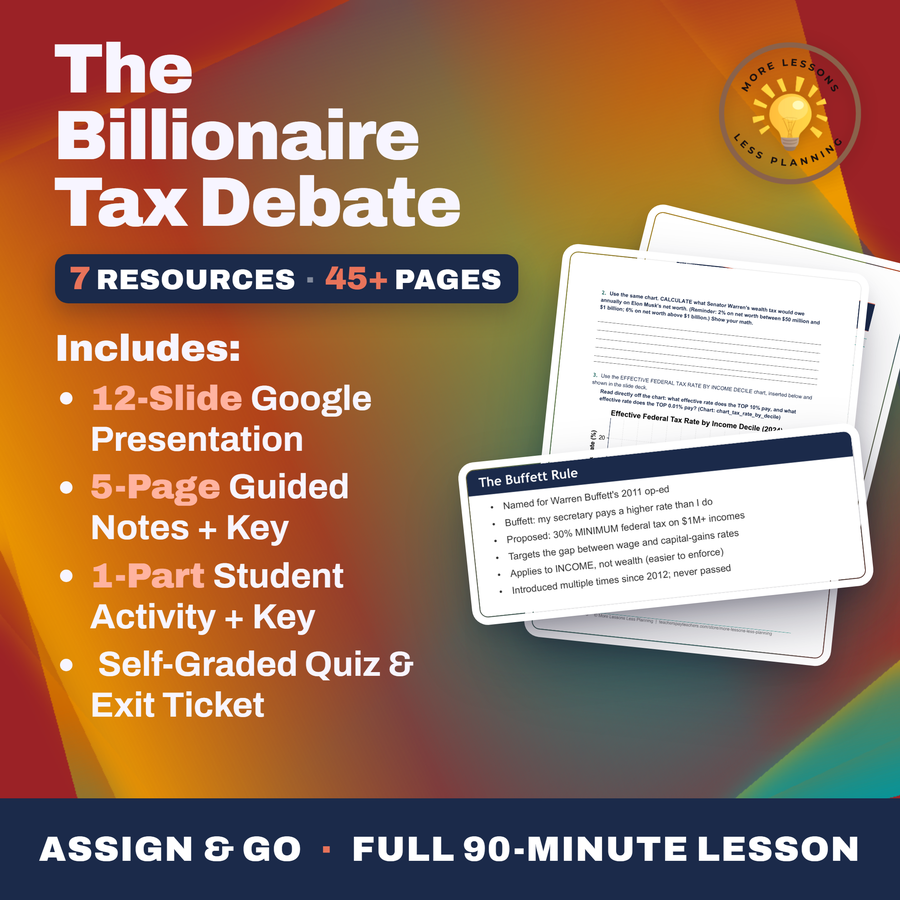

The Billionaire Tax Debate
Quality reviewed September 2026
- Grades
- Grades 9-12
- Time
- About two 50-minute class periods
- Includes
- 11 ready-to-teach files
- Format
- Word (.docx) · PowerPoint (.pptx)
- Slide deck
- Guided notes
- Guided notes teacher key
- Activity + answer key
- Quiz + answer key
- Exit ticket + answer key
- Teacher guide
- Teacher presentation notes
What students do
- Distinguish a wealth tax on net worth from an income tax, and classify four real proposals as one or the other
- Trace the buy-borrow-die strategy step by step, from holding appreciating stock to a stepped-up basis at death
- Calculate Senator Warren's proposed wealth tax on a real billionaire's net worth using her 2%/6% bracket structure
- Write a Senate policy memo recommending one of four proposals, citing the top 0.01%'s roughly 8% effective tax rate
What it covers
- The buy-borrow-die strategy, from holding appreciating stock to a stepped-up basis that erases the gain at death
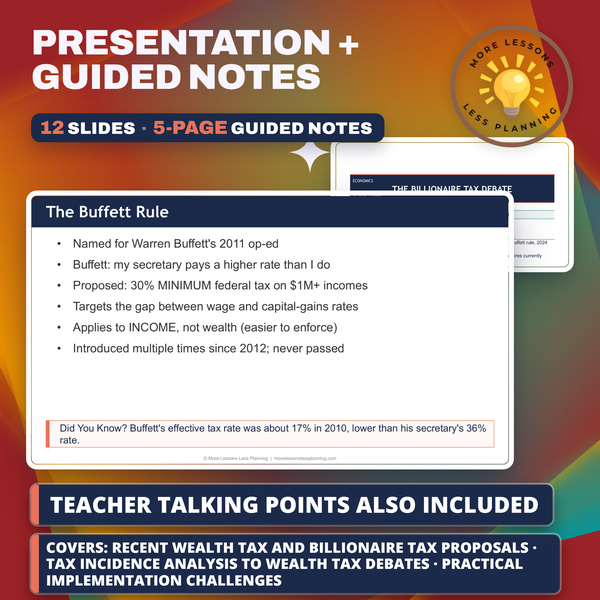
- Four real proposals, Warren's and Sanders's wealth taxes versus the Buffett Rule and the 2024 billionaire minimum income tax
- The top 0.01%'s roughly 8% effective tax rate against the top 10%'s roughly 22%
- Applying Senator Warren's proposed 2%/6% wealth tax bracket structure to a real billionaire's net worth
Learning targets
- Identify recent wealth tax and billionaire tax proposals (Warren, Sanders, Buffett rule, 2024 billionaire minimum income tax)
- Apply tax incidence analysis to wealth tax debates and explain how billionaires currently avoid taxes
- Evaluate practical implementation challenges and the constitutional question around taxing wealth
Peek inside
The Concentration Problem
Top 1% holds about 30% of all U.S. wealth
About 800 U.S. billionaires held ~$5.5T in 2024
Wealth gap widened during 2020-2024 stock boom
Existing income tax barely touches stored wealth
The Concentration Problem
The top 1% holds about % of all U.S. wealth.
About U.S. billionaires held roughly $5.5T in 2024.
The wealth gap widened during the 2020-2024 boom.
The Rate Mismatch
The top STATUTORY income tax rate is %.
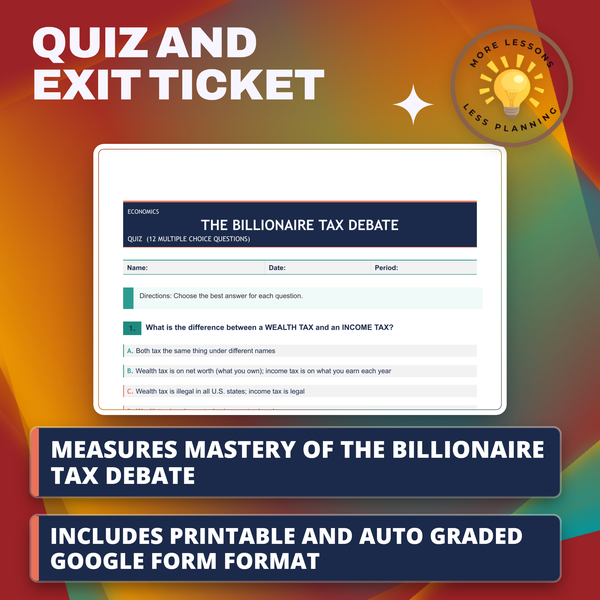
1. Q1. An annual tax on a household's total accumulated wealth - everything you own minus everything you owe - rather than on the money you earn each year, is a .
Why this matters
The top 0.01% pays an effective rate near 8%, lower than the top 10%'s roughly 22%, and the gap is fully legal. Buy-borrow-die is why: hold stock, borrow against it tax-free, then pass it to heirs at a stepped-up basis that erases the gain at death.
Students arrive assuming Warren's and Sanders's wealth taxes and the Buffett Rule are one idea. They are not the same kind of policy: one taxes net worth, the other income. Running Warren's 2%/6% bracket against a real billionaire before the Senate memo forces them to defend an actual number.
From one teacher to another
The number that gets every student's attention is the one Warren Buffett pointed out himself: the top 0.01% pays an effective federal tax rate of about 8%, lower than the roughly 22% the merely well-off top 10% pays. This lesson explains why, walking through buy-borrow-die step by step, hold appreciating stock instead of selling it, borrow against it tax-free to spend, then pass it to heirs at a stepped-up basis that erases the gain entirely, all completely legal. From there students classify four real proposals, Warren's and Sanders's actual wealth taxes on net worth versus the Buffett Rule and the 2024 billionaire minimum, which are technically income taxes, calculate what Warren's 2%/6% structure would cost a real billionaire from the lesson's chart, and close by writing a Senate memo that has to pick one proposal and name a real trade-off, not just list pros and cons.
Every file in this toolkit
-
Activity (Student)
Avery Chen classifies four real proposals as wealth taxes or income taxes, then walks the buy-borrow-die loophole from an appreciating stock all the way to an heir's stepped-up basis. Warren's 2 percent and 6 percent brackets get applied to a real billionaire before a Senate memo.
-
Activity (Answer Key)
A $14.36 billion annual bill lands on Elon Musk's $240 billion net worth under Senator Warren's wealth tax, worked out step by step. The top 0.01 percent's roughly 8 percent effective rate against the top 10 percent's 22 percent backs the memo.
-
Exit Ticket (Student)
Questions define the buy-borrow-die strategy some billionaires use to avoid income tax, identify which proposal taxes net worth instead of income, and name the constitutional concern about a federal wealth tax. One specific challenge a wealth tax would face if passed tomorrow needs naming.
-
Exit Ticket (Answer Key)
Holding stock, borrowing against it, and passing it on at death spells out buy-borrow-die, Warren's 2 percent and 6 percent plan is the net-worth proposal, and the apportionment question under the 16th Amendment is the constitutional worry. Grading here is a short written check, no point scale.
-
Guided Notes (Student)
Warren's 2 percent tax above $50 million and 6 percent above $1 billion get applied to a real billionaire, and students work the buy-borrow-die sequence piece by piece, holding stock, taking a loan against it, then passing it on tax-free. They sort four proposals into wealth taxes or income taxes.
-
Guided Notes (Teacher Key)
Warren's plan raising about $2.6 trillion against Sanders's $4.4 trillion, next to the Buffett Rule's 30 percent minimum and the 2024 proposal's 25 percent minimum on households worth $100 million or more, all stand worked out. Buy-borrow-die and stepped-up basis carry full definitions.
-
Quiz (Student)
A bracket item applies Senator Warren's proposed wealth-tax rates to a specific billionaire's fortune, and another asks what the stepped-up basis rule actually resets at the moment of death.
-
Quiz (Answer Key)
The proposed rate runs 2 percent above $50 million and 6 percent above $1 billion, the top 400 households' effective rate sits near 8 to 10 percent, and Berkeley economists put the revenue estimate at $2.6 trillion.
-
Slides
Buy-borrow-die gets its own slides, hold appreciating stock, borrow against it, then erase the gain at death through a stepped-up basis. Warren's 2 percent and 6 percent brackets sit next to Sanders's sliding plan and the income-only Buffett Rule with its 30 percent minimum.
-
Teacher Guide
Buy-borrow-die gets its own slide stop in the pacing guide, and discussion prompts have students tax Elon Musk's net worth under Warren's plan before naming the constitutional question no one has settled.
-
Teacher Presentation Notes
About 800 Americans holding roughly $5.5 trillion set the scale before any proposal comes up, then the 16th Amendment from 1913 gets cited as the reason income taxes dodged a fight wealth taxes still face. ProPublica reports Bezos paid $0 in tax in 2007 and 2011, and Musk paid $0 in 2018.
Download
Where should I send the next one?
Everything here is free and it stays that way. Leave your email and I'll send you the new lessons as they go up. You can unsubscribe from any one of them.
Related resources

Pandemic Economics: COVID's Lasting Impact
Universal Basic Income: Free Money for Everyone?
Wealth Inequality: The Top 1% Explained

Why Gen Z Can't Buy a House

Amazon Warehouses: Working Conditions Investigation

Anti-Trust Laws and Regulation: Promoting Fair Competition
Every lesson on this site is free to download and use. If one of them saved you a prep period, you can chip in a few bucks toward my three kids' daycare fund. That's genuinely where tips go.