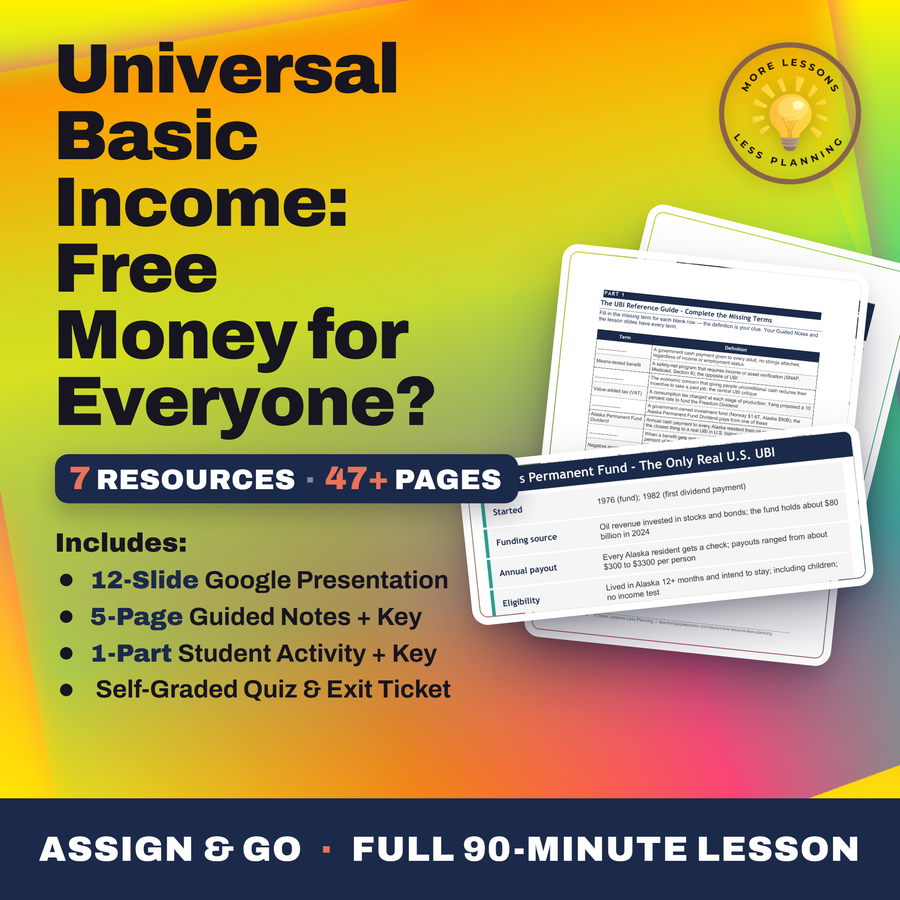
Universal Basic Income: Free Money for Everyone?
Quality reviewed September 2026
- Grades
- Grades 9-12
- Time
- About two 50-minute class periods
- Includes
- 11 ready-to-teach files
- Format
- Word (.docx) · PowerPoint (.pptx)
- Slide deck
- Guided notes
- Guided notes teacher key
- Activity + answer key
- Quiz + answer key
- Exit ticket + answer key
- Teacher guide
- Teacher presentation notes
What students do
- Define UBI's three features - universal, basic, unconditional - and compare it to means-tested programs like SNAP
- Calculate what Yang's $1,000/month Freedom Dividend and a $400/month hybrid would cost against the federal budget
- Read cost-by-proposal and Alaska Permanent Fund Dividend charts to pull specific dollar figures
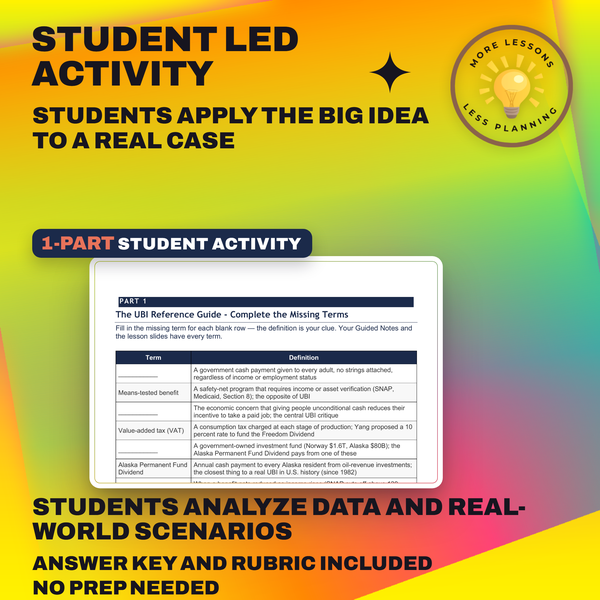
- Write a policy memo to a senator recommending one of three UBI bills, citing three specific facts and a real trade-off
What it covers
- The real Stockton SEED and Finland pilots, and what they actually found about whether UBI reduces work effort
- Andrew Yang's $1,000/month Freedom Dividend proposal and why its funding math has never fully closed
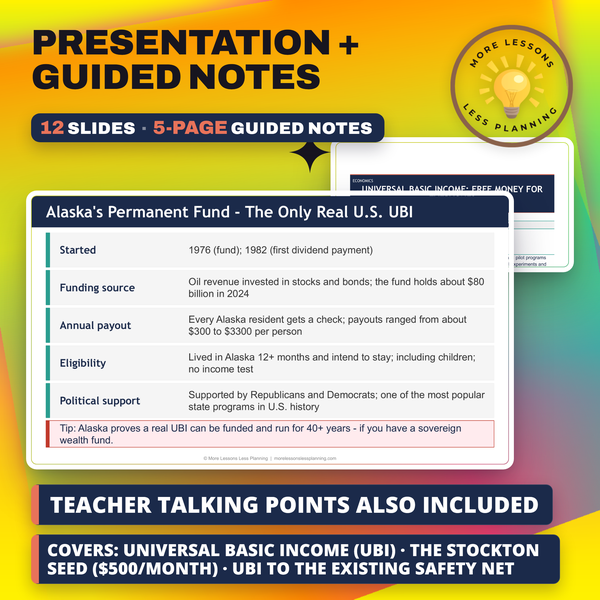
- Alaska's Permanent Fund Dividend, the closest real UBI in U.S. history, running since 1982 off oil-revenue investment
- The funding debate itself - VAT revenue, welfare consolidation, and a wealth tax - laid out as unresolved, not settled
Learning targets
- Define universal basic income (UBI) and identify recent U.S. proposals and pilot programs
- Evaluate the Stockton SEED ($500/month) and Finland (2017-2018) UBI experiments and what they found
- Compare UBI to the existing safety net and analyze the funding debate using cost-of-program math
Peek inside
Three Defining Features
Universal: every adult gets it, no exceptions
Basic: enough to cover food, rent, the basics
Unconditional: no work or income requirement
How UBI Differs from Welfare
Three Defining Features
UNIVERSAL = every adult gets it, no .
BASIC = enough to cover food, , the basics.
UNCONDITIONAL = no work or requirement.
How UBI Differs from Welfare
SNAP requires income below percent of poverty.
1. A government cash payment given to every adult with no income test and no work requirement, regardless of how much they earn, is called a (UBI).
Why this matters
Free money for doing nothing should make people stop working, and Stockton's pilot found the opposite: full-time employment among recipients rose from 28% to 40%. Alaska has run the closest real UBI since 1982, a check that swung from about $300 in 1984 to $3,300 in 2022.
I make students hold the caveats too, a 125-person sample, a second year tangled with COVID, because this debate deserves better than a headline. Calculating what Yang's $1,000 dividend would cost against his VAT shows most of them the real question was always the math.
From one teacher to another
I wanted students working real numbers on this one instead of just debating whether free money sounds fair, so the lesson opens with the brutal arithmetic: students calculate for themselves what Yang's $1,000-a-month Freedom Dividend would actually cost the federal budget once every adult is included, then check that total against how much his proposed VAT actually raises. From there students get honest about what the actual pilots found, because the Stockton SEED program's first year saw full-time employment among recipients rise from 28% to 40%, the opposite of what the work-disincentive critique predicts, while Finland's 2017-2018 pilot found a small positive effect too, and I make sure students also hear the caveats: Stockton's sample was only 125 people and its second year got tangled up with COVID. They read real charts too, pulling cost figures off a UBI-cost-by-proposal chart and tracing Alaska's actual Permanent Fund Dividend payouts, which swung from about $300 in 1984 to $3,300 in 2022 depending on oil prices and fund returns. Everything builds toward a policy memo where students pick one of three real bills to recommend to a senator, and I require they name a specific trade-off they're accepting, not just cheerlead for the option they like.
Every file in this toolkit
-
Activity (Student)
Maya's briefing work for the senator has students cost Yang's $1,000-a-month Freedom Dividend and a $400-a-month hybrid against a $6.8 trillion federal budget, read Alaska's dividend swinging from $300 to $3,300, then recommend one of three bills.
-
Activity (Answer Key)
Cost math in this key runs Yang's plan to $2.82 trillion a year, 41 percent of the federal budget, against a $1.128 trillion hybrid at 17 percent, then credits any of the three bills that names its funding math, one pilot result, and one trade-off.
-
Exit Ticket (Student)
Three questions name the three defining features of a true universal basic income, identify which state has paid residents an oil-revenue dividend since 1982, and work out what Yang's $1,000-a-month plan costs for about 235 million adults. Students compare three UBI bills on their funding math.
-
Exit Ticket (Answer Key)
Universal, basic, and unconditional together name the three defining features, Alaska is the state paying its 1982 dividend, and about $2.8 trillion a year is the cost of Yang's proposal at that scale. All three bills, one dollar figure each, and a funding verdict need to land in the response.
-
Guided Notes (Student)
A 2020 campaign proposal gets priced against a 10 percent VAT, then compared to an actual program running since 1982, where a resident's yearly payout has swung from about $300 to $3,300 as oil revenue and investment returns rise and fall.
-
Guided Notes (Teacher Key)
Federal math gets worked out fully, about $2.8 trillion a year for roughly 235 million adults against a VAT raising only about $800 billion, then a 2019 pilot's real result gets reported, employment rising from 28 percent to 40 percent among 125 people paid $500 a month.
-
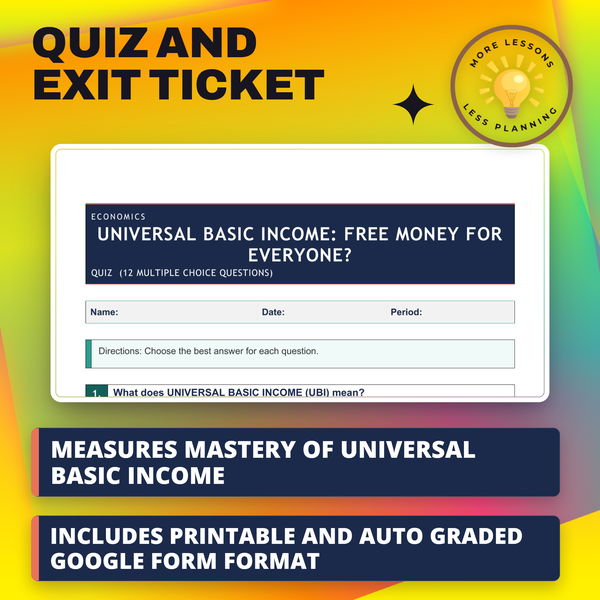
Quiz (Student)
Yang's proposed monthly dividend and Alaska's payout since 1982 anchor items on the Stockton and Finland pilots, the earned income tax credit, and the central critique aimed at every UBI plan.
-
Quiz (Answer Key)
Yang's $1,000 monthly dividend runs about 2.8 trillion a year, Stockton's full-time employment rises from 28 to 40 percent, and the work disincentive stands as UBI's central critique.
-
Slides
Alaska's Permanent Fund has paid residents since 1982, checks swinging from about $300 to $3,300 with oil prices, the closest real UBI running anywhere. Stockton's 125 person pilot saw full time work rise from 28 to 40 percent, a number set against Yang's $1,000 a month plan and its funding math.
-
Teacher Guide
Stockton's employment rate climbing from 28 to 40 percent gets its own discussion prompt, set against Yang's $2.8 trillion price tag and Alaska's dividend swinging from $300 to $3,300.
-
Teacher Presentation Notes
A Stockton pilot with just 125 people gets flagged as proof employment rose instead of falling, right next to a caution card noting the same program's second year ran straight into COVID.
Download
Where should I send the next one?
Everything here is free and it stays that way. Leave your email and I'll send you the new lessons as they go up. You can unsubscribe from any one of them.
Related resources
Pandemic Economics: COVID's Lasting Impact
The Billionaire Tax Debate
Wealth Inequality: The Top 1% Explained
Why Gen Z Can't Buy a House
Amazon Warehouses: Working Conditions Investigation
Anti-Trust Laws and Regulation: Promoting Fair Competition
Every lesson on this site is free to download and use. If one of them saved you a prep period, you can chip in a few bucks toward my three kids' daycare fund. That's genuinely where tips go.